

Introduction
In a rapidly changing advertising and communication environment, brands need visibility that goes beyond websites, social media, television and mobile advertising. A brand also needs to be seen where people travel, shop, work, commute and spend their daily lives. This is where OOH signage, or Out-of-Home signage, plays an important role.
OOH signage covers a broad range of communication and advertising displays installed in public, commercial and outdoor environments. These include large-format billboards, hoardings, unipoles, building signage, illuminated signs, roadside displays, transit signage, digital LED displays, outdoor kiosks, wayfinding systems and other large-scale visual communication structures.
The growth of cities, highways, shopping destinations, airports, railway stations, commercial complexes and organized retail has created more opportunities for businesses to communicate with audiences outside the home. Traditional static signage continues to be widely used, while digital out-of-home technology is adding flexibility through LED displays and other digital screens. Current industry references describe OOH as encompassing billboards, transit advertising, airport advertising, street furniture and digital screens, while DOOH represents the digital segment of this wider category.
Jyoti Display Pvt. Ltd. is a design and manufacturing company based in Mumbai and Nashik, with capabilities spanning static signage, digital display, retail fixtures and related display solutions. According to the company’s published profile, Jyoti Display was established in Mumbai in 2004 and operates an approximately 80,000-square-foot factory, with design, manufacturing, installation and project-management capabilities.
This article explains OOH signage in detail, including its types, materials, applications, design considerations, manufacturing process, digital signage integration, installation requirements and why selecting an experienced signage manufacturer can be important for large-scale projects.
What Is OOH Signage?
OOH stands for Out-of-Home.
OOH signage refers to visual communication or advertising signage encountered by people outside their homes. It can be placed beside roads, on buildings, inside or around commercial spaces, at transport hubs, in retail environments and in other high-visibility public locations.
OOH signage can be used for two broad purposes:
- Advertising and brand promotion
- Information, identification and wayfinding
For advertising, OOH signage can display brand campaigns, products, services, offers, corporate messages and promotional content.
For information and navigation, signage can identify buildings, departments, entrances, exits, parking areas, facilities and directions.
The physical format can be static or digital.
Static OOH signage generally uses printed graphics, vinyl, acrylic, metal panels, aluminium structures or other physical materials. Digital OOH signage uses electronic displays such as LED screens and digital signage displays to deliver dynamic content.
Modern OOH projects can therefore combine traditional fabrication with lighting, electronics, digital displays, structural engineering and content-management technology.
Understanding OOH, Outdoor Signage and DOOH
The terms OOH, outdoor signage and DOOH are sometimes used interchangeably, but they describe related yet different concepts.
OOH
OOH means Out-of-Home. It is the broad category covering advertising and communication encountered outside the home.
Examples include:
- Billboards
- Hoardings
- Transit advertising
- Airport advertising
- Bus shelter advertising
- Street furniture
- Building signage
- Outdoor digital screens
- Retail outdoor displays
- Large-format promotional structures
Outdoor Signage
Outdoor signage generally refers to physical signs installed outdoors for identification, advertising, communication or navigation.
Examples include:
- Building signs
- Channel-letter signs
- Fascia signs
- Pylon signs
- Directional signs
- Illuminated signs
- Hoardings
- Roadside signs
DOOH
DOOH means Digital Out-of-Home.
It is the digital component of OOH advertising, where electronic displays are used to deliver content. The Interactive Advertising Bureau defines DOOH as digital media used for marketing purposes outside the home and highlights capabilities such as dynamic content and data-driven delivery.
Digital displays can support:
- Video
- Animation
- Promotional messages
- Multiple campaigns
- Time-based content
- Live information
- Brand storytelling
- Interactive experiences
This makes DOOH particularly useful when a brand needs to update content without physically replacing printed graphics.
Why OOH Signage Is Important for Businesses
A company’s physical presence contributes to brand recognition.
A person may see a company’s website, social media advertisement or online campaign for a few seconds. But a physical sign can become a permanent part of the environment in which customers travel or shop.
A well-designed OOH installation can help a business:
- Establish physical visibility
- Identify its location
- Communicate its brand identity
- Promote products and services
- Direct visitors
- Improve customer navigation
- Build local awareness
- Create a recognizable visual presence
- Support marketing campaigns
For businesses operating physical locations, signage can also perform a practical function.
For example, a hospital may use outdoor signage to identify the building and guide visitors toward emergency, registration and parking areas.
A shopping mall may use signage for brand promotion, entrance identification, parking navigation and tenant advertising.
An airport may use digital displays for advertising, information and wayfinding.
A corporate campus may use signage to identify buildings and departments.
Thus, OOH signage is not limited to advertising. It can combine branding, information, navigation and communication.
Types of OOH Signage
OOH signage can be customized according to location, viewing distance, audience, message, available space, environmental conditions and budget.
1. Hoarding Signage
Hoardings are large-format outdoor advertising structures commonly installed along roads, highways, commercial areas and building facades.
They provide a large visual surface for:
- Product campaigns
- Real estate advertising
- Corporate branding
- Retail promotions
- Events
- Public communication
- Service advertising
A hoarding normally consists of a structural frame, display surface, graphics and, where required, illumination.
The structural design must consider the installation location and environmental conditions.
2. Billboard Signage
Billboards are large outdoor advertising displays designed for visibility from roads and public areas.
The design of a billboard is different from a small shop sign because viewers may only have a few seconds to see the message.
An effective billboard therefore generally uses:
- Large typography
- Strong contrast
- Limited text
- Recognizable branding
- Clear imagery
- Simple messaging
- Appropriate viewing distance
Billboards can be static or digital.
3. Unipole Signage
A unipole is a large advertising or branding structure supported by a single vertical structural pole.
It is commonly used for:
- Highway advertising
- Large commercial developments
- Industrial areas
- Real estate projects
- Corporate branding
- Retail destinations
Because the sign is elevated, visibility can extend over a substantial distance.
Structural engineering is especially important for elevated signage because the support system must be designed according to the installation conditions and applicable requirements.
4. Pylon Signage
Pylon signs are vertical freestanding signs installed at the entrance or perimeter of commercial properties.
They are commonly used by:
- Shopping malls
- Business parks
- Hotels
- Hospitals
- Automotive dealerships
- Retail stores
- Industrial facilities
- Fuel stations
- Educational campuses
A pylon can carry one brand or multiple tenant identities.
Illumination can be incorporated to improve visibility during evening hours.
5. Building Facade Signage
Facade signage is installed directly on or in front of a building.
It can include:
- Logo signage
- Channel letters
- Backlit letters
- Front-lit letters
- Acrylic signage
- Metal letters
- LED signage
- Large-format branded panels
Facade signage can turn a building exterior into an important brand-identification element.
For corporate offices, retail outlets, hotels and commercial buildings, facade signage is often one of the first visual elements customers encounter.
6. LED Digital Billboards
LED digital billboards are one of the most visible forms of DOOH.
Unlike static signage, LED displays can show multiple pieces of content.
A single display can be programmed to show:
- Brand advertisements
- Product videos
- Promotional campaigns
- Announcements
- Event information
- Public information
- Time-sensitive offers
Digital OOH is particularly useful where content needs to change regularly. Industry sources identify dynamic creative, scheduling and digital content management as important characteristics of DOOH.
7. Digital Outdoor Signage
Digital outdoor signage can include LED displays, commercial displays and other electronic screens installed in outdoor or semi-outdoor environments.
The system may include:
- Display hardware
- Media player
- Controller
- Content-management software
- Network connection
- Power distribution
- Protective enclosure
- Structural mounting
- Remote monitoring
Outdoor digital signage requires consideration of brightness, ventilation, weather protection, electrical safety and maintenance access.
8. Transit OOH Signage
Transit advertising uses transportation environments to communicate with commuters and travelers.
Examples include:
- Bus advertising
- Metro advertising
- Railway signage
- Airport displays
- Taxi branding
- Transit shelters
- Vehicle wraps
- Station advertising
Transit environments can offer repeated exposure because commuters may travel through the same routes regularly.
9. Airport OOH Signage
Airports offer multiple signage opportunities.
These can include:
- Large digital displays
- Brand walls
- Directional signage
- Wayfinding
- Column branding
- Backlit displays
- LED screens
- Arrival and departure-area advertising
- Retail branding
Airport signage requires careful attention to visibility, passenger movement and the operating environment.
10. Mall OOH Signage
Shopping malls combine advertising, branding and navigation.
OOH signage in malls may include:
- Digital screens
- LED video walls
- Kiosks
- Directory boards
- Escalator branding
- Pillar branding
- Entrance signs
- Promotional displays
- Wayfinding systems
Digital signage is particularly useful in malls because content can be changed according to promotions, festivals, events and tenant campaigns.
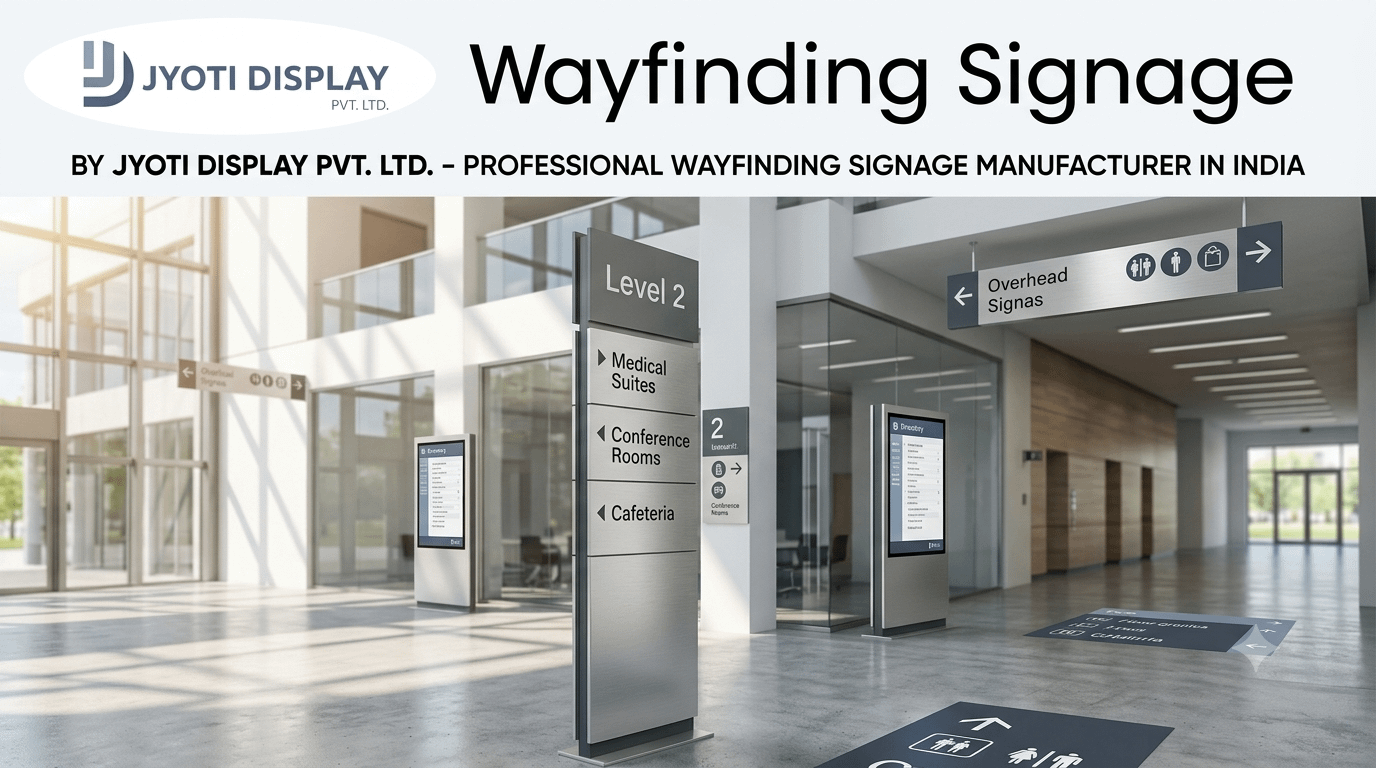
11. Wayfinding Signage
Not all OOH signage is advertising.
Wayfinding signage helps people navigate complex spaces.
Examples include:
- Entry signs
- Exit signs
- Parking signs
- Floor directories
- Direction arrows
- Facility signs
- Emergency information
- Department identification
Wayfinding is particularly important in:
- Hospitals
- Airports
- Railway stations
- Educational campuses
- Corporate campuses
- Shopping malls
- Industrial facilities
- Government buildings
Good wayfinding reduces confusion and improves visitor movement.
12. Illuminated Outdoor Signage
Illumination can make signage visible during low-light conditions.
Common lighting approaches include:
- LED modules
- LED strips
- Backlighting
- Front lighting
- Edge lighting
- Internal illumination
LED technology is widely used because it can be integrated into many signage formats.
Illumination should be planned as part of the overall signage design rather than treated as an afterthought.
13. Retail Outdoor Signage
Retail businesses depend heavily on visibility.
Outdoor retail signage may include:
- Storefront signs
- Fascia signage
- Logo signs
- Promotional boards
- Entrance signage
- Digital displays
- Pylon signs
- Directional signage
The design needs to maintain brand consistency while remaining visible from the intended viewing distance.
14. Corporate Outdoor Signage
Corporate signage communicates organizational identity.
A corporate campus may use:
- Main entrance signage
- Reception identification
- Building names
- Logo signage
- Parking signage
- Directional systems
- Safety signage
- Visitor information boards
Materials and finishes can be selected to create a professional and durable appearance.
Materials Used in OOH Signage
Selecting appropriate materials is one of the most important aspects of signage manufacturing.
Different projects require different combinations of materials.
Aluminium
Aluminium is frequently used in signage structures because it is lightweight and can be fabricated into various forms.
Applications include:
- Signage frames
- Lettering
- Fascia structures
- Outdoor cabinets
- Display structures
- Decorative panels
Jyoti Display’s published company profile lists aluminium among the materials used in its display-product manufacturing capabilities.
Stainless Steel
Stainless steel can be used where a premium appearance and durable metal construction are required.
It may be used for:
- Lettering
- Logo structures
- Outdoor architectural signage
- Decorative elements
- Premium sign frames
Mild Steel
Mild steel is commonly used for structural frameworks and support systems.
Depending on the application, protective finishing can be applied to improve durability.
Acrylic
Acrylic is frequently used for:
- Letters
- Logos
- Lightboxes
- Decorative signage
- Indoor-outdoor hybrid signage
Its ability to transmit and diffuse light makes it useful for illuminated signs.
ACP and Composite Panels
Aluminium composite panels can be used for flat signage surfaces, cladding and architectural applications.
They are available in multiple finishes and can provide a clean contemporary appearance.
Vinyl and Printed Graphics
Printed vinyl can be applied to suitable signage surfaces for:
- Advertising graphics
- Promotional campaigns
- Directional information
- Branding
- Temporary campaigns
LED Modules
LED modules can be integrated into illuminated signage and digital displays.
Their application depends on the required brightness, viewing distance, sign construction and environmental conditions.
OOH Signage Design Considerations
A successful OOH signage project starts with design.
The designer must consider how the sign will be viewed in its actual environment.
Viewing Distance
A sign positioned beside a highway needs different typography from a sign viewed from a pedestrian walkway.
Large viewing distances require:
- Larger letters
- Stronger contrast
- Simple graphics
- Clear hierarchy
Viewing Time
A moving vehicle may pass a sign within seconds.
Therefore, the primary message should be understandable quickly.
Brand Identity
OOH signage should maintain the brand’s:
- Logo
- Colours
- Typography
- Graphic language
- Visual hierarchy
Consistency helps audiences recognize the brand across multiple locations.
Lighting
Lighting should complement the design.
Excessive brightness can reduce readability, while insufficient lighting can make the sign difficult to see.
Environmental Conditions
Outdoor signage may be exposed to:
- Rain
- Dust
- Heat
- Humidity
- Wind
- Pollution
- Direct sunlight
Material selection and construction therefore need to reflect the installation environment.
Manufacturing Process of OOH Signage
Professional signage manufacturing involves multiple stages.
1. Requirement Analysis
The project begins with understanding:
- Sign type
- Dimensions
- Location
- Purpose
- Viewing distance
- Material preference
- Illumination requirements
- Installation conditions
- Branding requirements
- Project schedule
2. Site Survey
For large signage installations, a site survey can help identify:
- Available space
- Mounting surfaces
- Structural conditions
- Electrical availability
- Access requirements
- Viewing angles
- Installation challenges
3. Concept Design
The signage concept is developed according to the brand and site.
The design may include:
- Front elevation
- Side elevation
- Mounting details
- Material specifications
- Lighting
- Graphic layout
4. Engineering
Large signs require appropriate structural consideration.
Engineering may cover:
- Frame design
- Support structure
- Fixing points
- Mounting systems
- Load considerations
- Access provisions
5. Material Processing
Materials are cut, bent, fabricated or machined according to the approved design.
6. Fabrication
The frame and display components are assembled.
Depending on the design, this may include:
- Welding
- Fastening
- Bending
- Panel fabrication
- Letter fabrication
- Surface finishing
- Electrical integration
7. Surface Finishing
Possible finishes include:
- Powder coating
- Paint
- Polishing
- Lamination
- Vinyl application
- Brushed metal finishes
8. Graphics Application
Printed graphics, logos, letters or other branding components are installed.
9. Illumination Integration
LED modules, drivers and wiring are installed where required.
10. Quality Inspection
The finished signage can be checked for:
- Dimensions
- Surface quality
- Graphic alignment
- Illumination
- Structural assembly
- Electrical connections
- Finishing quality
11. Transportation
Large signage structures require appropriate packing and transportation planning.
12. Installation
The final stage is installation at the project site.
Installation may involve:
- Mounting
- Structural fixing
- Electrical connection
- Alignment
- Testing
- Final cleaning
Static OOH vs Digital OOH
Both static and digital signage have different applications.
| Feature | Static OOH | Digital OOH |
|---|---|---|
| Content | Fixed | Dynamic |
| Content change | Physical replacement | Digital update |
| Multiple campaigns | Usually requires replacement | Multiple campaigns can rotate |
| Video | No | Yes |
| Animation | No | Yes |
| Scheduling | Limited | Available |
| Initial technology | Simpler | More complex |
| Maintenance | Primarily physical | Physical + electronic |
| Best suited for | Long-term fixed messaging | Dynamic campaigns and frequent updates |
Digital OOH can provide dynamic content and scheduling, while static OOH remains useful for permanent branding and fixed communication.
Benefits of Professional OOH Signage
High Visibility
Large-format signage can be seen from considerable distances when appropriately designed and positioned.
Continuous Presence
A physical sign can remain visible throughout the day.
Local Brand Recognition
Businesses can establish a strong physical presence in the areas they serve.
Flexible Applications
OOH signage can be used for both marketing and practical communication.
Strong Brand Identification
A professionally designed sign can reinforce the identity of a business location.
Digital Flexibility
DOOH systems allow content to be updated without replacing physical graphics.
Integration With Marketing
OOH can complement:
- Social media
- Search advertising
- Websites
- Retail marketing
- Events
- Product launches
- QR-code campaigns
OOH Signage for Different Industries
Retail
Retailers use outdoor signage to attract customers and identify stores.
Applications include:
- Storefront branding
- Promotional signage
- Digital displays
- Entrance signage
- Pylon signs
Real Estate
Real estate developers use OOH signage for:
- Project launches
- Site branding
- Directional signage
- Property promotion
- Construction-site branding
Hospitality
Hotels and resorts use signage for:
- Brand identification
- Entrance signage
- Directional systems
- Restaurant identification
- Event promotion
Healthcare
Hospitals require clear identification and wayfinding.
Applications include:
- Hospital name signage
- Emergency signage
- Parking signage
- Department identification
- Directional signs
Education
Schools, colleges and universities can use OOH signage for:
- Campus identification
- Building names
- Department signage
- Event communication
- Directional systems
Manufacturing
Factories and industrial facilities require:
- Main gate signage
- Company identification
- Safety signage
- Department signs
- Visitor directions
- Parking signs
Banking and Finance
Financial institutions can use signage for:
- Branch identification
- Brand communication
- Promotional displays
- ATM identification
- Digital information
Automotive
Automotive dealerships frequently use:
- Pylon signage
- Building signage
- Brand-specific signs
- Promotional displays
- Directional signage
OOH Signage for High-Traffic Locations
Location has a significant influence on signage design.
A sign beside a highway may need to be:
- Large
- Simple
- Highly visible
- Structurally robust
A sign inside a shopping mall can be:
- More detailed
- Interactive
- Digital
- Close-view oriented
A sign at an airport may require:
- Internationally understandable symbols
- Clear navigation
- Multiple languages where appropriate
- Strong visual hierarchy
Therefore, there is no single OOH signage design that fits every location.
Digital Signage and Content Management
A digital OOH installation is more than an LED screen.
A complete system may include:
Display → Controller → Media Player → Network → Content Management System
The content-management platform can allow operators to:
- Upload content
- Schedule campaigns
- Create playlists
- Manage multiple screens
- Change content remotely
- Monitor displays
Modern DOOH platforms can also support data-driven content and contextual messaging. The IAB identifies dynamic content and data-driven marketing as central features of DOOH.
Outdoor LED Display Considerations
Outdoor LED displays must be selected according to the environment.
Important factors include:
Brightness
Outdoor displays generally require sufficient brightness to remain visible under daylight.
Pixel Pitch
Pixel pitch influences viewing quality and appropriate viewing distance.
Weather Protection
Outdoor equipment needs suitable protection from environmental conditions.
Heat Management
Electronic displays generate heat, making ventilation and thermal management important.
Power Supply
Stable power distribution is essential for reliable operation.
Maintenance Access
The design should provide practical access for servicing.
Content Compatibility
The display controller and media player should support the required content formats and resolutions.
OOH Signage and Brand Experience
Modern signage is increasingly viewed as part of the overall customer experience.
A customer may encounter a brand through several touchpoints:
- Outdoor signage
- Storefront
- Reception
- Digital display
- Product display
- Website
- Social media
When these elements share a consistent visual identity, the brand experience becomes more coherent.
This is why signage should not be considered only as a physical board.
It can be part of a broader brand environment.
Sustainable OOH Signage
Sustainability is becoming increasingly relevant to large signage projects.
Designers and manufacturers can consider:
- Long-lasting materials
- Energy-efficient LED systems
- Repairable components
- Modular structures
- Replaceable graphics
- Recyclable materials where appropriate
- Efficient power systems
- Reusable structural components
Modular signage can also simplify maintenance because individual components can sometimes be repaired or replaced without rebuilding the complete structure.
Maintenance of OOH Signage
Even high-quality signage requires maintenance.
A maintenance program can include:
Physical Inspection
Check:
- Frames
- Fasteners
- Panels
- Mounting points
- Structural components
Electrical Inspection
Check:
- Wiring
- Drivers
- LED modules
- Power supplies
- Earthing
- Connections
Surface Cleaning
Dust and pollution can reduce visual quality.
Lighting Inspection
Illuminated signs should be inspected for:
- Non-functioning LEDs
- Uneven brightness
- Flickering
- Driver issues
Digital Display Maintenance
Digital systems may require:
- Screen cleaning
- Controller inspection
- Software monitoring
- Network checks
- Media-player maintenance
- Pixel or module replacement
Regular maintenance helps extend the functional life of the installation.
Why Choose an Experienced OOH Signage Manufacturer?
Large signage projects often involve multiple disciplines.
An experienced manufacturer can coordinate:
- Design
- Material selection
- Fabrication
- Electrical integration
- Graphics
- Structural requirements
- Transportation
- Installation
- Project management
This integrated approach can reduce coordination problems between different suppliers.
For large-format signage, the ability to manage the project from design through installation can be particularly valuable.
Jyoti Display Pvt. Ltd. – OOH Signage Design and Manufacturing
Jyoti Display Pvt. Ltd. operates in the display and signage manufacturing space with facilities in Mumbai and Nashik.
According to its published company profile, the company was established in 2004 in Mumbai and operates an approximately 80,000-square-foot manufacturing facility. Its stated capabilities include design, manufacturing and installation, along with static signage and digital display solutions.
The company profile also describes capabilities involving aluminium, stainless steel and metal display products, modular furniture, HDF products and Corian products.
This manufacturing-oriented approach enables signage projects to be developed around specific:
- Dimensions
- Materials
- Branding
- Installation environments
- Display technologies
- Functional requirements
For projects requiring multiple signage types, having design, fabrication and project-management capabilities under one organization can simplify project coordination.
Jyoti Display OOH Signage Solutions
Jyoti Display can be positioned as a signage manufacturing partner for projects involving different forms of physical and digital display.
Potential applications include:
- Outdoor signage
- Static signage
- Digital signage
- LED display structures
- Corporate signage
- Retail signage
- Mall signage
- Airport signage
- Wayfinding signage
- Building signage
- Promotional displays
- Large-format display structures
- Custom signage fabrication
The exact material, construction and technology can be developed according to the project requirements.
Custom OOH Signage Manufacturing
Every location is different.
A standard catalogue product may not always meet the requirements of a large commercial or infrastructure project.
Custom signage can be developed according to:
- Available wall dimensions
- Building architecture
- Brand guidelines
- Viewing distance
- Illumination requirements
- Structural conditions
- Installation height
- Environmental exposure
- Electrical availability
Custom manufacturing also allows multiple signage components to maintain a consistent appearance across a large project.
OOH Signage for Mumbai and Maharashtra
Mumbai is one of India’s major commercial and advertising markets, with extensive movement across roads, railways, metro systems, retail destinations, commercial districts and airports.
Maharashtra’s other major urban and industrial centres also offer applications for OOH signage.
Cities such as:
- Nashik
- Pune
- Thane
- Nagpur
- Aurangabad
- Navi Mumbai
- Mumbai
have diverse commercial, industrial, retail and institutional environments.
A signage manufacturer serving Maharashtra can support projects ranging from individual building signs to larger multi-location signage programs.
OOH Signage for Pan-India Projects
Large brands frequently require consistent signage across multiple locations.
A multi-location signage program may involve:
- Standardized design
- Common materials
- Brand guidelines
- Multiple sizes
- Regional installation
- Quality control
- Project tracking
- Maintenance support
A manufacturer with centralized design and production capabilities can help maintain consistency across locations.
How to Select the Right OOH Signage
Before ordering signage, businesses should consider several questions.
1. What is the purpose?
Is the sign intended for:
- Advertising?
- Branding?
- Identification?
- Navigation?
- Public information?
2. Where will it be installed?
Consider:
- Roadside
- Building facade
- Mall
- Airport
- Railway station
- Factory
- Campus
- Retail store
3. How far away will viewers be?
This determines:
- Sign size
- Font size
- Image resolution
- Brightness
- Message length
4. Is the message permanent or changing?
Permanent branding may suit static signage.
Frequently changing campaigns may benefit from digital signage.
5. Does the sign need illumination?
If the sign operates after dark, illumination may be required.
6. What environmental conditions exist?
Consider:
- Sun
- Rain
- Wind
- Dust
- Humidity
- Temperature
7. How will maintenance be performed?
Maintenance access should be considered during the initial design stage.
OOH Signage Cost Factors
There is no single fixed price for OOH signage.
The cost depends on multiple variables.
These can include:
- Overall dimensions
- Material
- Structural framework
- Graphics
- Illumination
- LED technology
- Digital controller
- Installation height
- Site conditions
- Transportation
- Electrical work
- Engineering
- Quantity
- Project location
- Maintenance requirements
For this reason, a professional quotation should generally be prepared after understanding the project requirements.
A simple non-illuminated sign and a large outdoor LED display can have completely different specifications and cost structures.
Importance of Site Survey Before Manufacturing
A site survey can prevent problems during installation.
The survey can identify:
- Exact dimensions
- Mounting surfaces
- Access limitations
- Electrical points
- Existing structures
- Installation height
- Obstructions
- Visibility
- Required equipment
For large OOH installations, site conditions should be considered before fabrication begins.
This allows the manufacturer to develop a solution appropriate to the actual location rather than relying only on photographs or approximate measurements.
OOH Signage and Safety
Large outdoor signage must be treated as a physical installation rather than merely a graphic.
Safety considerations may include:
- Structural stability
- Proper anchoring
- Electrical safety
- Safe installation procedures
- Maintenance access
- Appropriate materials
- Environmental exposure
- Applicable local requirements
Projects should be designed, engineered and installed according to applicable regulations, site requirements and professional standards.
Future of OOH Signage
The future of OOH signage is increasingly connected to digital technology.
Traditional static signage is likely to continue serving applications where permanent communication and branding are required.
At the same time, digital signage provides opportunities for:
- Dynamic content
- Remote updates
- Scheduled campaigns
- Multiple advertisers
- Video
- Data-driven messaging
- Interactive experiences
Industry definitions and current market discussions show a growing distinction between conventional static OOH and digital OOH, with DOOH enabling dynamic content and technology-driven campaign management.
Future OOH systems may increasingly combine:
Physical signage + LED displays + sensors + connectivity + content management + data
This creates opportunities for signage to become more responsive and interactive.
OOH Signage and Smart Cities
As cities adopt smart infrastructure, digital communication becomes increasingly important.
Digital displays can potentially provide:
- Public information
- Transport updates
- Emergency communication
- Event information
- Advertising
- Navigation
- City announcements
This means digital signage can become part of the wider urban communication infrastructure.
OOH Signage and QR Codes
A physical advertisement can also connect audiences to digital platforms.
For example, an OOH advertisement can include a QR code that directs viewers to:
- Website
- Product page
- Online catalogue
- Registration page
- Mobile application
- Social media
- Promotional offer
This creates a bridge between physical advertising and digital engagement.
The important consideration is keeping the QR code large and clear enough for the intended viewing distance.
OOH Signage for Brand Launches
Product launches can benefit from highly visible signage campaigns.
A launch campaign may use:
- Large hoardings
- Digital LED displays
- Mall signage
- Transit advertising
- Retail signage
- Event branding
Digital screens can be particularly useful for campaigns that require multiple creative versions.
OOH Signage for Events
Events frequently require temporary signage.
Examples include:
- Exhibition branding
- Conference signage
- Product launches
- Sports events
- Cultural events
- Corporate events
- Trade shows
Temporary signage can include:
- Entrance structures
- Directional signs
- Stage branding
- Digital displays
- Sponsor boards
- Wayfinding
- Promotional panels
OOH Signage for Industrial and Corporate Campuses
Large industrial campuses often have multiple buildings, departments and access points.
A comprehensive signage system can include:
- Main gate identification
- Company logo
- Visitor reception signage
- Department signs
- Parking signage
- Safety information
- Directional signs
- Loading-area identification
- Building numbers
A coordinated signage system makes the campus easier to navigate and strengthens corporate identity.
Difference Between Signage Manufacturer and Advertising Agency
An advertising agency may focus primarily on:
- Campaign strategy
- Media planning
- Creative concepts
- Advertising placement
A signage manufacturer focuses on:
- Product design
- Fabrication
- Materials
- Engineering
- Lighting
- Display hardware
- Installation
Large OOH projects may involve both.
The advertising agency develops the communication strategy and creative campaign, while the signage manufacturer converts the design into a physical or digital installation.
Why Manufacturing Capability Matters
Manufacturing capability can influence:
- Production consistency
- Material control
- Customization
- Quality inspection
- Delivery coordination
- Large-volume production
Jyoti Display’s published profile describes the company as a direct manufacturing factory with design, manufacturing, quality-control and project-management functions.
For businesses planning a large signage project, these capabilities can be relevant when evaluating suppliers.
Complete OOH Signage Project Workflow
A typical project can follow this sequence:
Requirement
↓
Site Survey
↓
Concept Design
↓
Technical Design
↓
Quotation
↓
Approval
↓
Engineering
↓
Material Procurement
↓
Fabrication
↓
Graphics & Finishing
↓
Electrical / Digital Integration
↓
Quality Inspection
↓
Transportation
↓
Installation
↓
Testing
↓
Project Handover
This structured workflow helps connect creative requirements with manufacturing and installation.
Key Qualities of Effective OOH Signage
An effective OOH sign should be:
Visible
The sign should be noticeable from the intended viewing distance.
Readable
The main message should be easy to understand.
Relevant
The content should match the target audience and location.
Durable
Materials should be suitable for the installation environment.
Consistent
Brand elements should remain consistent across locations.
Maintainable
Components should be accessible for servicing.
Safe
Structural and electrical aspects should be appropriately addressed.
Scalable
The design should allow replication when multiple locations are involved.
Why Businesses Choose Custom OOH Signage
Standard signage products may not always match a brand’s architecture or specifications.
Custom signage offers flexibility in:
- Shape
- Size
- Material
- Colour
- Illumination
- Branding
- Structure
- Mounting
- Digital integration
For premium retail, corporate, hospitality and infrastructure projects, customization can help create a distinctive physical identity.
Jyoti Display – Design, Manufacturing and Installation Approach
Jyoti Display’s published company information describes a business model built around “Imagine Design Build”, with capabilities extending across design, manufacturing, installation and service.
This approach is relevant to OOH signage because a signage project often requires more than fabrication alone.
The complete requirement may involve:
Design → Engineering → Manufacturing → Finishing → Digital Integration → Installation → Service
By coordinating these stages, signage projects can be developed as complete solutions rather than isolated products.
Frequently Asked Questions About OOH Signage
What does OOH signage mean?
OOH signage means Out-of-Home signage. It refers to advertising, branding, information or navigation displays encountered outside the home.
What is the difference between OOH and DOOH?
OOH is the broader category of out-of-home communication. DOOH, or Digital Out-of-Home, specifically refers to digital media and screens used for out-of-home communication or advertising.
What are examples of OOH signage?
Examples include:
- Hoardings
- Billboards
- Unipoles
- Pylon signs
- Building signage
- Transit signage
- Airport displays
- Mall signage
- Outdoor LED displays
- Wayfinding systems
Is OOH signage only for advertising?
No. OOH signage can also be used for identification, information, navigation, safety and public communication.
What is DOOH signage?
DOOH signage uses digital screens to display dynamic content outside the home.
Can OOH signage be customized?
Yes. Signage can be customized according to size, materials, graphics, illumination, mounting requirements and location.
Which materials are used for outdoor signage?
Depending on the application, materials can include aluminium, stainless steel, mild steel, acrylic, composite panels, vinyl and other suitable materials.
Can outdoor signage be illuminated?
Yes. LED lighting can be integrated into many types of outdoor signage.
Can digital signage display videos?
Yes. Digital displays and LED screens can display video, animation, graphics and other supported content.
Is site inspection necessary?
For many large or technically complex projects, a site survey is useful for determining dimensions, mounting conditions, access, electrical requirements and installation considerations.
Can one manufacturer handle a complete signage project?
A full-service signage manufacturer may be able to manage design, manufacturing, finishing, digital integration and installation under one project.
Conclusion
OOH signage continues to be an important component of physical brand communication in India. From traditional hoardings and billboards to illuminated building signs, pylon structures, transit advertising and modern LED displays, OOH provides businesses with multiple ways to communicate with audiences in public environments.
The development of DOOH is expanding the possibilities further. Digital displays can support dynamic content, scheduled campaigns, video and remotely managed communication.
However, successful OOH signage is not simply about creating a large graphic. It requires careful consideration of location, viewing distance, materials, structural design, lighting, environmental conditions, electrical systems, installation and maintenance.
Jyoti Display Pvt. Ltd. brings design and manufacturing capabilities to signage and display projects, with facilities in Mumbai and Nashik and an approximately 80,000-square-foot manufacturing facility described in its company profile. Its stated capabilities include static signage, digital display, design, manufacturing, installation and project management.
For businesses, retailers, corporates, hospitals, educational institutions, real estate developers, malls, airports, industrial facilities and other organizations, the right OOH signage solution can combine visibility, branding, communication and functionality.
Whether the requirement is a static outdoor sign, illuminated corporate identity, large-format hoarding, custom pylon, wayfinding system or digital LED display, a professionally planned solution begins with understanding the site and ends with a signage system designed for its real-world environment.
Jyoti Display Pvt. Ltd. — Design. Manufacture. Install.
For custom OOH signage requirements, businesses can evaluate the project based on the required format, dimensions, material, location, illumination, digital technology and installation conditions to develop a suitable signage solution.