

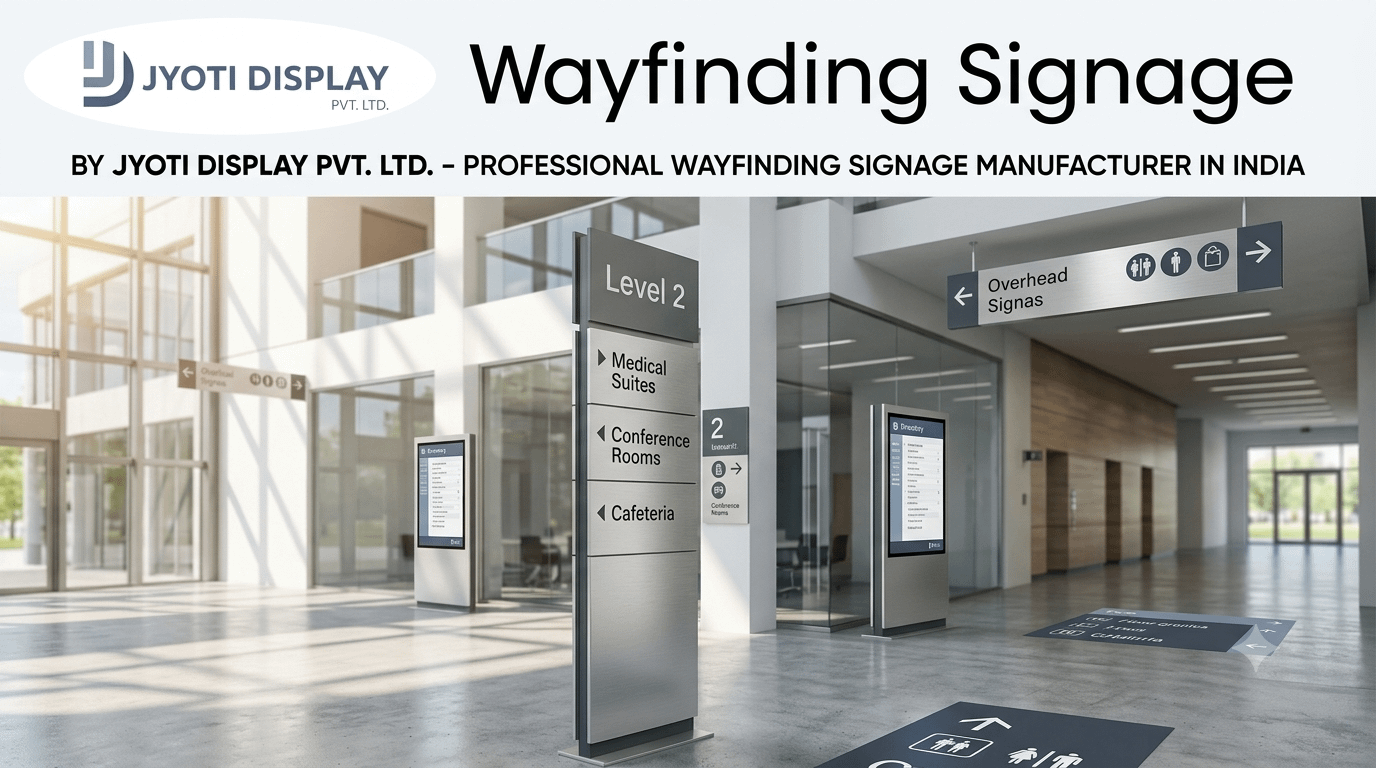
Wayfinding signage plays an essential role in helping people navigate complex environments quickly, safely, and confidently. From airports and railway stations to hospitals, shopping malls, corporate offices, educational institutions, hotels, factories, residential developments, and public infrastructure, well-designed wayfinding signs make it easier for visitors to understand where they are, where they need to go, and how they can reach their destination.
As buildings and public spaces become larger and more sophisticated, effective navigation has become an important part of architectural planning and visitor experience. A beautifully designed building can still become difficult to navigate if directional information is unclear, inconsistent, poorly positioned, or difficult to read.
Jyoti Display Pvt. Ltd. provides signage solutions designed to combine visibility, durability, functionality, and professional appearance. With experience in signage manufacturing and display solutions, the company develops customized wayfinding systems for commercial, institutional, industrial, hospitality, healthcare, transportation, retail, and public environments.
This article explains wayfinding signage in detail, including its purpose, types, materials, design principles, applications, manufacturing process, installation considerations, customization options, and the role of professional signage manufacturers in creating effective navigation systems.
What Is Wayfinding Signage?
Wayfinding signage is a system of visual communication used to guide people through a physical environment. It provides directional information that helps visitors identify locations, routes, entrances, exits, facilities, departments, floors, buildings, and important destinations.
Unlike ordinary promotional signage, wayfinding signage is primarily functional. Its objective is to reduce confusion and make movement through a space more intuitive.
A complete wayfinding system can include:
- Directional signs
- Arrow signs
- Floor directories
- Building directories
- Entrance identification signs
- Exit signs
- Parking signs
- Room identification signs
- Reception signs
- Department signs
- Lift and staircase signs
- Facility identification signs
- Campus signs
- Roadside directional signs
- Pedestrian signs
- Accessibility signs
- Emergency navigation signs
- Digital wayfinding displays
A successful wayfinding system does not depend on a single sign. Instead, multiple signs work together as a coordinated visual language.
For example, a visitor entering a large hospital may encounter an entrance identification sign, reception directory, directional signs, department markers, lift indicators, floor directories, and room identification signs. Each sign should communicate information in a consistent manner.
Why Wayfinding Signage Is Important
Navigation is an important part of the visitor experience. When people enter an unfamiliar environment, they immediately begin looking for visual information that can help them understand their surroundings.
Poor navigation can result in:
- Visitor confusion
- Missed destinations
- Unnecessary walking
- Congestion
- Repeated enquiries at reception
- Poor visitor experience
- Increased staff workload
- Safety concerns
- Difficulty locating emergency exits
- Accessibility challenges
Effective wayfinding signage helps address these problems by presenting information at appropriate locations.
A well-planned system allows people to make decisions before they reach a junction or decision point. Instead of waiting until visitors become confused, directional information can be provided in advance.
This is particularly important in large facilities where visitors may be unfamiliar with the building layout.
Jyoti Display Pvt. Ltd. – Wayfinding Signage Manufacturer in India
Jyoti Display Pvt. Ltd. develops customized signage and display solutions for a variety of commercial and institutional environments.
The company’s signage capabilities can be adapted for projects requiring different sizes, materials, finishes, mounting methods, branding requirements, and environmental conditions.
Wayfinding signage can be designed according to the architectural character of a location while maintaining functional readability.
For example, a corporate office may require a clean and minimalist signage system, while a hospital may require highly visible signs with clear department identification and accessibility symbols.
Similarly, a shopping mall may require a combination of directional signs, floor directories, parking guidance, retail-zone identification, and digital displays.
The objective is to create a signage system that works as part of the overall environment rather than appearing as an unrelated element.
Types of Wayfinding Signage
Wayfinding signage can be classified according to its purpose, location, mounting method, and communication format.
1. Directional Wayfinding Signs
Directional signs provide information about the direction visitors should follow.
They commonly use:
- Arrows
- Text
- Icons
- Floor numbers
- Department names
- Location names
- Distance information
Directional signs are usually installed at intersections, corridors, entrances, lobbies, parking areas, and other decision points.
Clear arrows are particularly important because visitors should be able to understand the intended direction without having to read large amounts of text.
2. Directory Signs
Directory signs provide a list of multiple destinations in a particular area.
A directory may include:
- Department names
- Office numbers
- Floor information
- Shop names
- Facility locations
- Room numbers
- Service areas
Directories are commonly found in:
- Corporate buildings
- Hospitals
- Shopping malls
- Hotels
- Educational campuses
- Government buildings
- Commercial complexes
A well-designed directory should make information easy to scan rather than presenting a dense block of text.
3. Floor Directory Signs
Floor directories help visitors understand what facilities are available on a particular floor.
For example:
Ground Floor
Reception
Customer Service
Cafeteria
Meeting Rooms
First Floor
Administration
Finance
Human Resources
Conference Hall
Floor directories are particularly useful in multi-storey buildings.
4. Building Identification Signs
Building identification signs indicate the name or function of a building.
They may be installed:
- Above entrances
- On building facades
- At campus entrances
- Near roads
- In reception areas
- On external walls
Building identification signs can incorporate corporate logos, brand colors, illuminated lettering, metal finishes, acrylic elements, or other architectural materials.
5. Parking Wayfinding Signs
Parking areas often require extensive wayfinding systems because drivers need to identify routes quickly.
Parking signage may include:
- Entry signs
- Exit signs
- Parking level identification
- Zone identification
- Reserved parking signs
- Visitor parking
- Disabled parking
- Two-wheeler parking
- Car parking
- Direction arrows
- Lift directions
- Staircase directions
- Emergency exits
Large, highly visible graphics are generally useful in parking environments where lighting and viewing distances can vary.
6. Hospital Wayfinding Signage
Hospitals are among the environments where effective wayfinding is particularly important.
Visitors may need to locate:
- Emergency departments
- OPD
- Diagnostics
- Radiology
- Pharmacy
- Laboratories
- ICU
- Operation theatres
- Billing
- Registration
- Wards
- Patient rooms
- Cafeteria
- Toilets
- Lifts
- Staircases
Hospital signage should prioritize clarity and readability.
Color coding can also be used to distinguish departments or zones, provided that the system is consistent throughout the facility.
7. Hotel Wayfinding Signage
Hotels require signage that is both functional and visually compatible with the property’s interior design.
Common hotel wayfinding signs include:
- Reception directions
- Lobby directions
- Restaurant directions
- Banquet hall directions
- Conference room directions
- Guest room directions
- Lift signs
- Pool directions
- Gym directions
- Parking signs
- Emergency exits
Materials and finishes can be selected to complement the hotel’s architectural theme.
8. Mall Wayfinding Signage
Shopping malls can be complicated environments because they contain multiple floors, stores, restaurants, entertainment areas, parking zones, and service facilities.
A mall wayfinding system may include:
- Floor directories
- Shop directories
- Parking guidance
- Food court signs
- Cinema directions
- Restroom signs
- Lift directions
- Escalator signs
- Emergency exits
- Information desk signs
- Zone identification
- Digital directories
Wayfinding signs in malls need to remain visible without competing excessively with advertising and promotional displays.
9. Corporate Office Wayfinding
Large corporate offices often require internal navigation systems for employees, customers, vendors, and visitors.
Typical signage includes:
- Reception identification
- Department signs
- Floor directories
- Meeting room signs
- Conference room signs
- Lift signs
- Pantry signs
- Restroom signs
- Visitor directions
- Emergency signage
Corporate signage can be designed using a company’s brand identity to create a consistent visual environment.
10. Educational Campus Wayfinding
Schools, colleges, universities, training centers, and research campuses often cover large areas with multiple buildings.
Campus wayfinding may guide visitors toward:
- Administration
- Academic blocks
- Laboratories
- Libraries
- Auditoriums
- Sports facilities
- Hostels
- Cafeterias
- Parking
- Reception
- Medical facilities
External directional signs are particularly important because visitors may need to travel between buildings.
11. Industrial Wayfinding Signage
Factories, warehouses, manufacturing plants, logistics facilities, and industrial campuses often require robust signage solutions.
Industrial wayfinding systems may identify:
- Production departments
- Warehouses
- Loading areas
- Dispatch areas
- Employee entrances
- Visitor entrances
- Parking
- Safety zones
- Fire exits
- Assembly points
- Administrative offices
Signs used outdoors or in industrial environments should be selected according to exposure to weather, dust, chemicals, vibration, and mechanical impact.
12. Airport and Transportation Wayfinding
Transportation facilities require clear and rapidly understandable signage because people are often moving through unfamiliar environments under time pressure.
Wayfinding systems may guide passengers toward:
- Check-in
- Security
- Boarding gates
- Baggage claim
- Parking
- Arrivals
- Departures
- Restrooms
- Information desks
- Transport connections
Icons and internationally recognizable symbols can be useful where visitors speak different languages.
Materials Used for Wayfinding Signage
Different materials can be used depending on application, design, budget, durability requirements, and environmental conditions.
Aluminium
Aluminium is widely used for signage because it is lightweight, durable, and suitable for indoor and outdoor applications.
It can be finished using:
- Powder coating
- Anodizing
- Brushed finish
- Painted finish
- Vinyl graphics
- Printed graphics
Aluminium is particularly useful for architectural signage and external directional systems.
Stainless Steel
Stainless steel provides a premium appearance and strong resistance to corrosion.
It can be used for:
- Corporate signage
- Hotel signage
- Institutional signage
- Premium directories
- Indoor architectural signage
Finishes may include:
- Mirror
- Hairline
- Brushed
- Matte
Acrylic
Acrylic is commonly used where a clean, contemporary appearance is required.
It is available in various:
- Colors
- Thicknesses
- Transparency levels
- Finishes
Acrylic can be combined with aluminium, stainless steel, LED lighting, vinyl graphics, or printed graphics.
ACP
Aluminium Composite Panel can provide a lightweight and economical signage surface.
It is suitable for:
- Direction boards
- Building signage
- Outdoor signs
- Large-format sign panels
ACP can be fabricated into customized shapes and sizes.
PVC and Foam Board
PVC and foam board materials can be used for indoor signs and temporary applications.
They are lightweight and can support printed graphics and vinyl applications.
Glass
Glass can be used for premium interior signage and corporate environments.
It can be combined with:
- Vinyl
- Frosted graphics
- Printed graphics
- Stainless steel fixtures
- Acrylic
- Metal lettering
LED and Illuminated Materials
Illuminated signage can improve visibility during low-light conditions.
Lighting options may include:
- LED modules
- LED strips
- Backlighting
- Edge lighting
- Front illumination
Illumination should be designed to improve readability rather than create excessive glare.
Wayfinding Signage Design Principles
Good wayfinding design is not simply about making attractive signs. It requires careful consideration of how people interact with their environment.
1. Readability
Text should be easy to read from the intended viewing distance.
Important factors include:
- Font selection
- Letter height
- Letter spacing
- Contrast
- Sign size
- Lighting
2. Consistency
All signs within a facility should follow a common design system.
Consistency can include:
- Fonts
- Colors
- Icons
- Arrow styles
- Logo placement
- Mounting heights
- Materials
- Finishes
Consistency helps visitors understand that different signs belong to the same navigation system.
3. Visibility
Signs should be positioned where people naturally look for information.
A directional sign hidden behind a column or installed too close to another sign may not perform effectively.
Visibility should be considered from multiple approach directions.
4. Information Hierarchy
Not all information has equal importance.
The destination should generally receive more visual emphasis than secondary information.
For example:
EMERGENCY DEPARTMENT →
may be visually prioritized over smaller supporting information.
5. Use of Symbols
Icons can communicate information quickly.
Common symbols include:
- Toilet
- Lift
- Stairs
- Parking
- Information
- Restaurant
- Emergency
- Accessibility
- Exit
Symbols are particularly helpful in environments with multilingual visitors.
Accessibility in Wayfinding Signage
Accessibility should be considered when developing wayfinding systems.
Depending on the application and applicable requirements, accessible signage may include:
- High-contrast text
- Recognizable symbols
- Tactile lettering
- Braille
- Appropriate mounting heights
- Accessible route information
- Clear directional indicators
For public and institutional projects, applicable Indian standards, building requirements, accessibility guidelines, and project-specific specifications should be reviewed before manufacturing and installation.
Indoor and Outdoor Wayfinding Signage
The environment in which a sign will be installed has a major influence on material selection.
Indoor Wayfinding
Indoor signs are generally protected from direct exposure to:
- Rain
- Sunlight
- Dust
- Temperature fluctuations
This allows greater flexibility in material selection and finishing.
Indoor signage may use:
- Acrylic
- Aluminium
- Stainless steel
- Glass
- PVC
- MDF or other architectural materials
Outdoor Wayfinding
Outdoor signs need to withstand environmental conditions.
Important considerations include:
- UV exposure
- Rain
- Wind
- Dust
- Temperature changes
- Corrosion
- Structural stability
Outdoor signs may require stronger materials, protective finishes, weather-resistant graphics, and suitable mounting systems.
Custom Wayfinding Signage
Every building has a different layout and navigation requirement.
For this reason, customized wayfinding signage is often more appropriate than generic signs.
Customization can include:
- Custom dimensions
- Custom colors
- Corporate branding
- Custom icons
- Floor numbering
- Department coding
- Material selection
- Mounting style
- Illumination
- Multilingual information
Jyoti Display Pvt. Ltd. can develop signage according to project requirements and architectural environments.
Corporate Branding and Wayfinding
Wayfinding signage can also contribute to corporate identity.
A company may use its:
- Logo
- Brand colors
- Typography
- Graphic language
- Icons
- Materials
- Finishes
throughout its facility.
The objective is to create consistency between the physical environment and the organization’s brand identity.
However, branding should not compromise the primary function of the sign.
Directional information should remain easy to identify and understand.
Wayfinding Signage Manufacturing Process
Professional signage manufacturing involves several stages.
Step 1: Requirement Analysis
The project requirements are reviewed.
Information may include:
- Building plans
- Sign locations
- Sign quantities
- Dimensions
- Materials
- Branding requirements
- Installation conditions
- Indoor or outdoor application
Step 2: Site Survey
For larger projects, a site survey may be useful.
The survey can identify:
- Sign mounting locations
- Viewing distances
- Ceiling heights
- Wall conditions
- Electrical requirements
- Pedestrian movement
- Vehicle movement
- Existing signage
Step 3: Signage Design
Designers prepare the visual layout.
This can include:
- Typography
- Icons
- Arrows
- Colors
- Logo placement
- Information hierarchy
- Material finishes
Step 4: Technical Drawings
Technical drawings can define:
- Dimensions
- Material thickness
- Fabrication details
- Mounting systems
- Electrical connections
- Finishing specifications
Step 5: Material Selection
Materials are selected according to application and project specifications.
For example, outdoor signage may require corrosion-resistant and weather-resistant materials, while indoor signs may prioritize aesthetics and integration with interiors.
Step 6: Fabrication
Fabrication may involve processes such as:
- CNC cutting
- Laser cutting
- Bending
- Welding
- Routing
- Drilling
- Engraving
- Printing
- Vinyl application
- Powder coating
- Assembly
Step 7: Graphics and Finishing
Graphics are applied using the specified method.
Possible methods include:
- UV printing
- Digital printing
- Vinyl graphics
- Laser engraving
- Screen printing
- Cut lettering
- Acrylic lettering
- Metal lettering
Step 8: Quality Inspection
Finished signs can be checked for:
- Dimensions
- Surface quality
- Color consistency
- Graphic alignment
- Letter positioning
- Structural integrity
- Electrical performance
- Mounting components
Step 9: Installation
Installation is completed according to the approved layout.
Depending on the project, installation may involve:
- Wall mounting
- Ceiling suspension
- Pole mounting
- Hanging systems
- Freestanding structures
- Post mounting
- Flush mounting
Freestanding Wayfinding Signage
Freestanding signs are installed independently of walls and can be positioned along pedestrian pathways, campuses, gardens, parking areas, and large properties.
They are useful where wall surfaces are unavailable or where signage needs to be visible from multiple directions.
Freestanding signs can be customized in terms of:
- Height
- Width
- Shape
- Base design
- Materials
- Graphics
- Illumination
Suspended Wayfinding Signs
Suspended signs are commonly used in corridors, airports, malls, hospitals, offices, and large commercial buildings.
They can be mounted from:
- Ceilings
- Structural supports
- Cable systems
- Rod systems
Suspended signs can be viewed from a distance and can help visitors identify routes before reaching intersections.
Wall-Mounted Wayfinding Signs
Wall-mounted signs are commonly used for:
- Department identification
- Room identification
- Floor information
- Corridor directions
- Facility identification
They are suitable where walls provide convenient mounting surfaces.
Digital Wayfinding Signage
Modern facilities increasingly use digital displays for navigation.
Digital wayfinding can provide:
- Interactive maps
- Floor maps
- Search functions
- Department information
- Store directories
- Real-time announcements
- Event information
- Dynamic directions
Digital signage can be particularly useful in large facilities where information changes frequently.
For example, a shopping mall may update store information, promotions, temporary closures, or event locations without physically replacing printed signs.
Static vs Digital Wayfinding
Static signage is generally suitable when information remains relatively stable.
Digital signage may be beneficial where information changes regularly.
Static Wayfinding
Advantages may include:
- Simple operation
- Low ongoing maintenance
- No software requirement
- Continuous visibility
- Suitable for permanent information
Digital Wayfinding
Potential advantages include:
- Dynamic information
- Interactive navigation
- Search functionality
- Multimedia capability
- Real-time updates
The appropriate solution depends on the building, budget, information frequency, visitor volume, and operational requirements.
Color Coding in Wayfinding
Color can help users distinguish between different zones.
For example:
- Blue – Administrative area
- Green – Public facilities
- Orange – Food and recreation
- Purple – Healthcare zone
However, color coding should be applied consistently and should not be the only method of communicating information.
Text and symbols should remain understandable even for users who have difficulty distinguishing certain colors.
Typography for Wayfinding Signs
Typography has a direct impact on readability.
Wayfinding fonts generally need to be:
- Clear
- Legible
- Uncluttered
- Appropriately spaced
- Consistent
Decorative fonts may look attractive but can reduce readability when viewed from a distance.
Letter size should be determined according to viewing distance and environmental conditions.
Arrows in Wayfinding Signage
Arrows are one of the most important elements in directional signage.
A directional arrow should clearly communicate:
- Left
- Right
- Straight
- Up
- Down
- Entrance
- Exit
Arrow placement should be consistent throughout the project.
If different signs use different arrow styles or positions, visitors may take longer to interpret them.
Multilingual Wayfinding Signage
India’s multilingual environment makes language planning important for many public facilities.
Depending on the location and project requirements, signage may use:
- English
- Hindi
- Marathi
- Regional languages
- Multiple-language combinations
Multilingual signage should maintain a clear hierarchy so that adding languages does not make the sign overcrowded.
Emergency and Safety Wayfinding
Wayfinding systems may work alongside safety signage to help occupants identify emergency routes.
Important information can include:
- Emergency exits
- Fire exits
- Assembly points
- Fire equipment
- Emergency stairs
- First aid
- Emergency departments
Safety signage should comply with applicable project and regulatory requirements.
Wayfinding Signage for Smart Buildings
Smart buildings can combine physical signage with digital technology.
A modern navigation system may connect:
- Digital directories
- Interactive displays
- Mobile applications
- QR codes
- Indoor maps
- Building management systems
- Digital kiosks
For example, a visitor could search for a department on an interactive kiosk and receive directions to the required floor or room.
Physical signage remains useful because it provides continuous environmental guidance even when visitors do not use a mobile application.
Wayfinding Signage for Large Campuses
Large campuses require a coordinated navigation strategy.
A campus may contain:
- Multiple buildings
- Roads
- Parking zones
- Pedestrian paths
- Gardens
- Service areas
- Visitor areas
- Employee facilities
A complete campus signage program can include entrance signage, directional road signs, building identification signs, pedestrian signs, parking signs, and internal directories.
Wayfinding Signage for Factories and Industrial Parks
Industrial facilities may cover large areas and include restricted zones.
Wayfinding can separate:
- Visitor routes
- Employee routes
- Logistics routes
- Heavy vehicle routes
- Loading zones
- Production zones
- Administrative zones
Signs should be positioned according to traffic patterns and safety requirements.
Durability is especially important for industrial signage.
Wayfinding Signage for Residential Projects
Large residential developments, townships, gated communities, and apartment complexes may also require wayfinding.
Signs can guide residents and visitors toward:
- Building blocks
- Clubhouses
- Parking
- Visitor parking
- Security offices
- Amenities
- Swimming pools
- Sports areas
- Gardens
- Community halls
- Service entrances
Consistent signage helps create a more organized environment.
Why Professional Signage Manufacturing Matters
Wayfinding signage combines design, communication, fabrication, materials, and installation.
A professionally manufactured signage system can help ensure that:
- Signs are correctly sized
- Graphics remain consistent
- Materials are suitable for the environment
- Mounting systems are appropriate
- Branding remains consistent
- Information is easy to understand
- The final installation matches approved designs
For large projects, coordination between architects, interior designers, consultants, facility managers, and signage manufacturers can be particularly important.
Quality Considerations for Wayfinding Signage
Before approving a signage system, project teams can review several factors.
Visual Quality
Check:
- Color accuracy
- Surface finish
- Letter alignment
- Graphic quality
- Logo proportions
Functional Quality
Check:
- Visibility
- Readability
- Arrow direction
- Information accuracy
- Sign positioning
Structural Quality
Check:
- Mounting strength
- Material thickness
- Fasteners
- Supports
- Outdoor stability
Maintenance
Consider:
- Cleaning
- Replacement of damaged components
- Graphic updates
- LED maintenance
- Accessibility for servicing
Maintenance of Wayfinding Signage
Even durable signage requires periodic inspection.
Maintenance may include:
- Cleaning surfaces
- Checking mounting hardware
- Replacing damaged graphics
- Checking illumination
- Updating outdated information
- Repairing structural components
- Replacing faded materials
For digital signage, maintenance may additionally involve:
- Display monitoring
- Software updates
- Network connectivity
- Content management
- Hardware servicing
A maintenance plan can help preserve the appearance and functionality of the signage system.
Sustainable Wayfinding Signage
Sustainability is becoming an increasingly important consideration in building projects.
Possible approaches include:
- Durable materials
- Long-life LED systems
- Efficient fabrication
- Recyclable metals
- Modular components
- Replaceable graphics
- Repairable structures
- Reduced material waste
A modular signage system can sometimes allow individual components to be replaced without replacing the complete sign.
Wayfinding Signage and Visitor Experience
Wayfinding has a direct relationship with how people experience a building.
Visitors generally expect to find important destinations without repeatedly asking for directions.
An effective signage system can support:
- Confidence
- Independence
- Convenience
- Reduced confusion
- Better movement
- Improved organization
This is particularly important for visitors entering a facility for the first time.
Common Wayfinding Signage Mistakes
Several mistakes can reduce signage effectiveness.
Too Much Information
Large amounts of information can make a sign difficult to scan.
Poor Contrast
Low contrast between text and background reduces readability.
Inconsistent Arrows
Different arrow styles can create confusion.
Incorrect Placement
A sign installed after a decision point may be too late to help.
Excessive Branding
Large logos or decorative graphics can compete with directional information.
Small Text
Text that is too small may not be readable from the intended distance.
Inconsistent Terminology
Using different names for the same destination can confuse visitors.
For example, using “Reception” on one sign and “Front Desk” on another without a clear reason can create uncertainty.
How to Plan a Wayfinding Signage Project
A systematic planning process can improve project results.
Step 1: Understand the User
Identify who will use the facility:
- Customers
- Patients
- Employees
- Students
- Tourists
- Drivers
- Visitors
Step 2: Map the Environment
Identify entrances, exits, intersections, corridors, floors, buildings, parking areas, and major destinations.
Step 3: Identify Decision Points
Determine where visitors need directional information.
Step 4: Create Sign Categories
Classify signs into:
- Identification
- Directional
- Informational
- Regulatory
- Safety
Step 5: Establish a Visual Language
Define:
- Fonts
- Colors
- Icons
- Arrows
- Materials
- Mounting methods
Step 6: Develop Sign Schedules
Prepare a list of:
- Sign codes
- Locations
- Quantities
- Dimensions
- Information
- Materials
Step 7: Produce Samples
Prototype signs can be reviewed before mass production.
Step 8: Manufacture and Install
After approval, signs can be fabricated, quality checked, delivered, and installed.
Wayfinding Signage Manufacturer for Customized Projects
Different projects require different signage solutions.
A professional signage manufacturer should be able to work with project-specific requirements rather than offering only standard templates.
Customization may involve:
- Architectural design
- Corporate branding
- Material combinations
- Special dimensions
- Illumination
- Digital displays
- Custom mounting
- Outdoor structures
- Interior signage
Jyoti Display Pvt. Ltd. can develop signage solutions for a range of commercial, institutional, industrial, hospitality, retail, healthcare, and public environments.
Applications of Wayfinding Signage
Wayfinding systems are suitable for a wide variety of environments.
Commercial
- Corporate offices
- Business parks
- Shopping centers
- Retail complexes
- Showrooms
Healthcare
- Hospitals
- Clinics
- Diagnostic centers
- Medical campuses
Hospitality
- Hotels
- Resorts
- Banquet facilities
- Restaurants
Education
- Schools
- Colleges
- Universities
- Training centers
Industrial
- Factories
- Warehouses
- Industrial parks
- Logistics centers
Transportation
- Airports
- Railway stations
- Bus terminals
- Metro facilities
Public Infrastructure
- Government buildings
- Civic facilities
- Public campuses
- Convention centers
Advantages of Professionally Designed Wayfinding Systems
A professionally planned wayfinding system can provide several practical benefits.
Improved Navigation
Visitors can identify routes more easily.
Better Visitor Experience
Clear information can reduce confusion and unnecessary enquiries.
Organized Environment
Consistent signage contributes to a structured physical environment.
Stronger Brand Presence
Corporate branding can be integrated into the signage system.
Long-Term Usability
Durable materials and proper fabrication can support long-term use.
Scalability
A well-designed system can be expanded when new departments, buildings, or facilities are added.
Future of Wayfinding Signage in India
The signage industry is evolving as buildings become larger, more connected, and more technology-driven.
Future wayfinding systems are likely to combine traditional physical signage with digital technology.
Potential developments include:
- Interactive kiosks
- Touchscreen directories
- QR-enabled navigation
- Mobile integration
- Digital maps
- Indoor positioning
- Dynamic information
- Real-time facility updates
- Smart building integration
However, physical signage will continue to play an important role because it provides immediate, passive navigation without requiring users to operate a device.
The most effective environments may therefore use a combination of static and digital wayfinding.
Why Choose Jyoti Display Pvt. Ltd. for Wayfinding Signage?
Jyoti Display Pvt. Ltd. provides signage and display solutions with an emphasis on customized design, manufacturing, and project requirements.
For wayfinding projects, important considerations can include:
- Customized signage design
- Multiple material options
- Indoor and outdoor solutions
- Architectural integration
- Corporate branding
- Illuminated signage
- Digital display integration
- Professional fabrication
- Project-specific dimensions
- Installation support
The signage system can be developed according to the requirements of the building, brand, visitor profile, and operating environment.
Conclusion
Wayfinding signage is an essential communication system for modern buildings and public spaces. It does much more than point people toward a destination. A properly planned signage system creates a logical visual language that helps people understand their surroundings, make decisions, and navigate unfamiliar environments.
From hospitals and airports to shopping malls, hotels, corporate offices, schools, universities, factories, warehouses, residential communities, and public infrastructure, effective wayfinding can contribute to a more organized and accessible environment.
The quality of a wayfinding system depends on several interconnected factors, including information architecture, typography, color, icons, materials, visibility, mounting position, accessibility, durability, and installation.
Professional manufacturing is equally important. The final signage must translate the approved design into a durable physical product capable of performing in its intended environment.
Jyoti Display Pvt. Ltd. develops customized signage and display solutions for organizations looking for functional, durable, and visually coordinated signage systems. From directional signs and directories to architectural signage and digital wayfinding displays, solutions can be tailored to different project requirements.
For organizations planning a new building, renovation, commercial facility, healthcare project, educational campus, industrial site, hotel, mall, or public infrastructure project, a well-planned wayfinding system can become an important part of the overall visitor experience.
Jyoti Display Pvt. Ltd. – Wayfinding Signage Manufacturer in India
Customized signage. Professional design. Durable materials. Clear navigation.
For project enquiries, signage design requirements, customized manufacturing, or wayfinding solutions, contact Jyoti Display Pvt. Ltd. to discuss your project requirements.

