Introduction
Airport Digital Signage Manufacturing has become an important part of modern airport infrastructure. Airports are complex environments where thousands of passengers, employees, airlines, retailers and service providers interact every day. In such an environment, information must be visible, timely, easy to understand and available exactly where it is needed.
Digital signage helps airports communicate flight information, directions, announcements, advertising, emergency messages, retail promotions and other passenger services through dynamic displays. Unlike conventional printed signs, digital signage can be updated remotely and can present text, graphics, videos, maps and real-time information on the same display.
Jyoti Display Pvt. Ltd. provides design, manufacturing, fabrication, installation and digital display solutions for high-traffic environments including airports, metro systems, malls, hospitals, retail spaces and other commercial locations. The company’s current public profile describes its capabilities across LED and LCD video walls, smart kiosks, interactive digital signage, wayfinding signage and customized display solutions. (LinkedIn)
This article explains the role of airport digital signage, manufacturing considerations, applications, technologies, customization options and how Jyoti Display Pvt. Ltd. can support airport signage projects.
1. What Is Airport Digital Signage?
Airport digital signage refers to electronic display systems installed throughout an airport to communicate information, directions, advertising, announcements and other visual content.
These systems may include:
- LED video walls
- LCD commercial displays
- Digital information screens
- Flight information displays
- Interactive kiosks
- Passenger information displays
- Digital wayfinding systems
- Directional displays
- Advertising screens
- Digital directories
- Touchscreen kiosks
- Promotional displays
- Outdoor LED displays
- Indoor digital displays
- Interactive information boards
- Emergency communication screens
The major difference between conventional signage and digital signage is flexibility.
A conventional board normally requires physical replacement or printing when its information changes. A digital display can receive new content electronically, allowing airport operators to change information according to flight schedules, passenger movement, advertising campaigns, emergency situations or operational requirements.
Airport digital signage therefore combines display hardware, structural fabrication, content management and installation into a communication system.
2. Why Digital Signage Is Important for Airports
Airports are among the most information-intensive public environments.
A passenger may need to know:
- Where to check in
- Which terminal to use
- Where security screening is located
- Which gate to reach
- Whether a flight is delayed
- Where baggage collection is located
- Where immigration counters are located
- Where customs is located
- Where lounges are available
- Where restaurants and shops are located
- Where taxis and buses can be accessed
- Where parking facilities are located
- Where emergency exits are located
This information needs to be communicated quickly.
Digital signage provides airports with a flexible communication medium that can be used for both operational information and commercial communication.
The Airports Council International has highlighted digital transformation, passenger information, wayfinding and accessibility as important elements of modern airport experience. Its research has also examined the increasing use of digital channels and personalized passenger information. (Store | ACI World)
3. Airport Digital Signage Manufacturing Requires More Than a Screen
A professional airport signage project is not simply about purchasing a television or LED panel.
Airport digital signage manufacturing can involve several engineering disciplines:
- Concept development
- Industrial design
- Structural design
- Display selection
- Metal fabrication
- Electrical integration
- LED/LCD integration
- Protective finishing
- Content-system integration
- Installation
- Testing
- Maintenance planning
This makes the manufacturer an important part of the overall project.
The display has to look attractive while also fitting the airport’s architectural environment. At the same time, the enclosure, mounting structure, ventilation, cabling and electrical components must be considered.
Jyoti Display’s company profile describes its business as covering design, manufacturing and installation, with capabilities involving digital displays, static signage, fabrication and related display products. (Jyoti Display)
4. Jyoti Display Pvt. Ltd. as an Airport Digital Signage Manufacturer
Jyoti Display Pvt. Ltd. is based in Maharashtra and has developed capabilities in signage, display manufacturing, fabrication and visual communication.
According to its current public company profile, Jyoti Display has been operating since 2004 and works across design and manufacturing, with a stated focus on retail fixtures, static signage and digital display. Its LinkedIn profile also identifies airports, metro systems, malls, retail, hospitals, hospitality and other high-traffic environments among the sectors it serves. (Jyoti Display)
Its published profile describes an approximately 80,000-square-foot factory and a team covering production, quality control, engineering and project management. (Jyoti Display)
For airport projects, this type of integrated manufacturing capability can be useful because the physical enclosure, structural fabrication, display integration and branding elements can be developed as part of a coordinated project.
5. Types of Airport Digital Signage Manufactured and Integrated
Every airport has different communication requirements. Consequently, digital signage can be manufactured in different formats.
5.1 Digital Flight Information Displays
Flight information displays are among the most visible digital systems in an airport.
They can communicate:
- Flight number
- Airline
- Destination
- Departure time
- Arrival time
- Gate
- Boarding status
- Delays
- Cancellations
- Baggage information
These displays need clear typography and high readability.
For large passenger areas, multiple screens can be combined into larger display systems.
5.2 LED Video Walls
LED video walls can be used in:
- Airport entrances
- Departure halls
- Arrival areas
- Retail zones
- Advertising zones
- Waiting areas
- Terminal concourses
- Large architectural spaces
A large LED display can create a strong visual impact because individual modules are combined to create a large-format screen.
LED video walls can display:
- Brand campaigns
- Airport announcements
- Destination information
- Promotional videos
- Public-service messages
- Event communication
- Sponsorship content
Jyoti Display’s public profile specifically lists LED and LCD video walls within its digital-display portfolio. (LinkedIn)
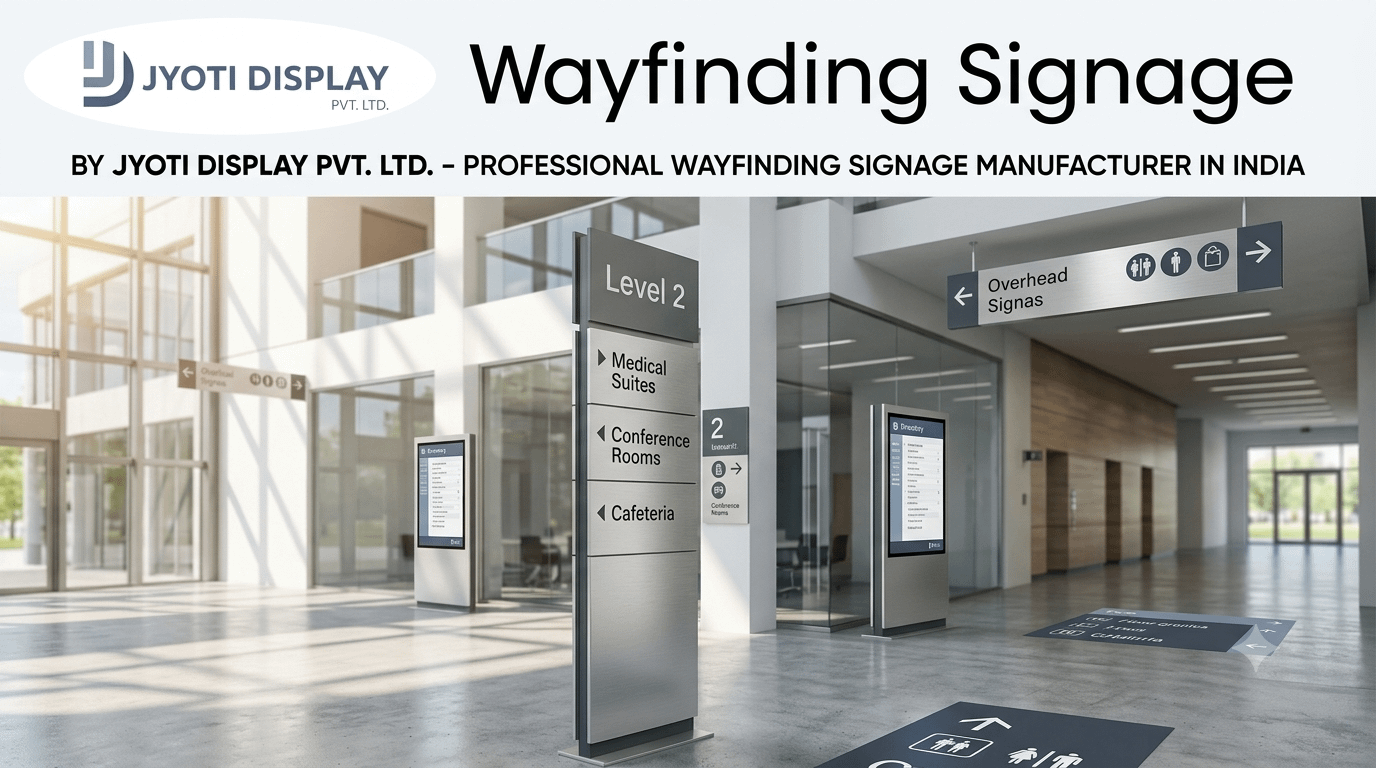
6. Digital Wayfinding for Airports
Wayfinding is one of the most important applications of digital signage.
An airport may contain multiple terminals, gates, floors, security zones, immigration areas, lounges and transportation facilities.
Digital wayfinding can help passengers locate:
- Departure gates
- Arrival gates
- Security
- Immigration
- Customs
- Baggage claim
- Toilets
- Food courts
- Lounges
- Parking
- Taxi areas
- Bus stations
- Railway connections
- Car rental facilities
Digital wayfinding displays can combine text, arrows, icons, maps and animated directions.
A digital screen can also change its message according to operational requirements.
For example:
Gate 24 → Boarding
can later become:
Gate 24 → Final Call
and subsequently:
Gate 24 → Flight Closed
This flexibility is particularly valuable in a fast-changing airport environment.
7. Interactive Airport Kiosks
Interactive digital kiosks are another important category.
Passengers can use touchscreens to access information without depending entirely on airport personnel.
Possible applications include:
- Terminal maps
- Flight searches
- Gate information
- Restaurant directories
- Shopping directories
- Airport facilities
- Transportation information
- Parking information
- Tourist information
- Customer support
- Accessibility information
An interactive kiosk can be designed as a floor-standing unit, wall-mounted unit or customized architectural installation.
Jyoti Display’s public profile lists smart kiosks and interactive digital signage among its digital ecosystem capabilities. (LinkedIn)
8. Digital Advertising Displays
Airports provide high-traffic environments for brand communication.
Digital advertising screens can be installed in:
- Departure lounges
- Arrival halls
- Security waiting zones
- Retail areas
- Food courts
- Passenger corridors
- Airport entrances
- Parking areas
- Baggage collection areas
Digital advertising has an advantage over static advertising because multiple campaigns can share the same display.
For example, a single screen could show:
Airline Advertisement → Automobile Advertisement → Banking Advertisement → Travel Advertisement → Airport Announcement
according to a programmed content schedule.
This makes digital signage useful for airport advertising operators and commercial partners.
9. Indoor Airport Digital Signage
Indoor signage normally requires careful consideration of:
- Viewing distance
- Screen size
- Brightness
- Mounting height
- Passenger movement
- Interior architecture
- Viewing angles
- Cable routing
- Maintenance access
Indoor displays can be wall mounted, ceiling suspended, integrated into columns or installed as free-standing structures.
A manufacturer can design the enclosure around the airport’s architectural requirements rather than treating the screen as a standalone product.
10. Outdoor Airport Digital Signage
Outdoor displays face additional environmental conditions.
These can include:
- Sunlight
- Rain
- Dust
- Temperature variation
- Wind
- Humidity
- Pollution
- Continuous operation
Outdoor digital signage therefore needs appropriate display specifications and enclosure design.
Depending on the location, the structure may require weather protection, appropriate ingress protection, thermal management and corrosion-resistant finishing.
The correct specification should be determined according to the exact installation environment.
11. Custom Metal Fabrication for Digital Signage
One of the important aspects of airport digital signage manufacturing is structural fabrication.
A display may require:
- Mild steel fabrication
- Stainless steel fabrication
- Aluminium fabrication
- Acrylic components
- Sheet-metal enclosures
- Powder-coated structures
- Brackets
- Mounting frames
- Floor stands
- Ceiling suspension structures
- Custom kiosks
- Architectural housings
Jyoti Display’s published company material describes experience with materials including stainless steel, aluminium, metal and other display-related materials, alongside manufacturing and assembly capabilities. (Jyoti Display)
The exact material should be selected according to the application, structural requirement, environment, aesthetics and project specification.
12. Design and Engineering of Airport Digital Signage
Airport signage needs to balance appearance with functionality.
A well-designed system considers:
Screen size
The screen must be appropriate for viewing distance.
Viewing angle
Information should remain readable from the expected passenger flow.
Brightness
Indoor and outdoor environments have different brightness requirements.
Typography
Text must be easy to read quickly.
Contrast
Important information should have sufficient contrast.
Mounting
The mounting system should suit the architectural structure.
Maintenance
Technicians need access to components without unnecessary disruption.
Cable management
Power and data cables should be properly routed and protected.
Ventilation
Electronic components generate heat and require appropriate thermal management.
13. Passenger Experience and Digital Signage
The objective of airport signage is not simply to display information.
It is also to improve the passenger experience.
A passenger who can quickly find the correct gate or baggage area may spend less time asking for directions.
Digital signage can provide information at strategic decision points.
For example:
Decision Point 1:
Terminal → Security
Decision Point 2:
Security → Gate Area
Decision Point 3:
Gate Area → Gate Number
Decision Point 4:
Arrival → Baggage Claim
This creates a logical passenger journey.
Airport accessibility guidance also recognizes the importance of accessible information, wayfinding and signage, including digital technologies such as flight information displays and kiosks. (ACI World Insights)
14. Multilingual Airport Digital Signage
International airports serve passengers from different linguistic backgrounds.
Digital signage can support multiple languages.
For example:
English
Hindi
Marathi
Arabic
French
or other languages depending on the airport.
Instead of installing separate physical boards for every language, digital displays can rotate or simultaneously present multiple languages.
The content management system can determine which information should appear on each screen.
15. Emergency Communication Through Digital Displays
Digital signage can also support emergency communication.
Depending on the airport’s systems and approved operational procedures, displays can be used to communicate:
- Emergency instructions
- Evacuation directions
- Restricted-area messages
- Security notifications
- Weather-related information
- Temporary route changes
- Operational announcements
Emergency messaging should be integrated with the airport’s approved safety and communication infrastructure.
Digital displays should complement—not replace—required statutory safety signage and emergency systems.
16. Airport Branding Through Digital Displays
Airport terminals are also major commercial environments.
Digital signage can strengthen the visual identity of an airport through:
- Branded welcome messages
- Architectural LED installations
- Digital walls
- Sponsor displays
- Event branding
- Promotional zones
- Destination campaigns
- Corporate communication
A customized enclosure can make the display appear integrated into the architecture instead of looking like an independent electronic device.
17. Digital Signage and Airport Advertising Revenue
Digital signage can support commercial advertising models.
A conventional billboard generally carries one creative execution for a particular period.
A digital display can support multiple advertisers.
For example, a screen could operate on a scheduled playlist:
| Time/Slot | Content |
|---|---|
| Slot 1 | Airport information |
| Slot 2 | Airline promotion |
| Slot 3 | Banking advertisement |
| Slot 4 | Automobile advertisement |
| Slot 5 | Retail promotion |
| Slot 6 | Public information |
This allows operators to manage multiple campaigns from a central content system.
Digital Out-of-Home, or DOOH, is particularly relevant in high-footfall environments such as airports.
Jyoti Display’s public company profile identifies both OOH and DOOH among its areas of activity. (LinkedIn)
18. Centralized Content Management
A modern airport may contain hundreds or thousands of screens.
Managing them individually would be inefficient.
A digital signage network can instead use centralized content management.
An authorized operator can manage content across a network.
For example:
Airport Control Center
↓
Central Content Management System
↓
Terminal A Displays
Terminal B Displays
Terminal C Displays
Arrival Displays
Departure Displays
Advertising Displays
This approach makes it possible to manage content according to location and purpose.
19. Real-Time Information Integration
Airport digital signage becomes particularly valuable when connected to live information sources.
Possible integrations can include:
- Flight information
- Gate allocation
- Boarding status
- Baggage information
- Airport announcements
- Weather information
- Transportation information
- Parking status
- Retail information
The specific integrations depend on the airport’s IT architecture, software platforms and security requirements.
The display manufacturer can work alongside system integrators and airport technology teams to provide the physical display infrastructure required for these systems.
20. Airport Digital Signage Manufacturing Process
A professional project typically follows several stages.
Stage 1: Requirement Analysis
The manufacturer first understands:
- Number of displays
- Locations
- Screen sizes
- Indoor/outdoor requirements
- Content requirements
- Mounting requirements
- Operating hours
- Environmental conditions
- Branding requirements
Stage 2: Site Survey
The installation area is evaluated.
Important considerations include:
- Available wall space
- Ceiling height
- Structural support
- Electrical supply
- Data connectivity
- Viewing distance
- Passenger movement
- Maintenance access
Stage 3: Concept Design
The manufacturer develops initial design concepts.
These may include:
- Display shape
- Enclosure
- Branding
- Mounting method
- Materials
- Finishing
- Screen arrangement
Stage 4: Engineering
Once the concept is approved, engineering details are developed.
This may include:
- Fabrication drawings
- Mounting details
- Structural details
- Electrical layouts
- Cable routes
- Ventilation
- Service access
Stage 5: Prototype
For large or complex projects, a prototype can be produced.
The prototype allows stakeholders to evaluate:
- Appearance
- Screen visibility
- Mounting
- Materials
- Accessibility
- Serviceability
Stage 6: Manufacturing
After approval, production begins.
The manufacturing process may involve:
- Cutting
- CNC routing
- Laser cutting
- Bending
- Welding
- Grinding
- Surface preparation
- Painting
- Powder coating
- Assembly
- Display integration
Stage 7: Quality Control
The finished units are checked for:
- Dimensions
- Finish
- Structural integrity
- Screen operation
- Electrical connections
- Visual quality
- Content presentation
- Mounting compatibility
Stage 8: Installation
The display is transported to the airport and installed according to the approved installation plan.
Stage 9: Testing and Handover
The final stage includes:
- Power testing
- Display testing
- Network testing
- Content testing
- Remote-management testing
- Physical inspection
- Client approval
21. Quality Considerations in Airport Digital Signage
Airport signage is often expected to operate for long hours.
Therefore, quality should be considered across the entire system.
Important areas include:
Display quality
Resolution, brightness, contrast and viewing angle affect passenger readability.
Enclosure quality
The enclosure protects internal components and contributes to appearance.
Structural quality
Mounting systems must be appropriate for the installation.
Electrical quality
Power distribution and protection need to comply with project requirements.
Thermal management
Displays and electronics generate heat.
Finish quality
Visible structures should match the airport’s architectural standards.
Serviceability
Maintenance personnel need practical access to replaceable components.
22. Custom Digital Signage for Different Airport Areas
Different airport areas require different display designs.
Airport Entrance
Large LED displays or digital welcome screens can communicate airport information and advertising.
Check-In Area
Displays can provide airline, counter and passenger information.
Security Area
Digital displays can communicate passenger instructions.
Departure Lounge
Displays can combine flight information and advertising.
Gate Area
Screens can show gate-specific information.
Arrival Area
Displays can provide baggage and transportation information.
Baggage Claim
Digital signage can help communicate baggage belt information and passenger instructions.
Retail Zone
Commercial displays can promote shops, restaurants and services.
Parking Area
Outdoor displays can provide parking and transportation information.
23. Architectural Digital Signage
Modern airports increasingly use digital displays as part of architectural design.
Instead of simply mounting a rectangular screen on a wall, manufacturers can create:
- Curved displays
- Column-mounted displays
- Suspended displays
- Freestanding digital totems
- Large-format LED walls
- Integrated kiosk systems
- Custom-shaped digital displays
The design can be coordinated with airport interiors.
This creates a stronger visual connection between technology and architecture.
24. Digital Totems for Airports
Digital totems are freestanding structures containing one or more displays.
They can be used for:
- Wayfinding
- Advertising
- Airport directories
- Passenger information
- Promotional communication
A digital totem can be designed with a narrow footprint, making it useful in passenger areas where floor space is limited.
The enclosure can include branding, illuminated logos and service panels.
25. Digital Pillar Displays
Airport columns provide another opportunity for digital communication.
A display can be integrated around or alongside an architectural column.
Possible uses include:
- Advertising
- Airport branding
- Wayfinding
- Passenger information
- Retail promotion
The design must account for the structural characteristics of the existing column.
26. Large-Format LED Displays
Large-format LED displays can be used where a high visual impact is required.
They may be installed in:
- Airport atriums
- Main entrances
- Departure halls
- Advertising zones
- Passenger lounges
The appropriate pixel pitch depends on viewing distance and application.
For close viewing, a finer pitch may be appropriate. For distant viewing, a larger pitch may provide a practical solution.
The final specification should be determined through a project-specific assessment.
27. LCD and Commercial Display Solutions
LCD-based digital signage can be suitable for many indoor applications.
Advantages can include:
- High image clarity
- Sharp text
- Flexible screen sizes
- Suitable indoor brightness
- Simple single-screen installations
LCD screens can be integrated into custom wall structures, kiosks, cabinets and information counters.
28. Smart Kiosks for Airports
A smart kiosk can combine:
- Display
- Touchscreen
- Computer
- Camera where required
- Printer where required
- Payment interface where applicable
- Network connectivity
- Audio
- Custom enclosure
The kiosk can be designed specifically for the airport’s passenger journey.
A manufacturer can customize its height, width, branding, materials and interface location.
29. Accessibility and Inclusive Digital Signage
Airport signage should consider passengers with different accessibility requirements.
Design considerations can include:
- Clear text
- High contrast
- Large typography
- Appropriate viewing height
- Recognizable icons
- Multilingual communication
- Audio support where appropriate
- Accessible kiosk positioning
ACI’s accessibility guidance specifically discusses flight information displays, kiosks, mobile platforms, wayfinding and signage as part of accessible airport design. (ACI World Insights)
Accessibility requirements should be assessed against the relevant airport, national and international standards for each project.
30. Why Custom Manufacturing Matters
Off-the-shelf displays may not always fit airport requirements.
A custom manufacturer can develop:
Screen + enclosure + structure + branding + installation
as one coordinated solution.
This can be especially useful where an airport requires:
- Non-standard dimensions
- Custom mounting
- Architectural integration
- Special finishes
- Multiple screen configurations
- Custom kiosks
- Large-format structures
- Branded enclosures
Jyoti Display’s public materials emphasize integrated design, manufacturing, installation and customized display solutions. (LinkedIn)
31. Materials Used in Digital Signage Manufacturing
Depending on the project, manufacturers may use:
Aluminium
Lightweight and suitable for many display structures.
Stainless Steel
Useful where durability, appearance and corrosion resistance are important.
Mild Steel
Can be used for strong structural frames and support systems.
Acrylic
Useful for branding, illuminated panels and decorative elements.
Glass
Can be incorporated into selected kiosk and display designs.
ACP
Can be used for selected enclosure and cladding applications.
Powder-Coated Metal
Provides a durable decorative finish when appropriately specified.
Jyoti Display’s published profile identifies stainless steel, aluminium and metal among materials used in its manufacturing operations. (Jyoti Display)
32. Airport Digital Signage Maintenance
Maintenance should be considered during the design stage.
A good display enclosure should provide practical access to:
- Display components
- Power supplies
- Controllers
- Media players
- Network devices
- Cooling components
- Cabling
Modular construction can help reduce service time.
Preventive maintenance can include:
- Screen inspection
- Cleaning
- Cable inspection
- Temperature checks
- Network checks
- Software updates
- Brightness monitoring
- Hardware inspection
33. Energy Efficiency
Airport facilities operate for extended periods, so energy consumption is an important design consideration.
Energy-efficient systems can be supported through:
- Appropriate screen selection
- Brightness management
- Scheduling
- Automatic sleep modes
- Efficient LED technology
- Centralized control
- Power-management systems
The appropriate energy strategy depends on the display type, operating schedule and airport requirements.
34. Security Considerations
Airport IT environments have strict security requirements.
Digital signage systems should therefore be evaluated for:
- Network security
- Access control
- User permissions
- Software security
- Remote-access security
- Physical access
- Content authorization
The display manufacturer may need to coordinate with the airport’s IT and cybersecurity teams.
The physical signage itself should also be designed to restrict unauthorized access to internal electronics.
35. Airport Signage as a Complete Solution
The future of airport signage is moving toward integrated communication ecosystems.
Instead of isolated screens, an airport may have a network containing:
Flight Displays
Wayfinding Screens
Digital Advertising
Interactive Kiosks
LED Video Walls
Mobile Information
Central Content Management
This creates a more consistent passenger communication environment.
ACI research has documented airport interest in integrating multiple digital channels and using data to improve passenger experience. (Store | ACI World)
36. Benefits of Working With a Specialized Manufacturer
Working directly with an experienced signage manufacturer can provide several potential advantages.
Customized Design
The display can be developed according to the airport’s requirements.
Manufacturing Integration
Fabrication and display integration can be coordinated.
Branding Consistency
Multiple display units can follow the same design language.
Project Coordination
Design, manufacturing and installation can be coordinated under one project structure.
Scalability
The solution can be developed for a single installation or larger networks.
Serviceability
Maintenance requirements can be incorporated into the design.
37. Jyoti Display’s Approach to Airport Projects
Jyoti Display describes its business approach around the combination of design, manufacturing and installation. Its public profile also describes project management capabilities and customized display solutions. (Jyoti Display)
For an airport digital signage project, this approach can cover the following workflow:
Understand → Design → Engineer → Manufacture → Integrate → Install → Test → Maintain
The exact scope depends on the project’s technical specification and the responsibilities assigned between the airport authority, signage manufacturer, system integrator, IT team and other contractors.
38. Airport Digital Signage Manufacturing in India
India’s airport infrastructure includes a mixture of large international airports, regional airports and rapidly developing aviation facilities.
This creates demand for different signage formats.
A major international airport may require:
- Large LED walls
- Extensive wayfinding
- Flight information displays
- Advertising networks
- Interactive kiosks
- Architectural digital displays
A regional airport may have a smaller and more focused requirement.
A manufacturer serving Indian customers needs to understand different architectural, climatic, operational and commercial requirements.
Jyoti Display’s Mumbai-based operations and stated pan-India project capabilities position it within India’s broader signage and display manufacturing ecosystem. (LinkedIn)
39. Choosing the Right Airport Digital Signage Manufacturer
Airport authorities, EPC companies, system integrators and advertising operators can evaluate manufacturers using several criteria.
Manufacturing capability
Can the manufacturer produce custom structures?
Engineering capability
Can it develop suitable fabrication and mounting solutions?
Display integration
Can different display technologies be incorporated?
Installation experience
Does the company have experience with large commercial installations?
Quality control
Is there a documented quality process?
Customization
Can the design be adapted to architectural requirements?
Project management
Can multiple departments and vendors be coordinated?
Service
Is post-installation support available?
Scalability
Can the manufacturer handle additional displays later?
These factors are often more important than simply comparing the price of individual screens.
40. Airport Digital Signage: Manufacturing vs. Assembly
It is useful to distinguish between a screen reseller and a complete signage manufacturer.
A reseller primarily supplies display equipment.
A signage manufacturer may additionally provide:
- Product design
- Metal fabrication
- Enclosure development
- Branding
- Structural systems
- Kiosk manufacturing
- Display integration
- Installation
For airport projects, the latter approach can be useful where the display must be physically integrated into the building.
Jyoti Display describes itself as a manufacturer with design and fabrication capabilities, rather than only a screen supplier. (Jyoti Display)
41. Applications Across the Airport Passenger Journey
Digital signage can support passengers from entrance to departure.
Step 1: Airport Entrance
Welcome and orientation.
Step 2: Check-In
Airline and counter information.
Step 3: Security
Passenger instructions.
Step 4: Departure Area
Flight information.
Step 5: Wayfinding
Gate directions.
Step 6: Gate
Boarding information.
Step 7: Arrival
Baggage and transportation information.
Step 8: Exit
Taxi, bus, metro and parking information.
This creates a connected information journey.
42. Digital Signage for Airport Retail
Airport retail is another major application.
Displays can promote:
- Duty-free stores
- Restaurants
- Cafes
- Fashion brands
- Electronics
- Travel products
- Lounges
- Services
Retailers can change content according to:
- Time
- Location
- Campaign
- Product availability
- Passenger profile
- Promotional schedule
This turns signage into a flexible commercial communication platform.
43. Digital Signage for Airport Restaurants
Restaurants and food courts can use digital displays for:
- Menus
- Offers
- Digital promotions
- Brand videos
- Queue information
- Restaurant directions
Menu boards can be changed without physically replacing printed boards.
44. Airport Lounge Digital Displays
Airport lounges can use digital displays for:
- Welcome messages
- Flight updates
- Lounge services
- Food menus
- Promotional information
- Partner advertising
The display design can be matched to the lounge interior.
45. Outdoor Advertising at Airports
Airport entry roads and parking zones can use large digital displays for advertising and public information.
Outdoor digital signage can provide:
- High visibility
- Scheduled campaigns
- Multiple advertisers
- Dynamic content
- Emergency communication
Outdoor installations need to be engineered according to local environmental conditions and structural requirements.
46. Digital Signage for Airport Parking
Parking facilities can use digital displays for:
- Parking directions
- Available spaces
- Entry and exit instructions
- Payment information
- Taxi zones
- Pickup areas
Dynamic signage can reduce confusion by changing directions according to operational requirements.
47. Sustainability and Long-Term Use
Sustainable signage design can consider the entire lifecycle of a display.
This includes:
- Energy consumption
- Repairability
- Replaceable components
- Modular construction
- Durable materials
- Efficient electronics
- Responsible disposal
Designing an enclosure that permits component replacement may extend the useful life of the overall installation.
48. Future of Airport Digital Signage
Airport signage is likely to become increasingly connected.
Future systems may combine:
- Artificial intelligence
- Real-time analytics
- Interactive maps
- Mobile integration
- Personalized information
- Computer vision
- Data-driven advertising
- Automated content scheduling
- Smart wayfinding
- Multilingual interfaces
The physical display remains important, but the intelligence behind the display increasingly determines how useful it becomes.
ACI’s digital-transformation research has identified areas such as personalized information, wayfinding and integrated digital channels as significant parts of airport digital strategies. (Store | ACI World)
49. Why Jyoti Display for Airport Digital Signage?
Jyoti Display Pvt. Ltd. brings together several capabilities relevant to customized signage projects.
Its public materials describe:
- Design capabilities
- Manufacturing
- Digital display solutions
- LED and LCD video walls
- Smart kiosks
- Interactive digital signage
- Wayfinding
- Static signage
- Metal fabrication
- Project management
- Installation capabilities (LinkedIn)
The company also publicly identifies airport, metro, retail, mall, hospital and hospitality environments among its target sectors. (LinkedIn)
For an airport project, these capabilities can be combined into a customized solution rather than relying solely on standard display products.
50. Conclusion
Airport digital signage has evolved from simple electronic information boards into an important part of modern passenger communication, wayfinding, advertising and architectural design.
A successful airport digital signage system requires more than a high-quality screen. It requires careful planning of display technology, enclosure design, structural fabrication, mounting, electrical integration, content management, accessibility, maintenance and long-term service.
Jyoti Display Pvt. Ltd. offers design and manufacturing capabilities covering digital displays, LED/LCD video walls, smart kiosks, interactive signage, wayfinding and customized display structures. The company states that it has operated since 2004 and provides design, manufacturing and installation capabilities for display and signage projects. (Jyoti Display)
For airport authorities, infrastructure companies, system integrators, advertising operators and airport retail businesses, customized digital signage can provide a flexible platform for passenger information, navigation, branding and commercial communication.
The future airport will not rely on a single type of sign. It will use a connected combination of digital displays, LED walls, interactive kiosks, wayfinding systems, flight information screens and intelligent content management.
A specialized manufacturer such as Jyoti Display can help bring these physical and visual elements together into a coordinated airport signage environment.
Airport Digital Signage Manufacturing – Key Services
Jyoti Display Pvt. Ltd. can be positioned for airport projects across:
- Airport Digital Signage
- Airport Digital Display Manufacturing
- Airport LED Display
- Airport LCD Display
- Airport Video Wall
- Airport Digital Wayfinding
- Airport Directional Signage
- Airport Flight Information Displays
- Airport Digital Advertising Displays
- Airport Interactive Kiosks
- Airport Digital Totems
- Airport Digital Pillar Displays
- Airport Information Screens
- Airport Passenger Information Systems
- Airport Retail Digital Signage
- Airport Outdoor Digital Signage
- Airport Indoor Digital Signage
- Custom Digital Display Structures
- Digital Signage Enclosures
- LED Video Wall Fabrication
- Interactive Digital Signage
- Smart Kiosk Manufacturing
- Custom Signage Fabrication
- Airport Branding Solutions
Frequently Asked Questions
1. What is airport digital signage?
Airport digital signage consists of electronic displays used for flight information, passenger communication, wayfinding, advertising, branding, emergency communication and other airport services.
2. What types of digital signage are used in airports?
Common formats include LED video walls, LCD screens, flight information displays, digital wayfinding screens, interactive kiosks, digital totems, advertising displays and customized architectural digital displays.
3. Why is digital signage better suited to airports than only static signage?
Digital displays can be updated electronically, allowing information to change according to flight schedules, gate changes, announcements, advertising campaigns and other operational requirements.
4. Can airport digital signage be customized?
Yes. Display size, enclosure, mounting structure, materials, branding, screen orientation and physical configuration can be customized according to the project.
5. Does Jyoti Display manufacture digital signage?
Jyoti Display’s published company profile describes design, manufacturing and installation capabilities and identifies digital displays, LED/LCD video walls, kiosks and interactive digital signage among its offerings. (Jyoti Display)
6. Can digital signage be used for airport wayfinding?
Yes. Digital screens can communicate directions to gates, security, immigration, baggage claim, lounges, parking, transportation and other airport facilities.
7. Can airport displays show multiple languages?
Yes. Digital signage can be configured to display multiple languages, subject to the content-management system and airport requirements.
8. Can airport digital signage display advertisements?
Yes. Digital displays can support scheduled advertising campaigns alongside airport information.
9. Can airport digital displays be installed outdoors?
Yes, outdoor systems can be designed for appropriate environmental conditions. The required display and enclosure specifications should be selected according to the installation location.
10. Can digital signage be centrally controlled?
Yes. Networked digital signage systems can use centralized content management to distribute and schedule information across multiple displays.
11. What materials can be used for digital signage enclosures?
Depending on the project, materials can include aluminium, stainless steel, mild steel, acrylic and other architectural materials. Jyoti Display’s published profile identifies aluminium, stainless steel and metal among its manufacturing materials. (Jyoti Display)
12. Who can approach Jyoti Display for airport digital signage?
Potential customers include airport authorities, airport operators, EPC contractors, infrastructure companies, advertising agencies, DOOH operators, system integrators, architects, interior contractors and airport retailers.
airport-digital-signage-manufacturing
- Airport Digital Signage Manufacturing
- Airport Digital Signage Manufacturer
- Airport Digital Display Manufacturer
- Airport LED Display Manufacturer
- Airport Digital Wayfinding
- Airport Digital Signage Company India
- Airport Signage Manufacturer India
- Digital Signage Manufacturer Mumbai
- Airport LED Video Wall
- Airport Interactive Kiosk
- Airport Digital Display Solutions
- Airport Passenger Information Display
- Airport Digital Advertising Display
- Airport Wayfinding Display
- Digital Signage Manufacturing India
- Jyoti Display Pvt Ltd
- Jyoti Display Airport Digital Signage
Suggested CTA
Looking for customized Airport Digital Signage?
Partner with Jyoti Display Pvt. Ltd. for customized digital signage, LED/LCD displays, video walls, interactive kiosks, digital wayfinding and display fabrication solutions designed for high-traffic airport environments.