
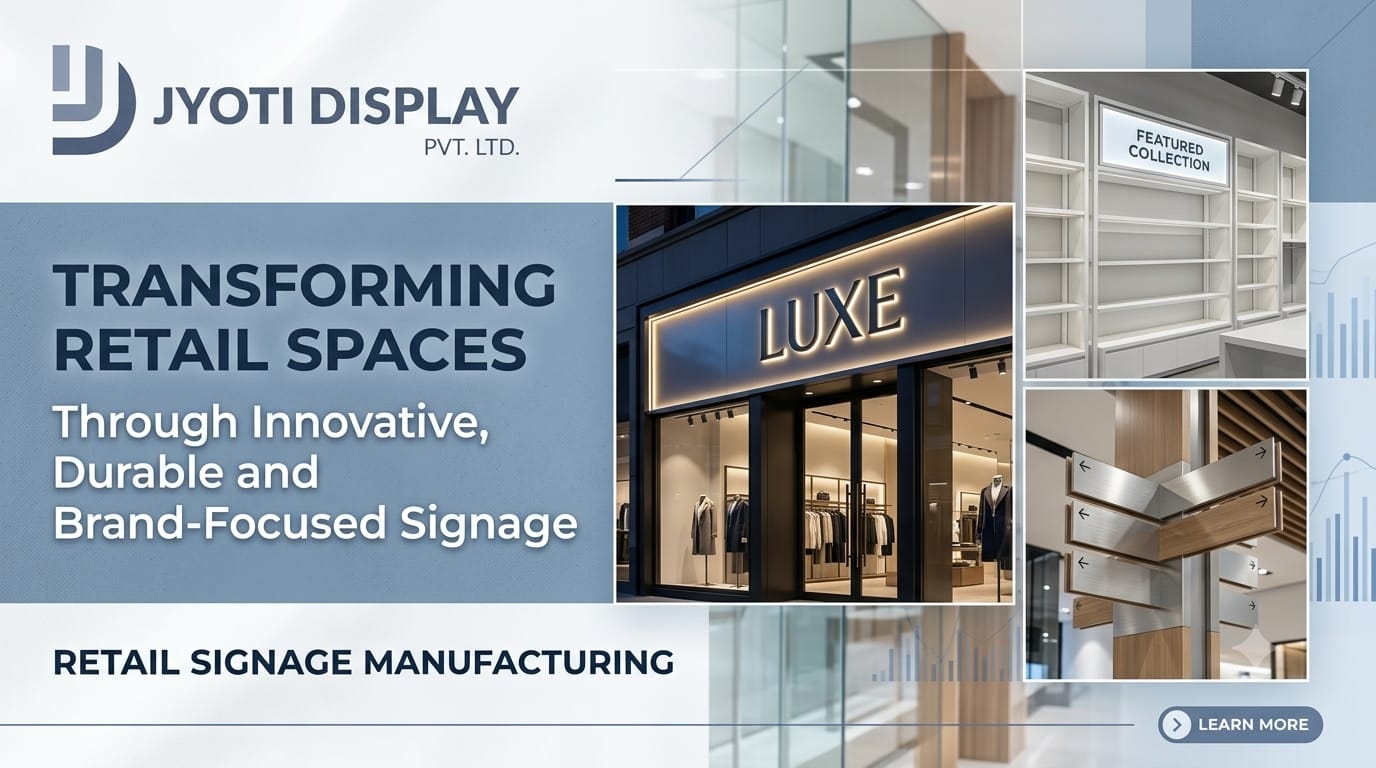
In modern retail, the customer experience begins long before a shopper enters a store. The storefront, brand name, illuminated logo, product displays, directional signs, promotional graphics and digital screens collectively create the first impression of a retail business. In an increasingly competitive marketplace, effective signage is no longer simply a method of displaying a company name. It is an important component of brand identity, customer communication, navigation, visual merchandising and retail experience.
Jyoti Display Pvt. Ltd. is a professional design and manufacturing company serving the retail display and signage industry, with capabilities covering retail fixtures, shop fittings, displays, static signage and digital display solutions. According to the company’s profile, Jyoti Display was established in 2004 and operates manufacturing facilities in Mumbai and Nashik, including a factory spanning more than 80,000 square feet. The company describes its approach through the philosophy “Imagine Design Build”, integrating design, manufacturing, installation and project management. (Jyoti Display Pvt Ltd)
This article explores the importance of retail signage manufacturing, the different types of signage used by modern retailers, manufacturing considerations, materials, illumination technologies, customization, installation, maintenance and how an experienced manufacturer such as Jyoti Display Pvt. Ltd. can help businesses create consistent and professional retail environments.
1. What Is Retail Signage Manufacturing?
Retail signage manufacturing is the process of designing, engineering, fabricating and finishing physical or digital communication systems used inside and outside retail stores.
Retail signage can include:
- Storefront signage
- Brand logos
- 3D letters
- LED channel letters
- Acrylic signage
- Stainless-steel signage
- Illuminated signboards
- Backlit signs
- Light boxes
- Directional signage
- Department identification signs
- Promotional displays
- Digital signage
- Wayfinding systems
- Hanging signs
- Pylon signs
- Fascia signage
- Wall graphics
- Point-of-sale signage
- In-store promotional displays
- Retail display fixtures
- Custom branded structures
The manufacturing process combines graphic design, material selection, fabrication, electrical engineering, illumination, finishing, quality control, logistics and installation.
A professionally manufactured retail sign should do more than look attractive. It should be readable, durable, appropriately illuminated, consistent with the brand and suitable for the location in which it will be installed.
For large retail chains, manufacturing consistency becomes particularly important because the same brand identity may need to be reproduced across dozens, hundreds or even thousands of stores.
2. Why Retail Signage Is Important
Retail businesses operate in environments where customers are exposed to numerous competing visual messages.
A store may be surrounded by:
- Competitor brands
- Advertising boards
- Promotional banners
- Building signage
- Road traffic
- Mall signage
- Digital screens
- Product advertisements
A strong signage system helps a retailer establish visual recognition.
2.1 Creating the First Impression
The exterior sign is often the first physical interaction between a customer and a store.
A well-designed sign can communicate:
- Brand name
- Brand personality
- Premium positioning
- Product category
- Store identity
- Opening location
- Visual quality
For example, a luxury fashion store may require understated stainless-steel or halo-lit letters, while a quick-service restaurant may prefer bold illuminated graphics.
The signage should therefore reflect the positioning of the brand.
3. Retail Signage as a Branding Tool
Retail signage is closely connected with brand identity.
A company’s:
- Logo
- Colours
- Typography
- Lighting
- Materials
- Shapes
- Finishes
- Dimensions
can all be translated into physical signage.
When the same specifications are maintained across multiple locations, customers can recognize the brand even before reading the complete store name.
For national retail chains, this consistency is particularly important. The sign installed in Mumbai should visually match the sign installed in Pune, Nashik, Bengaluru, Delhi or another city.
A professional manufacturing partner can create standardized production drawings and specifications to help achieve this consistency.
4. Jyoti Display Pvt. Ltd. – Retail Display and Manufacturing Expertise
Jyoti Display Pvt. Ltd. positions itself as a design and manufacturing company specializing in retail fixtures, shop fittings, displays and retail equipment for national retailers and wholesalers. Its company profile states that its manufacturing operations include approximately 80,000 square feet of factory space and around 120 employees across manufacturing, quality control, engineering and project-management functions. (Jyoti Display Pvt Ltd)
Its stated product capabilities include:
- Stainless-steel products
- Aluminium products
- Metal display products
- PU-finish HDF products
- Modular furniture
- Corian products
- Static signage
- Digital displays
- Retail fixtures
- Store equipment
The combination of retail fixtures and signage manufacturing can be particularly useful because modern retail projects frequently require more than a standalone signboard.
A store may need an integrated package containing:
Storefront signage + interior signage + display fixtures + furniture + digital displays + promotional elements.
This integrated manufacturing approach can help retailers maintain design consistency throughout the customer journey.
5. Types of Retail Signage Manufactured for Modern Stores
Retail signage can be divided into multiple categories depending on location, purpose and technology.
5.1 Storefront Signage
Storefront signage identifies the business from outside the building.
Common examples include:
- Illuminated brand logos
- 3D letters
- Channel letters
- Acrylic letters
- Stainless-steel letters
- ACP fascia signs
- LED signboards
- Backlit logos
Storefront signage must be designed according to viewing distance and available mounting space.
5.2 3D Letter Signage
Three-dimensional letters create depth and visual impact.
They can be manufactured using:
- Acrylic
- Stainless steel
- Aluminium
- Mild steel
- PVC
- Other engineered materials
Depending on the design, 3D letters may be:
- Non-illuminated
- Front illuminated
- Back illuminated
- Halo illuminated
- Front-and-back illuminated
Dimensional signage is particularly effective when a retailer wants the brand logo to become a prominent architectural feature.
6. LED Channel Letter Signage
LED channel letters are individually fabricated three-dimensional letters or logos containing internal illumination.
They are widely used for:
- Retail storefronts
- Shopping malls
- Brand outlets
- Restaurants
- Showrooms
- Corporate spaces
- Commercial buildings
Channel letters may use front illumination, halo illumination or a combination of lighting techniques.
The manufacturing quality is determined by factors such as:
- Letter depth
- Material thickness
- Face quality
- Edge finishing
- LED positioning
- Electrical connections
- Weather protection
- Mounting system
Modern channel-letter manufacturing commonly uses LED modules because they can provide strong illumination with relatively efficient energy consumption. Industry examples also show front-lit and reverse/halo-lit channel letters being used for different visual effects.
7. Front-Lit Retail Signage
Front-lit signage directs illumination toward the viewer.
The light source is installed inside the letter or sign housing, while the front face allows light to pass through.
This approach offers:
- Strong visibility
- Excellent readability
- Clear brand recognition
- High night-time visibility
- Effective storefront communication
Front-lit signage is suitable for retailers located on busy streets, shopping centres and commercial complexes.
8. Backlit and Halo-Lit Signage
Backlit signage creates illumination behind the letters or logo.
Instead of the letter face being brightly illuminated, light produces a glow around or behind the letter.
This is often called a halo effect.
It is suitable for:
- Premium retail
- Fashion brands
- Jewellery stores
- Hotels
- Corporate interiors
- Luxury showrooms
- Premium commercial spaces
The effectiveness of halo signage depends on the wall surface because the reflected light becomes part of the visual effect.
9. Acrylic Retail Signage
Acrylic is widely used in retail signage because it can be:
- CNC cut
- Laser cut
- Formed
- Printed
- Painted
- Illuminated
- Layered
- Fabricated into dimensional letters
Acrylic signage can be manufactured in different colours and finishes.
Applications include:
- Logo boards
- Storefront signs
- Directional signs
- Counter signs
- Product category signs
- Interior brand walls
- Illuminated displays
For illuminated signage, translucent acrylic can be used to allow light to pass through the face.
10. Stainless-Steel Retail Signage
Stainless steel provides a premium and durable appearance.
Possible finishes include:
- Mirror finish
- Hairline finish
- Brushed finish
- Matte finish
- Gold-tone finish
- Custom coated finish
Stainless-steel letters can be used for:
- Luxury stores
- Jewellery outlets
- Corporate offices
- Premium retail
- Hotels
- Showrooms
The material can also be combined with acrylic or LED illumination.
11. Aluminium Retail Signage
Aluminium is another important material for signage manufacturing because of its combination of:
- Low weight
- Strength
- Fabrication flexibility
- Corrosion resistance
- Modern appearance
Aluminium can be fabricated into:
- Channel letters
- Sign boxes
- Fascia systems
- Hanging signs
- Directional signage
- Structural frames
For large retail rollouts, material selection must consider transportation, installation and long-term maintenance in addition to appearance.
12. ACP Retail Signboards
Aluminium Composite Panel, commonly called ACP, can be used for retail fascia and architectural signage applications.
ACP can provide a clean, contemporary surface for branding.
It may be combined with:
- Acrylic letters
- Stainless-steel letters
- LED illumination
- Printed graphics
- Cut-out logos
- Channel letters
ACP-based systems are frequently used where a larger branded background surface is required.
13. Illuminated Light Boxes
Light boxes use an internal light source to illuminate a graphic or translucent face.
They are useful for:
- Retail promotions
- Brand logos
- Product advertisements
- Shopping malls
- Supermarkets
- Pharmacy stores
- Food outlets
- Showrooms
Light boxes can be rectangular, square, circular or custom-shaped.
A professionally engineered light box should provide reasonably uniform illumination without visible hotspots.
14. Digital Retail Signage
The retail environment is increasingly incorporating digital displays.
Digital signage allows businesses to display:
- Product videos
- Advertisements
- Offers
- Prices
- Promotional campaigns
- Product information
- Brand videos
- Seasonal content
- Customer announcements
Unlike static signage, digital signage can be updated without physically replacing the printed sign.
This makes digital signage particularly useful for retailers with frequently changing promotions.
Jyoti Display’s company profile specifically identifies digital display among its areas of expertise. (Jyoti Display Pvt Ltd)
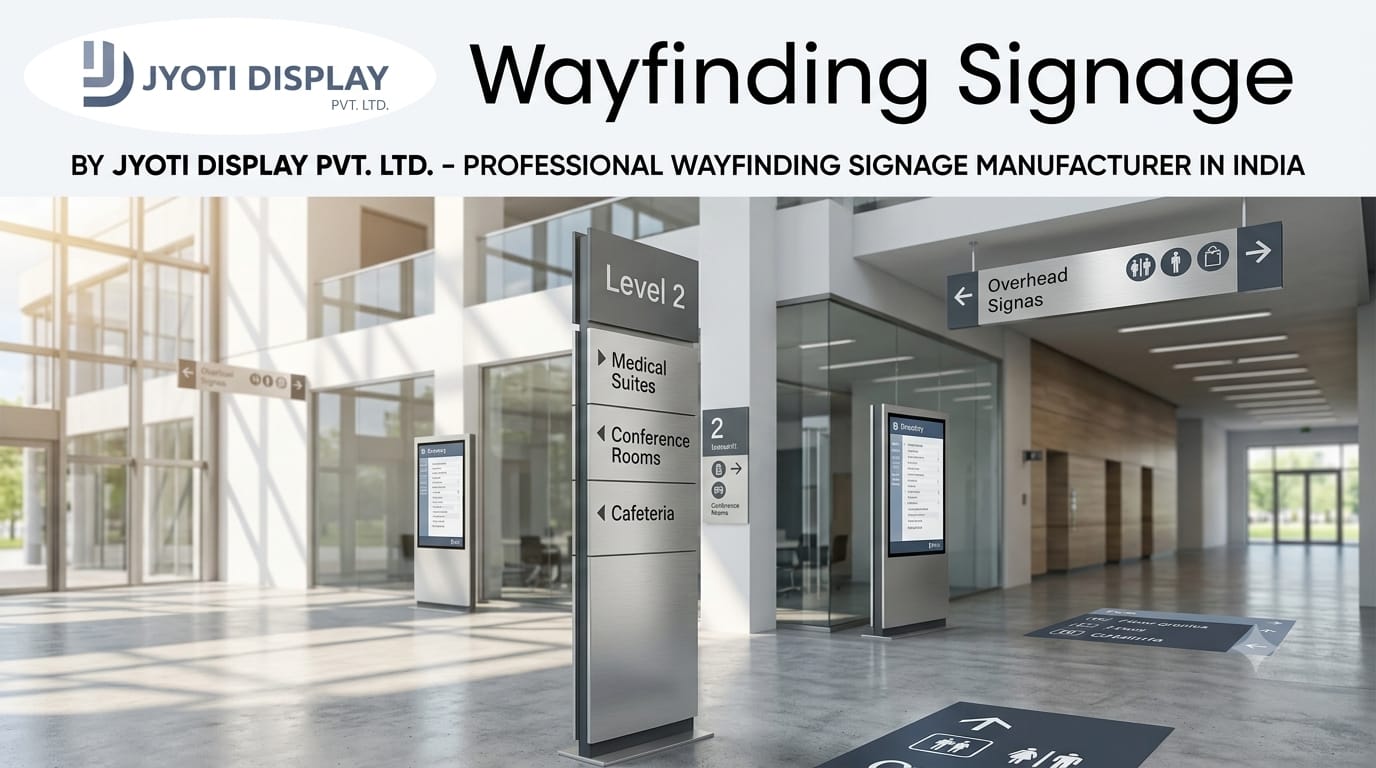
15. Retail Wayfinding Signage
A large store, mall or showroom can be confusing without proper directional communication.
Wayfinding signage helps customers locate:
- Departments
- Billing counters
- Trial rooms
- Elevators
- Escalators
- Restrooms
- Customer service
- Exits
- Parking
- Specific product categories
Effective wayfinding signage should be:
- Easy to read
- Consistent
- Visually simple
- Positioned correctly
- Recognizable from a reasonable distance
The design should minimize the amount of information presented on a single sign.
16. Promotional Retail Signage
Retailers regularly conduct:
- Sales
- Seasonal campaigns
- Festive promotions
- Clearance events
- Product launches
- New-store promotions
Promotional signage can be integrated into:
- Window displays
- Hanging boards
- Counter displays
- Digital screens
- Light boxes
- Shelf signage
- Wall graphics
The signage should allow the retailer to communicate the promotion without overpowering the overall store identity.
17. Point-of-Sale Signage
Point-of-sale signage communicates with customers close to the purchase decision.
Examples include:
- Countertop displays
- Product information boards
- Promotional stands
- Price communication
- Offer boards
- Payment-area signs
- Product comparison displays
These signs are usually smaller than storefront signage but can have a direct impact on customer decisions.
18. Retail Display Fixtures and Signage Integration
One of the major advantages of working with a retail display manufacturer is the ability to coordinate signage with store fixtures.
For example, a retailer may require:
- Gondolas
- Shelving
- Counters
- Wall displays
- Promotional units
- Signage
- Digital displays
- Storage furniture
If these components are manufactured independently by different suppliers, differences in colour, finish and dimensions may occur.
An integrated manufacturer can coordinate the components around one design specification.
Jyoti Display’s capabilities span retail fixtures, shop fittings, displays and equipment, making this type of integrated retail manufacturing an important part of its stated offering. (Jyoti Display Pvt Ltd)
19. The Retail Signage Manufacturing Process
Professional signage manufacturing involves multiple stages.
Step 1: Understanding the Brand
The manufacturer first studies:
- Logo
- Brand guidelines
- Corporate colours
- Typography
- Required dimensions
- Location
- Illumination requirements
Brand guidelines are essential for multi-store projects.
Step 2: Site Survey
A site survey determines:
- Available installation area
- Wall dimensions
- Mounting surface
- Electrical availability
- Sign visibility
- Customer viewing angle
- Structural conditions
- Access for installation
- Local restrictions
For outdoor signs, environmental exposure should also be considered.
Step 3: Concept Design
The design team prepares concepts showing:
- Sign dimensions
- Materials
- Letter style
- Illumination
- Mounting
- Finish
- Brand colours
The objective is to create a sign that is attractive while remaining practical to manufacture and install.
20. Engineering and Production Drawings
Once the design is approved, technical drawings can be created.
These drawings may specify:
- Overall dimensions
- Material thickness
- Mounting positions
- LED arrangement
- Electrical requirements
- Structural supports
- Fabrication details
- Finishing specifications
For large retail chains, maintaining accurate production drawings is particularly important.
21. Material Selection
Material selection affects:
- Appearance
- Weight
- Cost
- Durability
- Maintenance
- Installation
- Weather resistance
A professional manufacturer should select materials according to the application rather than simply choosing the cheapest available option.
For example, an indoor retail sign may have very different requirements from an outdoor facade sign.
22. Fabrication
Fabrication can include:
- CNC cutting
- Laser cutting
- Bending
- Welding
- Forming
- Drilling
- Assembly
- Surface preparation
The exact process depends on the material and sign type.
Precision manufacturing becomes particularly important for complex logos and dimensional letters.
23. Surface Finishing
Finishing is an important part of retail signage because it determines the final appearance.
Possible processes include:
- Powder coating
- Paint finishing
- Polishing
- Brushing
- Anodizing
- Lamination
- Vinyl application
- Graphic printing
The finish should match the brand specification.
24. LED and Electrical Assembly
For illuminated signage, LED modules and power supplies must be properly selected and installed.
Important considerations include:
- Brightness
- Colour temperature
- LED spacing
- Heat management
- Power consumption
- Electrical protection
- Accessibility for maintenance
LED positioning should be carefully planned to minimize uneven illumination.
25. Quality Control
Before dispatch, signage should be inspected for:
- Dimensions
- Surface finish
- Colour
- Logo accuracy
- Structural quality
- Illumination
- Electrical connections
- Mounting hardware
- Packaging
For multi-location retail projects, quality control at the manufacturing facility can reduce inconsistencies between stores.
26. Packaging and Transportation
Retail signage can be vulnerable to damage during transportation.
Packaging should protect:
- Acrylic faces
- Painted surfaces
- Stainless-steel finishes
- LED components
- Corners
- Dimensional letters
Large signs may require custom crates or protective packaging.
The transportation plan should consider the installation schedule so signage reaches the location at the correct stage of the store project.
27. Installation of Retail Signage
Installation is as important as manufacturing.
Even a high-quality sign can look poor if it is incorrectly installed.
Installation teams need to consider:
- Alignment
- Level
- Mounting strength
- Electrical connections
- Visibility
- Safety
- Access
- Structural support
For multi-store retail chains, standardized installation procedures help maintain consistency.
28. Importance of Retail Signage Durability
Retail signage is a long-term investment.
Outdoor signs may be exposed to:
- Sunlight
- Rain
- Dust
- Humidity
- Temperature variation
- Wind
- Pollution
Therefore, outdoor signage requires appropriate material and component selection.
Indoor signs generally face fewer environmental challenges, but they still need to withstand regular cleaning and customer interaction.
29. Energy-Efficient LED Signage
LED technology has become an important part of modern illuminated signage.
LED-based systems can provide:
- Bright illumination
- Long operating life
- Low heat compared with some legacy technologies
- Flexible installation
- Lower energy consumption in many applications
The actual energy performance depends on the sign design, LED components, operating hours and electrical system.
For retailers operating signage for long periods each day, efficient lighting can help reduce operating costs.
30. Custom Retail Signage Manufacturing
Every retail brand has different requirements.
A custom manufacturer can create signage according to:
- Exact logo proportions
- Custom dimensions
- Brand colours
- Store architecture
- Illumination style
- Installation location
- Customer viewing distance
Customization is particularly important for flagship stores where signage forms part of the architectural identity.
31. Signage for Shopping Malls
Shopping malls present unique signage challenges.
Retail signage must often comply with:
- Mall design guidelines
- Sign dimensions
- Installation restrictions
- Electrical requirements
- Working-hour restrictions
- Fire and safety requirements
- Approved material specifications
The sign must also stand out while fitting into the mall’s overall visual environment.
32. Signage for High-Street Retail
High-street stores need signage that competes with surrounding visual information.
Important factors include:
- Viewing distance
- Traffic direction
- Pedestrian movement
- Building height
- Storefront width
- Night visibility
Illuminated channel letters, light boxes and dimensional logos are common solutions for such locations.
33. Signage for Supermarkets and Large Retail Stores
Large-format retailers may require complete signage systems rather than one storefront sign.
These can include:
- Main entrance signage
- Department signage
- Category boards
- Promotional signage
- Wayfinding
- Checkout signs
- Safety signs
- Digital screens
- Exterior identification
A standardized signage system makes the customer experience easier to understand.
34. Signage for Fashion Retail
Fashion brands often require visually sophisticated signage.
Common solutions include:
- Stainless-steel letters
- Acrylic dimensional letters
- Halo-lit logos
- Brushed metal
- Premium backlit signage
- Digital displays
The objective is not simply maximum brightness. The signage must support the brand’s desired personality.
35. Signage for Jewellery Retail
Jewellery stores generally require premium finishes.
Potential signage solutions include:
- Gold-tone metal letters
- Stainless steel
- Acrylic
- Halo illumination
- Backlit logos
- Premium light boxes
Lighting colour temperature and brightness should be selected carefully so the signage complements the store interior.
36. Signage for Electronics Retail
Electronics stores often combine static and digital communication.
They may use:
- Illuminated logos
- Digital screens
- Product-category signs
- Promotional displays
- LED walls
- Countertop branding
- Hanging signs
Digital signage can be especially useful for frequently changing promotions.
37. Retail Signage for Restaurants and Food Outlets
Restaurants need highly visible signs that communicate their identity quickly.
Applications include:
- Exterior fascia
- 3D letters
- Menu boards
- Illuminated logos
- Drive-through signage
- Directional signs
- Digital menu displays
Signage should remain readable during both daytime and night-time operation.
38. Retail Signage and Customer Experience
Signage affects the customer journey.
A customer may encounter:
Storefront → Entrance → Category Sign → Product Display → Promotional Sign → Billing → Exit
Each stage requires appropriate communication.
Therefore, signage should not be treated as an isolated product.
It should be considered as part of the overall customer-experience strategy.
39. Importance of Consistency Across Multiple Stores
For a national retail brand, inconsistency can weaken brand recognition.
For example:
- Different logo sizes
- Different colours
- Different illumination
- Different letter depths
- Different mounting positions
can make stores look unrelated.
A centralized manufacturing partner can help maintain common specifications.
This is particularly valuable for retailers undertaking rapid expansion.
40. Retail Rollout Manufacturing
A retail rollout may involve dozens or hundreds of locations.
Such projects require:
- Brand guideline review
- Site survey
- Design approval
- Standardized production drawings
- Centralized manufacturing
- Quality inspection
- Location-wise packaging
- Logistics planning
- Installation
- Final inspection
The ability to coordinate these stages is an important factor when selecting a retail signage manufacturer.
41. Why Choose a Professional Retail Signage Manufacturer?
Working directly with a manufacturer can offer several advantages.
Design Control
The manufacturer understands how a design translates into a physical product.
Production Control
Manufacturing processes can be monitored internally.
Quality Control
Products can be inspected before dispatch.
Customization
Special sizes and finishes can be produced.
Project Coordination
Manufacturing and installation schedules can be coordinated.
Consistency
Multiple stores can be produced according to the same specification.
42. Jyoti Display’s Integrated Manufacturing Approach
Jyoti Display’s stated capabilities extend beyond individual signs to retail fixtures, displays, shop fittings and digital display solutions. The company describes itself as a direct manufacturing factory and emphasizes design, manufacturing, installation and service. (Jyoti Display Pvt Ltd)
This integrated approach can be valuable for retailers that want a single manufacturing partner for multiple physical components of a store.
Instead of treating signage, fixtures and displays as completely separate products, they can be considered as parts of one retail environment.
43. Technology in Modern Retail Signage Manufacturing
Manufacturing technology continues to improve the precision and customization of signage.
Modern production environments can use:
- CNC machining
- Laser cutting
- Digital printing
- Computer-aided design
- Precision bending
- Automated fabrication
- LED technology
- Digital display systems
These technologies make it possible to produce complex logos and customized retail elements with greater repeatability.
44. Static Signage vs Digital Signage
Both static and digital signage have their own advantages.
| Feature | Static Signage | Digital Signage |
|---|---|---|
| Content | Fixed | Changeable |
| Maintenance | Generally simple | Requires electronic maintenance |
| Installation | Usually straightforward | Requires power and equipment |
| Promotions | Requires replacement | Can be updated digitally |
| Operating complexity | Low | Higher |
| Best use | Permanent branding | Dynamic communication |
The best retail environment may use both.
45. Combining Static and Digital Signage
A modern store could use:
Illuminated storefront logo + digital promotional display + directional signage + product-category signs + promotional fixtures.
This creates a layered communication system.
Static signs provide permanent brand identity while digital displays provide flexible communication.
46. Designing Signage for Visibility
A good sign should be visible at the intended viewing distance.
Designers should consider:
- Letter height
- Typeface
- Contrast
- Illumination
- Background
- Viewing angle
- Mounting height
- Environmental lighting
Overly complicated fonts may reduce readability.
A professional signage manufacturer can help balance brand aesthetics with practical visibility.
47. Colour Management in Retail Signage
Brand colour accuracy is important.
A sign may need to match:
- Logo colours
- Interior finishes
- Packaging
- Digital branding
- Printed material
Differences in material can affect the perceived colour.
Therefore, physical samples and approved specifications can be useful for large projects.
48. Signage Maintenance
Retail signs require periodic inspection.
Maintenance may include:
- LED replacement
- Power-supply inspection
- Cleaning
- Electrical checks
- Fastener inspection
- Surface cleaning
- Repainting or refinishing
- Graphic replacement
A maintenance program can extend the useful life of signage.
49. Designing for Easy Maintenance
Good signage engineering should consider future servicing.
For example:
- LED modules should be accessible.
- Power supplies should be serviceable.
- Electrical connections should be protected.
- Sign components should be replaceable where practical.
- Maintenance access should be considered during installation.
This can reduce long-term service costs.
50. Safety Considerations
Signage manufacturing and installation should consider:
- Structural stability
- Electrical safety
- Weather conditions
- Mounting strength
- Working-at-height requirements
- Cable management
- Appropriate protective components
- Local building requirements
The exact engineering requirements vary according to location and sign size.
Large outdoor signage may require structural engineering calculations and appropriate permissions.
51. Sustainability in Retail Signage
Retailers are increasingly interested in sustainable design.
Potential approaches include:
- Energy-efficient LED lighting
- Durable materials
- Repairable components
- Reusable signage structures
- Reduced packaging waste
- Responsible material selection
- Long-life components
Long-lasting signage can also reduce the frequency of replacement and associated manufacturing waste.
52. Retail Signage as an Investment
Signage should not be evaluated only on initial purchase price.
A lower-cost sign may require:
- Frequent LED replacement
- Repainting
- Repairs
- Structural corrections
- Early replacement
A professionally engineered sign can provide better long-term value.
The correct comparison should therefore consider:
Purchase cost + installation + energy + maintenance + expected service life.
53. Importance of Quality Materials
Materials affect the appearance and lifespan of a sign.
For outdoor applications, the manufacturer should consider:
- Corrosion
- UV exposure
- Rain
- Dust
- Temperature
- Wind
For indoor applications, priorities may include:
- Finish
- Weight
- Cleanability
- Aesthetics
- Customer safety
Material specifications should therefore be selected according to the actual environment.
54. Retail Signage for Brand Expansion
When a company expands into new cities, standardized signage becomes a strategic requirement.
A manufacturer can maintain:
- Common drawings
- Common material specifications
- Common colour standards
- Common LED specifications
- Common installation details
This makes new outlets visually consistent with existing stores.
55. Signage for Flagship Stores
Flagship stores often require unique signage.
The signage can become part of the building architecture.
Examples include:
- Large dimensional logos
- Architectural illuminated letters
- Custom metal structures
- Digital media walls
- Feature signage
- Integrated facade elements
Such projects require close coordination between design and manufacturing teams.
56. Retail Signage and Visual Merchandising
Visual merchandising is the art of presenting products in a way that attracts customers and encourages engagement.
Signage supports visual merchandising by:
- Highlighting product categories
- Communicating promotions
- Creating focal points
- Supporting navigation
- Reinforcing brand messages
Therefore, signage and retail fixtures should be designed together wherever possible.
57. The Role of Custom Manufacturing
Standard products may not always meet a retailer’s requirements.
Custom manufacturing enables:
- Unique shapes
- Special dimensions
- Custom finishes
- Brand-specific materials
- Integrated lighting
- Custom mounting systems
This flexibility is especially important for brands with distinctive visual identities.
58. Why Direct Manufacturing Matters
A direct manufacturer can potentially provide better control over the production process because design, fabrication and quality inspection can be coordinated internally.
Jyoti Display describes itself as a direct manufacturing factory and states that it provides design, manufacturing, installation and service capabilities. (Jyoti Display Pvt Ltd)
For retail projects, single-point coordination can simplify communication between:
Brand → Design Team → Manufacturing → Logistics → Installation
59. Retail Signage Manufacturing in India
India’s retail market includes a wide range of formats:
- Shopping malls
- High-street stores
- Supermarkets
- Department stores
- Fashion outlets
- Electronics stores
- Jewellery stores
- Furniture stores
- Restaurants
- Pharmacies
- Convenience stores
- Specialty retailers
Each category has different signage requirements.
A manufacturer serving the Indian market must therefore be able to work with diverse materials, designs, budgets and site conditions.
60. Mumbai and Nashik Manufacturing Capability
Jyoti Display identifies Mumbai and Nashik among its operating locations and describes a substantial manufacturing facility. (Jyoti Display Pvt Ltd)
This geographical presence can support retail projects requiring coordinated manufacturing and project execution.
For retailers operating across multiple Indian locations, a centrally managed manufacturing program can help simplify production and logistics.
61. Retail Signage Manufacturing for National Brands
National retailers need a signage partner capable of handling:
- Large production volumes
- Strict brand guidelines
- Multiple store formats
- Location-specific requirements
- Tight deadlines
- Quality documentation
- Installation coordination
Manufacturing capacity is therefore only one part of the requirement.
Project management and consistency are equally important.
62. Quality Control for Large Retail Rollouts
Quality control should ideally occur at several stages:
Incoming Material Inspection
Materials should be checked against specifications.
Production Inspection
Fabrication dimensions and finishes should be reviewed.
Electrical Testing
Illuminated signs should be tested before dispatch.
Final Inspection
The finished sign should be compared against approved drawings.
Installation Inspection
The installed sign should be checked for alignment, visibility and functionality.
63. The Future of Retail Signage
The future of retail signage is likely to involve increasing integration between:
- Physical signage
- Digital displays
- Retail fixtures
- Interactive technology
- Data-driven communication
- Energy-efficient lighting
Retailers will increasingly expect signage to be more flexible, more visually engaging and easier to update.
At the same time, traditional fabricated signage will remain important because physical brand identity continues to be essential for storefront recognition.
64. Why Experience Matters in Retail Signage Manufacturing
Signage appears simple from the outside, but successful manufacturing involves many technical decisions.
An experienced manufacturer understands:
- Material behaviour
- Fabrication techniques
- Illumination
- Installation
- Retail environments
- Brand guidelines
- Project scheduling
- Quality control
This experience can reduce design errors and improve project execution.
65. Jyoti Display as a Retail Manufacturing Partner
Jyoti Display Pvt. Ltd. brings together design and manufacturing capabilities covering retail fixtures, shop fittings, displays, signage and digital display solutions. Its company profile describes its approach as integrating the client’s vision with design, manufacturing, installation and service, while emphasizing competitive pricing, quality and timely delivery. (Jyoti Display Pvt Ltd)
For retailers, this type of integrated capability can provide a practical foundation for projects ranging from individual store signage to larger retail environments.
66. Applications of Retail Signage
Retail signage manufactured for modern commercial environments can be used in:
- Shopping malls
- Department stores
- Supermarkets
- Fashion outlets
- Jewellery stores
- Electronics showrooms
- Furniture stores
- Automobile showrooms
- Restaurants
- Cafes
- Pharmacies
- Lifestyle stores
- Beauty stores
- Consumer electronics outlets
- Corporate retail environments
67. Benefits of Professionally Manufactured Retail Signage
A well-engineered retail signage system can provide:
Strong Brand Visibility
Helps customers identify the store.
Professional Appearance
Supports a high-quality brand image.
Better Navigation
Makes it easier for customers to find departments and facilities.
Promotional Communication
Helps retailers communicate offers and campaigns.
Consistency
Supports standardized branding across multiple stores.
Durability
Appropriate materials and manufacturing can improve service life.
Customization
Signs can be designed around the brand and store architecture.
68. How to Select a Retail Signage Manufacturer
Before selecting a manufacturer, retailers should evaluate:
- Manufacturing infrastructure
- Design capabilities
- Material expertise
- LED and electrical capabilities
- Quality-control systems
- Installation capability
- Project-management experience
- Multi-location rollout capability
- Customization options
- After-sales support
A manufacturer should ideally be evaluated not only on price but also on total project capability.
69. Questions Retailers Should Ask Before Ordering
Before placing an order, ask:
- What materials will be used?
- What is the sign’s expected service life?
- What LED system is being used?
- Is the sign suitable for outdoor use?
- What mounting system is proposed?
- Is installation included?
- What warranty is provided?
- How will maintenance be performed?
- Can the manufacturer support multiple locations?
- Can the same specifications be reproduced later?
These questions can help prevent unexpected problems during the project.
70. Conclusion
Retail signage has evolved from simple painted boards into sophisticated brand communication systems combining design, fabrication, materials, LED technology, digital displays and engineering.
For modern retailers, signage is an essential part of the customer experience. It communicates the brand before a customer enters the store, supports navigation inside the store, highlights promotions and contributes to the overall visual identity of the retail environment.
A successful retail signage project requires more than attractive artwork. It requires accurate manufacturing, appropriate material selection, controlled illumination, reliable electrical systems, strong mounting, quality finishing, professional installation and long-term serviceability.
Jyoti Display Pvt. Ltd. brings together design and manufacturing capabilities for retail fixtures, shop fittings, displays, static signage and digital display solutions. Its stated manufacturing infrastructure, including its large factory operation and multidisciplinary teams, provides a foundation for handling customized retail display and signage requirements. (Jyoti Display Pvt Ltd)
For retailers, the objective should not simply be to manufacture a signboard. The objective should be to create a complete visual communication system that strengthens the brand, improves customer experience and remains consistent across every retail location.
From illuminated storefront logos and 3D channel letters to acrylic signs, stainless-steel displays, wayfinding systems, light boxes, promotional displays and digital signage, professional manufacturing allows retailers to turn brand guidelines into physical experiences.
As retail continues to become more competitive and experience-driven, high-quality signage will remain an important connection between a brand and its customers.
Jyoti Display Pvt. Ltd. — Imagine. Design. Build.
For official company information and capabilities, Jyoti Display’s company profile describes its retail fixture, display, signage and digital-display manufacturing activities. (Jyoti Display Pvt Ltd)