A school is much more than a building filled with classrooms. It is an environment where students learn, teachers guide, parents interact, and visitors experience the institution for the first time. Every part of a school campus contributes to this experience, including its architecture, interiors, landscaping, furniture, lighting and signage.
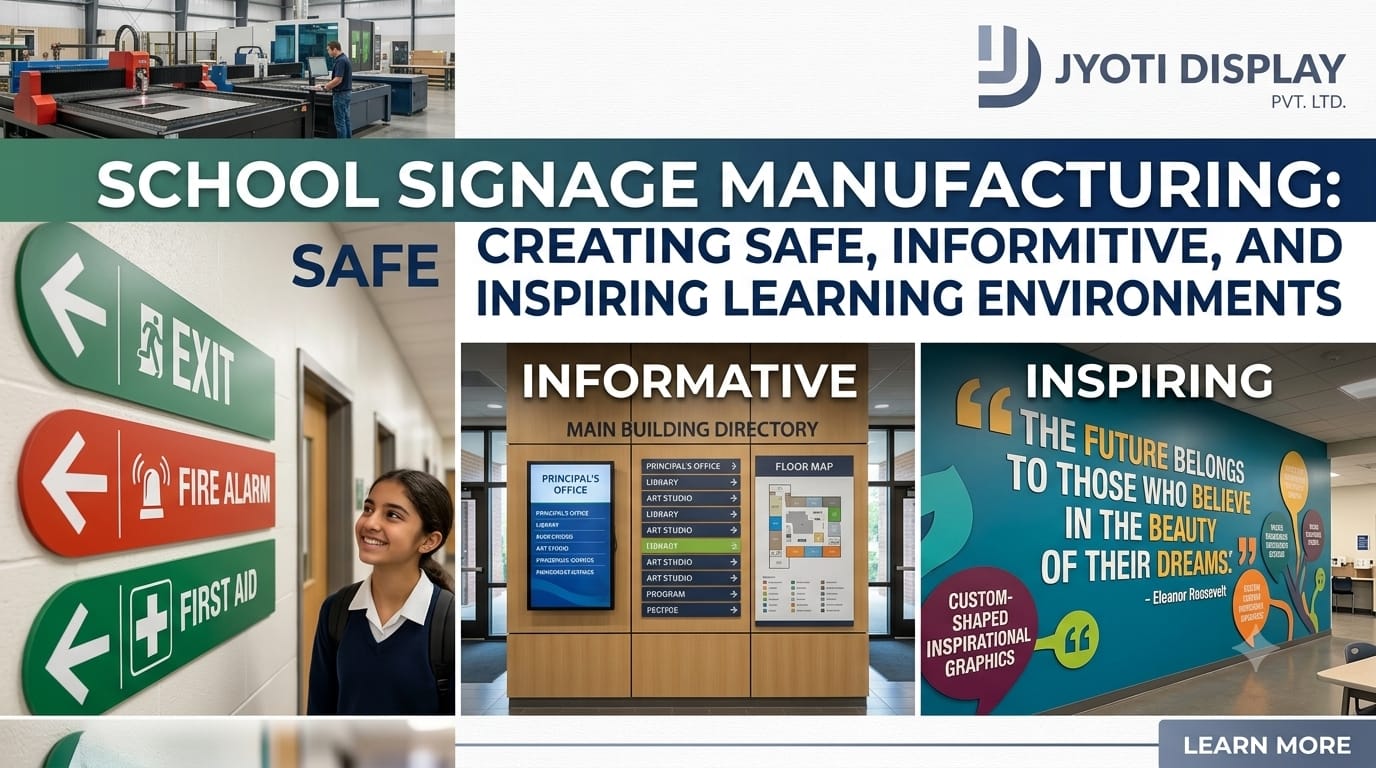
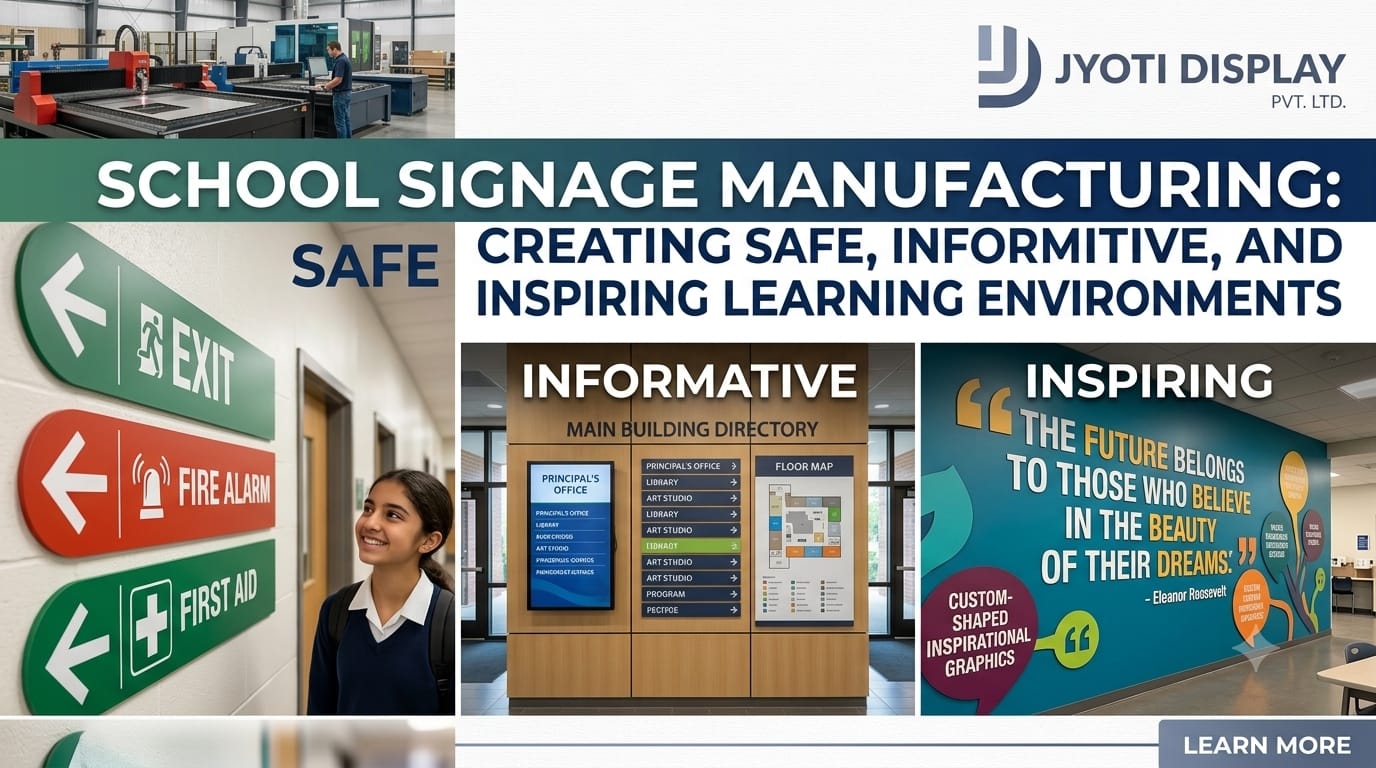
Among these elements, school signage plays an important practical and visual role. Well-designed signs help students and visitors navigate the campus, identify classrooms and facilities, understand safety instructions, locate important departments and recognize the school’s brand identity. Effective signage can make a large campus easier to understand while creating a professional, organized and welcoming atmosphere.
As educational institutions continue to invest in modern infrastructure, the demand for durable, attractive and customized signage has increased. Schools today require signage solutions that combine functionality, safety, aesthetics, visibility and long-term durability.
Jyoti Display Pvt. Ltd. specializes in the design and manufacturing of customized display and signage solutions for institutional and commercial environments. With a focus on quality manufacturing, thoughtful design and application-specific solutions, the company can develop school signage systems that are aligned with the architectural identity, operational requirements and branding of an educational institution.
This article explores the importance of school signage, different types of signs used across educational campuses, materials and manufacturing techniques, design considerations, safety requirements and how professional school signage manufacturing can transform the overall campus experience.
What Is School Signage?
School signage refers to the complete range of visual communication systems installed inside and outside an educational institution. These signs provide information, directions, identification, warnings, instructions and branding.
School signage can range from a simple classroom nameplate to a large illuminated school entrance sign. It can also include directional boards, floor directories, emergency signs, parking signs, reception signs, washroom signs, laboratory identification boards, library signs, sports-area signs and campus maps.
A properly planned signage system should allow a student, teacher, parent or first-time visitor to understand the campus without constantly asking for assistance.
For example, a visitor entering a large school campus may need to quickly find:
- Main reception
- Principal’s office
- Administration department
- Admission office
- Classrooms
- Laboratories
- Library
- Auditorium
- Playground
- Cafeteria
- Medical room
- Washrooms
- Parking area
- Emergency exits
Strategically positioned signage can make this information immediately accessible.
Why School Signage Is Important
1. Improves Campus Navigation
Large schools often have multiple buildings, floors, corridors and activity areas. New students, parents and visitors may find it difficult to navigate such spaces.
Directional school signage provides a simple visual navigation system.
Signs such as:
“Administration →”
“Library ←”
“Science Laboratory →”
“Auditorium – First Floor”
can significantly reduce confusion.
A well-planned wayfinding system creates a logical path throughout the campus.
2. Enhances Student Safety
Safety is one of the most important considerations in educational environments.
Schools require signs that communicate safety information clearly. These may include:
- Emergency exit signs
- Fire safety signs
- Assembly point signs
- No-entry signs
- Electrical hazard signs
- First-aid signs
- CCTV monitoring signs
- Staircase signs
- Fire extinguisher identification
- Restricted-area signs
- Emergency contact information
Safety signs should be easy to recognize and understand, especially during stressful situations.
The design should prioritize visibility and readability rather than unnecessary decoration.
3. Creates a Professional School Image
A school’s physical environment communicates its values.
A clean reception area with professionally manufactured signage can create a strong first impression for parents and visitors.
Entrance signage displaying the school name and logo can become an important branding element.
For example:
ABC International School
Knowledge • Character • Excellence
displayed using premium three-dimensional lettering can create a modern and professional appearance.
4. Strengthens School Branding
Schools increasingly operate in competitive educational markets. Branding is therefore becoming an important part of institutional communication.
Signage can consistently use:
- School logo
- School colors
- Typography
- Tagline
- Institutional symbols
- Brand graphics
- Architectural design language
When the same visual identity appears on the entrance sign, reception signage, classroom signs, directories and internal displays, the campus develops a cohesive identity.
Types of School Signage Manufactured for Educational Institutions
A complete school signage project usually involves several categories of signs.
1. School Entrance Signage
The main entrance sign is often the most visible signage element on the campus.
It may include:
- School name
- Logo
- Tagline
- Established year
- Address
- Institutional emblem
- Illuminated elements
Entrance signage should be visible from an appropriate distance and should complement the building architecture.
Large three-dimensional letters, acrylic signage, stainless-steel lettering, aluminum structures and illuminated channel letters can be used depending on the project requirements.
2. School Building Signage
Schools with multiple blocks may require identification signs for each building.
Examples include:
- Primary School Block
- Senior School Block
- Administration Block
- Science Block
- Sports Complex
- Performing Arts Center
- Library Building
Building identification signs help visitors quickly understand the campus layout.
Large outdoor signage may use weather-resistant materials and mounting systems designed for long-term exposure.
3. Reception Signage
Reception is usually the first indoor destination for visitors.
A professionally designed reception sign can include the school’s logo, name and tagline.
Common solutions include:
- Acrylic lettering
- Stainless-steel letters
- Backlit lettering
- 3D logo signs
- Acrylic panels
- Metal letters
- Combination signage
The reception sign should match the interior design of the school.
4. Classroom Nameplates
Classroom signage may appear simple, but it is one of the most frequently used signage categories in a school.
A classroom nameplate can display:
Class 5 – A
Mathematics – Room 204
Grade 8 – Section B
Modern schools may also use color coding, icons or educational graphics.
Classroom signs should be:
- Easy to read
- Durable
- Easy to clean
- Properly mounted
- Consistent throughout the campus
5. Laboratory Signage
Laboratories require clear identification and safety communication.
Signs may identify:
- Physics Laboratory
- Chemistry Laboratory
- Biology Laboratory
- Computer Laboratory
- Robotics Laboratory
- STEM Laboratory
- Language Laboratory
Additional signs can communicate laboratory rules and safety precautions.
For example:
LABORATORY SAFETY RULES
- Wear appropriate protective equipment.
- Follow teacher instructions.
- Do not operate equipment without permission.
- Keep work areas clean.
- Report accidents immediately.
Such signage can contribute to a safer educational environment.
6. Library Signage
A school library is a key academic facility and should be easy to locate.
Library signage may include:
LIBRARY
with an appropriate icon or school branding.
Additional signs may identify:
- Reading area
- Reference section
- Digital library
- Book issue counter
- Return counter
- Silent zone
- Computer section
Creative typography and subtle educational graphics can be used to make library signage visually appealing.
7. Auditorium and Multipurpose Hall Signage
Large schools often have auditoriums or multipurpose halls for:
- Annual functions
- Parent meetings
- Seminars
- Cultural programs
- School assemblies
- Conferences
- Competitions
Directional signs can guide visitors to the venue.
Door signs can identify the auditorium, backstage area, green room, control room and other supporting facilities.
8. Washroom Signage
Washroom signage is essential for easy identification.
Standard male, female and accessible restroom symbols can be combined with text.
For inclusive educational environments, schools may also require accessible signage with tactile or Braille elements where appropriate.
Signs should have sufficient contrast and be positioned at a practical viewing height.
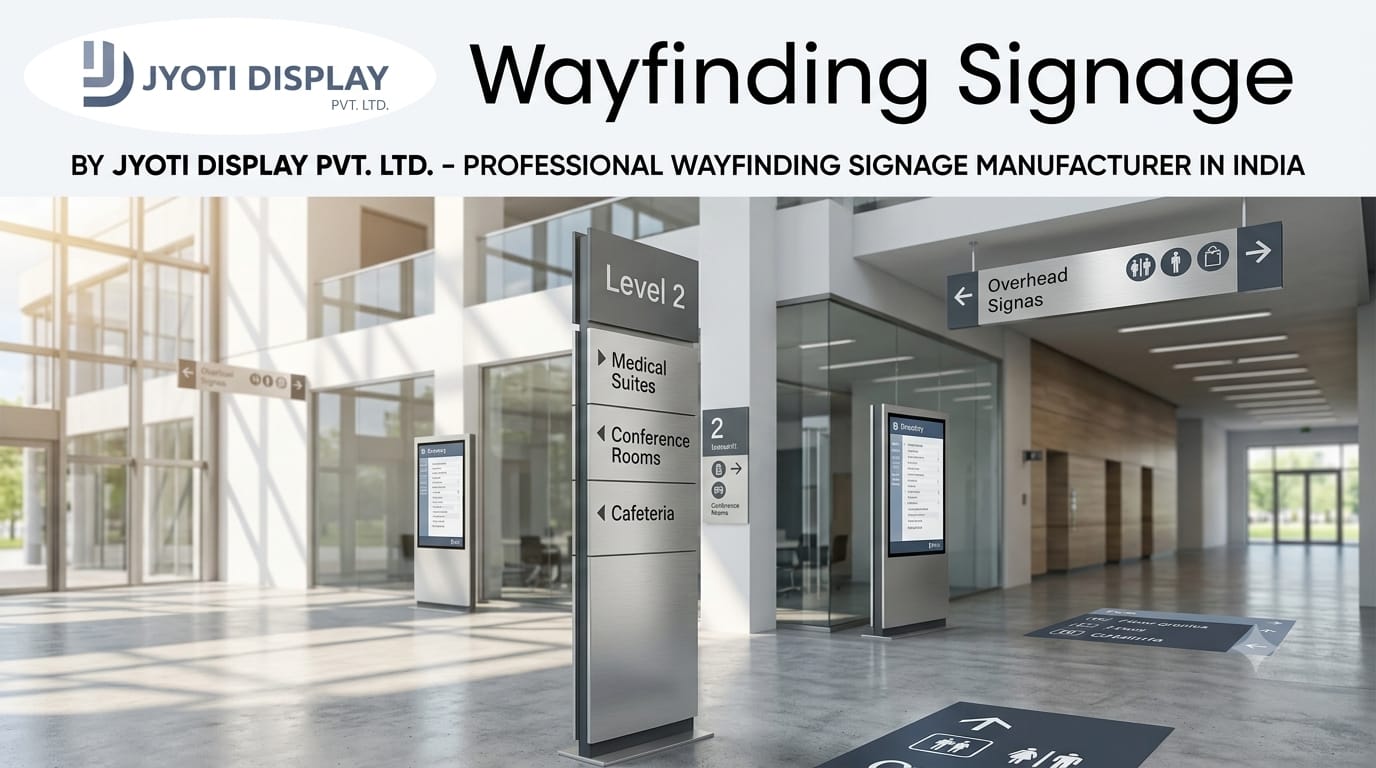
9. Directional and Wayfinding Signage
Wayfinding signage is one of the most important components of a large educational campus.
Directional boards can use:
- Arrows
- Text
- Icons
- Color coding
- Building numbers
- Floor numbers
For example:
Reception →
Admin Office →
Library ←
Sports Ground ↑
A complete wayfinding system should be planned before individual signs are manufactured.
10. Floor Directory Signs
Multi-story schools benefit from floor directory signage.
A directory may display:
Ground Floor
Reception
Administration
Principal’s Office
Conference Room
First Floor
Classrooms
Computer Laboratory
Staff Room
Second Floor
Science Laboratory
Library
Activity Room
Such directories help visitors understand the building layout quickly.
11. Staircase Signage
Staircase signs can identify:
- Floor numbers
- Building sections
- Emergency exits
- Staircase directions
- Safety instructions
Creative educational graphics can also be incorporated into staircase areas.
For example, a school may display motivational messages or subject-related illustrations along staircases.
12. Emergency Exit Signage
Emergency signage is an essential component of school infrastructure.
Signs may identify:
- Emergency exits
- Fire exits
- Evacuation routes
- Assembly points
- Fire extinguishers
- First-aid facilities
Emergency signage should be designed according to applicable safety requirements and local regulations.
Visibility is especially important in corridors, staircases and other areas where students and visitors may need quick guidance.
13. Fire Safety Signage
Schools need clear identification of fire safety equipment and procedures.
Signs may be used for:
- Fire extinguishers
- Fire hose reels
- Fire alarm points
- Fire exits
- Fire assembly areas
- Emergency equipment
These signs should remain visible and unobstructed.
14. Parking Signage
School campuses can experience significant traffic during:
- Morning arrival
- Afternoon dispersal
- Parent-teacher meetings
- School events
- Annual functions
Parking signage can help organize vehicle movement.
Examples include:
Visitor Parking
Staff Parking
School Bus Parking
Two-Wheeler Parking
No Parking
Drop-Off Zone
Clear parking signs can improve traffic management and campus safety.
15. School Bus Area Signage
Schools with dedicated transportation facilities may require signage for bus zones.
Signs can identify:
- Bus parking
- Bus waiting area
- Student boarding area
- Driver waiting area
- Transportation office
- Bus routes
These signs can be designed to remain clearly visible outdoors.
16. Playground and Sports Signage
Sports facilities can use signage for:
- Football ground
- Basketball court
- Cricket ground
- Volleyball court
- Athletics area
- Indoor sports hall
- Gymnasium
- Swimming pool
Rules and safety instructions can also be displayed.
For example:
SPORTS AREA
Please follow coach instructions.
17. Cafeteria and Dining Area Signage
Cafeteria signage can help students locate dining facilities while supporting a clean and organized environment.
Additional signs can communicate:
- Drinking water
- Hand washing
- Food service area
- Waste disposal
- Vegetarian food
- Staff dining
- Kitchen
- Restricted access
18. Medical Room Signage
A school medical room should be clearly identifiable.
A visible:
MEDICAL ROOM
sign allows students and staff to locate assistance quickly.
Appropriate medical symbols can make the sign easier to recognize.
19. Staff Room and Faculty Signage
Faculty areas can be identified using professional door signs.
Examples include:
Staff Room
Faculty Lounge
Teachers’ Resource Centre
Head of Department
These signs can follow the school’s overall signage design system.
20. Office and Administrative Signage
Administrative departments require clear identification.
Typical signs include:
- Principal’s Office
- Vice Principal
- Administration
- Accounts Department
- Admissions Office
- Examination Department
- Human Resources
- Reception
- Counselling Room
Consistent typography and materials help create a professional environment.
21. Inspirational and Educational Signage
Schools have an opportunity to use signage as part of the learning environment.
Educational wall graphics can feature:
- Inspirational quotes
- Historical information
- Scientific facts
- Mathematical concepts
- Environmental messages
- National symbols
- School values
- Student achievements
For example:
“Learn Today, Lead Tomorrow.”
or
“Every Question Is a Step Toward Discovery.”
Such signage can turn ordinary walls and corridors into educational spaces.
22. House-Wise Signage
Many schools divide students into houses.
House signage can use different colors and symbols for:
- Red House
- Blue House
- Green House
- Yellow House
These signs can be used near classrooms, sports areas and assembly zones.
23. Accessible School Signage
Modern school environments should consider accessibility.
Depending on the application and applicable requirements, signage may incorporate:
- High-contrast lettering
- Tactile characters
- Braille
- Accessible restroom symbols
- Clear pictograms
- Appropriate mounting heights
Accessible signage helps create a more inclusive environment for students, staff and visitors.
Materials Used in School Signage Manufacturing
The selection of material has a major impact on the appearance, durability and maintenance requirements of signage.
Acrylic
Acrylic is widely used for indoor school signage because it provides a clean and modern appearance.
It can be:
- Transparent
- Frosted
- Colored
- Printed
- Laser cut
- CNC cut
- Backlit
Acrylic is suitable for reception signs, classroom signs, office signs and decorative displays.
ACP – Aluminium Composite Panel
Aluminium composite panels can be used for outdoor and indoor applications.
Advantages include:
- Lightweight construction
- Good surface finish
- Weather resistance
- Easy fabrication
- Multiple finish options
ACP can be used for directional signs, building signs and larger outdoor signage structures.
Stainless Steel
Stainless-steel signage provides a premium and durable appearance.
It is commonly used for:
- Entrance letters
- Reception signage
- Premium school branding
- Institutional plaques
- 3D letters
Finishes may include brushed, mirror or coated surfaces depending on the design.
Aluminium
Aluminium is lightweight and suitable for outdoor applications.
It can be fabricated into:
- Flat signs
- Raised letters
- Directional boards
- Outdoor structures
- Nameplates
Aluminium’s corrosion resistance makes it useful for many exterior applications.
PVC and Foam Boards
PVC and foam boards are useful for lightweight indoor signs and temporary displays.
Applications may include:
- Classroom signs
- Event signs
- Promotional displays
- Educational graphics
- Temporary directional boards
Vinyl Graphics
Self-adhesive vinyl can be used for:
- Wall graphics
- Glass graphics
- Educational messages
- Safety communication
- Decorative branding
High-quality printing and proper surface preparation are important for achieving a professional finish.
3D School Signage
Three-dimensional signage can give educational institutions a distinctive identity.
The school name or logo can be fabricated using materials such as:
- Acrylic
- Stainless steel
- Aluminium
- ACP
- PVC
- Metal composites
3D letters can be:
- Flat cut
- Raised
- Front lit
- Backlit
- Halo lit
- Non-illuminated
The right option depends on the location, viewing distance, architectural design and branding requirements.
Illuminated School Signage
Illumination allows school signage to remain visible during evening events and low-light conditions.
LED technology can be incorporated into:
- Entrance signs
- Building signs
- Reception signs
- Logo signs
- Channel letters
- Directional displays
LED illumination can provide clear visibility while supporting an attractive modern appearance.
Backlit School Signage
Backlit signage creates a soft halo effect around letters or logos.
For example, a stainless-steel school logo mounted slightly away from the wall can produce a subtle glow around its edges.
This style is particularly suitable for:
- Reception areas
- Main entrances
- Administration buildings
- Auditorium entrances
- Premium school campuses
School Signage Design Considerations
Manufacturing high-quality signage begins with effective design planning.
1. Readability
The primary purpose of signage is communication.
Therefore:
- Text should be easy to read.
- Fonts should not be unnecessarily complicated.
- Contrast should be sufficient.
- Letter sizes should match viewing distance.
- Important information should receive visual priority.
2. Consistent Branding
All signs across a campus should feel like part of one system.
Consistency can be achieved through:
- Common typography
- School colors
- Standard iconography
- Consistent layouts
- Matching materials
- Repeated design elements
3. Appropriate Size
A sign that is too small may become difficult to read.
A sign that is excessively large may dominate the architecture.
The size should depend on:
- Viewing distance
- Location
- Information quantity
- Mounting height
- Building scale
4. Color Selection
Colors should support readability and school branding.
Schools can use their official brand colors while ensuring sufficient contrast between background and text.
Color coding can also help students navigate different sections.
For example:
- Blue – Academic Block
- Green – Sports Area
- Yellow – Primary Section
- Red – Administration
School Signage Manufacturing Process
Professional signage manufacturing involves multiple stages.
Step 1: Requirement Understanding
The manufacturer first studies the school’s requirements.
This may involve understanding:
- Campus size
- Number of buildings
- Number of classrooms
- Signage locations
- Branding guidelines
- Indoor and outdoor applications
- Safety requirements
- Budget
- Installation conditions
Step 2: Site Survey
A site survey helps determine the actual installation environment.
The survey may evaluate:
- Wall surfaces
- Mounting points
- Viewing distances
- Lighting conditions
- Electrical availability
- Existing signage
- Vehicle movement
- Pedestrian movement
Site measurements reduce installation-related problems.
Step 3: Design Development
After understanding the requirements, signage designs are prepared.
Design considerations include:
- Typography
- Logo placement
- Colors
- Material
- Dimensions
- Illumination
- Mounting method
For large projects, multiple design concepts may be evaluated before final approval.
Step 4: Material Selection
Materials are selected according to application.
Indoor classroom signs may require a different material than a large outdoor entrance sign.
This approach helps balance:
- Durability
- Appearance
- Cost
- Maintenance
- Installation requirements
Step 5: Cutting and Fabrication
Depending on the design, manufacturing may involve:
- Laser cutting
- CNC routing
- Bending
- Welding
- Engraving
- Drilling
- Assembly
- Surface preparation
Precision fabrication is particularly important for branded letters and complex logos.
Step 6: Surface Finishing
The appearance of signage depends heavily on finishing quality.
Possible finishing methods include:
- Powder coating
- Paint
- Brushed finish
- Polishing
- Lamination
- Vinyl application
- Printing
The finish should be selected according to environmental conditions and design requirements.
Step 7: LED and Electrical Integration
For illuminated signs, LEDs and electrical components are integrated during fabrication.
Proper electrical planning is essential for:
- Reliable illumination
- Safe operation
- Easy maintenance
- Uniform brightness
Step 8: Quality Inspection
Before installation, signage should be inspected for:
- Dimensions
- Surface finish
- Print quality
- Color accuracy
- Letter alignment
- Structural strength
- Illumination
- Electrical connections
Quality inspection helps reduce installation-stage corrections.
Step 9: Installation
The final stage is installation at the school premises.
Depending on the signage type, installation may involve:
- Wall mounting
- Stud mounting
- Hanging systems
- Pole mounting
- Frame mounting
- Standalone structures
Installation should be carried out carefully to protect both the signage and the building surface.
Indoor vs Outdoor School Signage
Not every sign requires the same construction.
Indoor Signage
Indoor signage generally experiences controlled environmental conditions.
Popular applications include:
- Classroom signs
- Office signs
- Department signs
- Reception signs
- Floor directories
- Library signs
- Laboratory signs
Materials can focus more heavily on aesthetics and lightweight construction.
Outdoor Signage
Outdoor signs must withstand environmental exposure.
They may face:
- Sunlight
- Rain
- Dust
- Humidity
- Temperature variation
- Wind
Therefore, outdoor school signage requires appropriate materials, finishes and mounting systems.
Customized School Signage Solutions
Every school has a unique identity.
A preschool may prefer colorful and playful signage, while an international school may prefer sophisticated architectural signage.
Similarly, a traditional educational institution may choose classic metal lettering and plaques.
Customization can involve:
- Dimensions
- Colors
- Shapes
- Materials
- Typography
- Icons
- Illumination
- Mounting style
- Graphics
This allows signage to become an integrated part of the campus architecture rather than an afterthought.
Digital Integration in Modern School Signage
Technology is changing the way institutions communicate.
Modern schools may combine traditional signage with digital displays.
Digital signage can be used for:
- Announcements
- Event schedules
- Welcome messages
- Emergency communication
- School achievements
- Examination notices
- Visitor information
A combination of physical wayfinding and digital communication can create a flexible campus communication system.
Sustainable School Signage
Environmental responsibility is increasingly important for educational institutions.
Schools may consider signage materials and manufacturing methods that support long-term sustainability.
Important considerations include:
- Durable materials
- Long service life
- Replaceable components
- Energy-efficient LED systems
- Reduced unnecessary replacement
- Responsible material selection
Durable signage can itself contribute to sustainability by reducing frequent replacement.
Why Professional School Signage Manufacturing Matters
School signage may appear simple, but large campus projects require careful coordination.
A professional manufacturer understands the relationship between:
Design + Material + Fabrication + Branding + Safety + Installation
If these elements are not coordinated, the final signage system may appear inconsistent or become difficult to maintain.
Professional manufacturing helps ensure that the signs are visually consistent and suitable for their intended environments.
Jyoti Display Pvt. Ltd. – School Signage Manufacturing Solutions
Jyoti Display Pvt. Ltd. focuses on customized display and signage solutions designed around the requirements of businesses, institutions and organizations.
For educational institutions, the objective is not simply to manufacture individual signs. A complete signage project should create a coherent communication system throughout the campus.
The company can support requirements involving:
- School entrance signage
- Building identification signs
- Reception signage
- Classroom signs
- Office nameplates
- Directional signage
- Wayfinding systems
- Floor directories
- Laboratory signage
- Library signage
- Auditorium signage
- Safety signage
- Parking signage
- Sports-area signage
- 3D letters
- Illuminated signage
- Branding displays
- Customized institutional signs
The exact material, design and construction can be selected according to the application and project specifications.
Advantages of Choosing a Specialized Signage Manufacturer
Better Customization
A specialized manufacturer can adapt signage to the school’s architectural and branding requirements.
Consistent Design
Large projects benefit from standardized manufacturing, helping maintain consistency throughout the campus.
Application-Specific Materials
Different environments require different materials and finishes. A professional manufacturer can recommend suitable options.
Better Quality Control
Manufacturing under controlled processes allows dimensions, finishes and components to be inspected before installation.
Integrated Project Execution
A signage project may involve design, fabrication and installation. Coordinating these stages through one experienced manufacturer can simplify project management.
School Signage for New School Construction Projects
New educational campuses provide an excellent opportunity to develop signage from the beginning.
Rather than installing signs randomly after construction, schools can create a complete signage master plan.
The plan can include:
- Main entrance identification
- Campus directory
- Building identification
- Parking and traffic signs
- Floor directories
- Classroom identification
- Department signs
- Safety signage
- Emergency evacuation signage
- Accessibility signage
- Sports-area signage
- Decorative educational graphics
This approach creates a consistent campus environment.
School Signage Renovation and Replacement
Existing schools may already have outdated signage.
Common problems include:
- Faded graphics
- Broken signs
- Inconsistent designs
- Poor visibility
- Outdated branding
- Missing directional signs
- Damaged mounting systems
A signage renovation project can modernize the campus without requiring major architectural changes.
Schools can retain useful existing signs while replacing outdated or damaged elements.
School Signage for CBSE, ICSE, International and Private Schools
Different schools may have different branding and communication requirements.
However, the core principles remain similar:
- Clear communication
- Safe navigation
- Strong branding
- Consistency
- Durability
- Accessibility
- Professional appearance
A customized signage manufacturer can develop designs according to the individual school’s identity rather than applying a generic template.
School Signage and Parent Experience
Parents frequently visit schools for:
- Admissions
- Meetings
- Events
- Fee-related work
- Parent-teacher meetings
- Student activities
- School functions
First-time visitors may not know the campus layout.
Clear signage can therefore improve the overall parent experience.
A visitor should ideally be able to enter the campus and find reception or the required department with minimal confusion.
School Signage and Student Experience
Students interact with signage every day.
Classroom identification, laboratory signs, library signs and directional displays become part of their daily environment.
Creative signage can also support school culture.
For younger students, signs can use:
- Friendly illustrations
- Simple icons
- Bright but controlled colors
- Easy-to-read typography
For senior students, schools may prefer a more mature institutional style.
The Role of Icons in School Signage
Icons can communicate information quickly.
Examples include:
- Toilet symbol
- Library symbol
- Medical symbol
- Parking symbol
- Food symbol
- Fire symbol
- Exit symbol
- Information symbol
Icons are particularly useful for visitors who may not be familiar with the school’s language.
Where possible, icons and text should work together to maximize understanding.
Multilingual School Signage
India’s diverse linguistic environment means some institutions may require signage in more than one language.
For example, a sign may display:
LIBRARY
along with its regional-language equivalent.
Multilingual signage should be carefully designed so that additional text does not reduce readability.
Typography, hierarchy and spacing become especially important in multilingual applications.
Maintenance of School Signage
Even durable signs require basic maintenance.
Schools should periodically inspect:
- Loose fittings
- Surface damage
- Faded graphics
- LED performance
- Electrical connections
- Dirt accumulation
- Broken acrylic
- Corrosion
- Missing letters
Regular maintenance helps preserve both appearance and functionality.
How to Plan a School Signage Project
Before contacting a signage manufacturer, schools can prepare a basic requirement list.
Step 1: Identify Locations
Create a list of areas requiring signage.
Step 2: Categorize Signs
Separate them into:
- Identification
- Directional
- Safety
- Branding
- Decorative
- Accessibility
Step 3: Determine Quantity
Estimate the number of signs required for each category.
Step 4: Establish Branding
Provide:
- School logo
- Brand colors
- Fonts
- Tagline
- Existing brand guidelines
Step 5: Decide Budget
A budget range helps determine appropriate materials and fabrication techniques.
Step 6: Conduct Site Survey
Measurements and photographs can help the manufacturer develop accurate designs.
Step 7: Approve Designs
Finalize designs before bulk production.
Step 8: Manufacture and Install
The final stage involves fabrication, inspection, transportation and installation.
Factors Affecting School Signage Cost
The cost of school signage depends on several factors.
These include:
- Sign dimensions
- Quantity
- Material
- Letter thickness
- Surface finish
- Printing
- 3D construction
- Illumination
- LED components
- Mounting method
- Installation height
- Structural requirements
- Site conditions
- Custom fabrication complexity
Therefore, a complete project quotation should ideally be prepared after understanding the actual requirements.
How to Choose the Right School Signage Manufacturer
Educational institutions should consider several factors before selecting a manufacturer.
Manufacturing Capability
The manufacturer should have appropriate fabrication capabilities for the required signage.
Design Capability
The company should be able to convert branding requirements into practical signage designs.
Material Knowledge
Understanding material performance is important for selecting appropriate solutions for indoor and outdoor environments.
Quality
Signage represents the institution. Poor finishing can negatively affect the campus appearance.
Installation
Correct installation is essential for safety, alignment and long-term performance.
Customization
Every school has different requirements. A manufacturer should be able to provide customized solutions.
Future of School Signage
The future of school signage is likely to combine physical and digital communication.
Traditional signs will continue to play a fundamental role because classroom identification, safety signage and wayfinding require permanent physical communication.
At the same time, digital displays can provide changing information.
Future campuses may increasingly use:
- Interactive directories
- Digital information screens
- QR-enabled information
- Smart wayfinding
- Dynamic announcement displays
- Energy-efficient illuminated signage
- Accessible communication systems
The most effective campuses may combine these technologies rather than replacing physical signage completely.
Conclusion
School signage is an essential part of modern educational infrastructure. It supports navigation, improves safety, strengthens institutional branding and contributes to a more organized campus environment.
From a large illuminated school entrance sign to a small classroom nameplate, every signage element has a role to play.
A successful school signage system should be:
Clear. Durable. Safe. Consistent. Attractive. Accessible. Brand-focused.
The right signage can help students move confidently around the campus, help visitors find their destinations, communicate safety information and reinforce the school’s identity.
Jyoti Display Pvt. Ltd. can serve as a professional partner for educational institutions looking for customized signage and display solutions. By combining design thinking, material selection, fabrication and installation, a school can develop a signage system that complements its architecture while meeting practical communication requirements.
Whether it is a new school campus, an educational institution undergoing renovation, or an established school looking to modernize its signage, professionally manufactured signage can make a meaningful difference.
A well-designed school campus communicates its values even before a class begins. Through thoughtful signage, educational institutions can create spaces that are easier to navigate, safer to use, more professional to experience and more closely connected to their unique identity.
Frequently Asked Questions About School Signage Manufacturing
What is school signage manufacturing?
School signage manufacturing is the process of designing, fabricating and installing customized signs for educational institutions. It includes entrance signs, classroom signs, directional boards, safety signs, office signs, directories, illuminated signs and branding displays.
What types of school signs can be customized?
Almost every school sign can be customized in terms of size, material, color, typography, graphics, logo, illumination and mounting method.
Which material is best for school signage?
There is no single best material for every application. Acrylic, aluminium, ACP, stainless steel, PVC and other materials can be selected according to location, durability requirements, appearance and budget.
Can school entrance signs be illuminated?
Yes. School entrance signs can incorporate LED illumination through backlighting, front lighting or illuminated channel letters, depending on the design.
Can signage include the school’s logo?
Yes. The school logo can be incorporated into entrance signs, reception signs, classroom signage, directories and other branded displays.
Can school signage be made for outdoor use?
Yes. Outdoor signage can be manufactured using suitable weather-resistant materials, finishes and mounting systems.
Do schools need wayfinding signage?
Wayfinding signage is particularly useful for large campuses, multi-building schools and institutions that receive frequent visitors.
Can school signage be bilingual?
Yes. Signage can be designed using two or more languages, provided the layout maintains adequate readability and visual hierarchy.
Can signage include Braille or tactile information?
Where required, accessible signage can incorporate tactile characters and Braille along with appropriate symbols and visual contrast, subject to applicable accessibility requirements.
Does Jyoti Display Pvt. Ltd. manufacture customized school signage?
Jyoti Display Pvt. Ltd. provides customized display and signage manufacturing solutions that can be developed according to the branding, architectural and functional requirements of educational institutions.
School Signage Manufacturing – Keywords
For search-engine optimization, this article can naturally target keywords such as:
- School signage manufacturer
- School signage manufacturing
- School sign board manufacturer
- School signage company
- School entrance signage
- School wayfinding signage
- Educational institution signage
- School display signage
- School name board manufacturer
- Classroom signage manufacturer
- School safety signage
- School directional signage
- School branding signage
- 3D school signage
- Illuminated school signage
- School signage manufacturers in India
- Customized school signage
- School sign maker
- School building signage
- School reception signage
- School directory signage
- School campus signage
- School indoor signage
- School outdoor signage
- School signage solutions
- Jyoti Display Pvt. Ltd.
- School signage manufacturing company in India
Final Takeaway
A school should not have to choose between functionality and visual appeal. With professionally planned and manufactured signage, educational institutions can achieve both.
Jyoti Display Pvt. Ltd. aims to provide customized signage solutions that help schools create organized, informative, safe and brand-focused environments.
From the main gate to the classroom corridor, every sign can become part of a unified campus communication system.