
Introduction: The Strategic Imperative of Corporate Digital Signage
In an era where visual communication has become the dominant language of commerce, Corporate Digital Signage has emerged as a cornerstone technology for enterprises seeking to inform, engage, and influence their audiences with unprecedented precision and impact. The modern corporate environment demands more than static messages and printed posters; it requires dynamic, responsive, and intelligently managed visual ecosystems that can adapt to real-time conditions and deliver measurable outcomes.
Jyoti Display Pvt. Ltd., an ISO 9001:2015 certified company based in Mumbai, India, stands at the forefront of this transformation. With over two decades of experience in manufacturing high-end signage, outdoor media, and digital signage products, the company has established itself as a comprehensive solutions provider from inception to installation . This article explores the multifaceted dimensions of Corporate Digital Signage as manufactured and delivered by Jyoti Display, examining the technological foundations, strategic applications, market dynamics, and operational considerations that define excellence in this rapidly evolving domain.
Understanding Corporate Digital Signage: Definition and Scope
Corporate Digital Signage refers to the use of digital displays—typically LCD, LED, or video wall configurations—to communicate information, branding, and messaging within corporate environments. Unlike traditional signage, which remains static and unchangeable once installed, digital signage leverages networked hardware and software platforms to deliver dynamic content that can be updated remotely, scheduled intelligently, and tailored to specific audiences or times of day.
The scope of corporate digital signage extends far beyond simple display technology. A complete solution encompasses display hardware, media players, content management software, mounting and installation infrastructure, connectivity solutions, and ongoing maintenance services. Jyoti Display’s portfolio reflects this comprehensive understanding, offering an extensive array of products including digital signage, digital displays, LED video walls, LCD video walls, interactive kiosks, and wayfinding signages designed for diverse corporate applications .
Corporate environments present unique requirements for digital signage. Unlike retail settings where promotional impact is paramount, corporate deployments must balance brand consistency with information utility, employee engagement with visitor communication, and technological sophistication with operational simplicity. The corporate sector demands solutions that integrate seamlessly with existing IT infrastructure, respect data privacy and security protocols, and deliver demonstrable return on investment through improved communication efficiency and enhanced brand perception.
The Jyoti Display Advantage: Manufacturing Excellence and Domain Expertise
A Legacy of Innovation and Quality
Founded in 2004, Jyoti Display has cultivated a reputation for manufacturing excellence that spans more than two and a half decades of industry experience . The company’s journey from traditional signage manufacturing to advanced digital display solutions mirrors the broader evolution of the visual communication industry itself. This evolution has been guided by a mission to continually upgrade production technology and quality systems, ensuring that clients receive superior quality, competitive pricing, and timely delivery .
The company operates as an accredited design and fabrication agency with a presence that extends beyond its Mumbai headquarters to Pune, Nashik, Delhi, Calcutta, and Bangalore . This geographical footprint enables Jyoti Display to serve clients across India’s major commercial centers, providing localized support while maintaining centralized quality standards. The company’s success is underscored by over 500 approved projects and a remarkable rate of more than 120 returning customers—a testament to the durability of client relationships built on consistent delivery and technical excellence .
In-House Manufacturing and Quality Assurance
Central to Jyoti Display’s competitive positioning is its commitment to in-house manufacturing. The company maintains a dedicated 24×7 research and development team that ensures continuous technological advancement, supported by the latest high-tech machinery and computer-driven processes . This vertically integrated approach allows for rigorous quality control at every stage of production, from initial design consultation through fabrication, assembly, and final testing.
The ISO 9001:2015 certification provides independent validation of Jyoti Display’s quality management systems, assuring clients that their digital signage investments are manufactured to internationally recognized standards . For corporate clients, this certification represents more than a compliance checkbox; it signals a partner committed to consistent processes, continuous improvement, and customer-focused outcomes.
Technological Foundations of Jyoti Display’s Corporate Digital Signage Solutions
Display Technologies: LED and LCD Video Walls
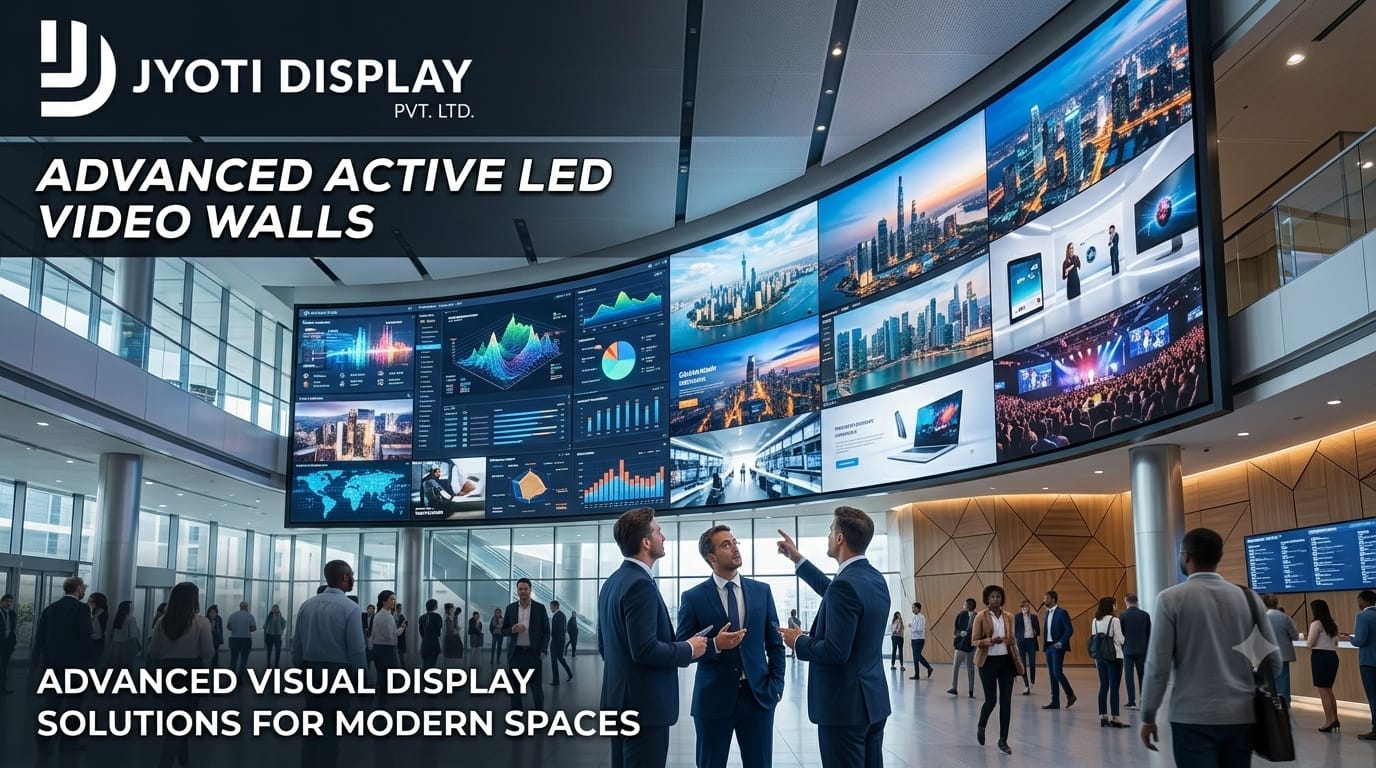
Jyoti Display’s corporate digital signage portfolio encompasses a range of display technologies suited to different applications and environments. LED video walls have emerged as a dominant force in the digital signage market, commanding 27.65% of 2025 revenue due to their immersive impact in control rooms and flagship corporate settings . These large-format displays offer several advantages for corporate environments: seamless scalability, high brightness suitable for well-lit lobbies and atriums, and exceptional durability for continuous operation.
LCD video walls complement the LED offerings, providing high-resolution imagery with excellent color accuracy for applications where fine detail and close viewing distances are priorities. Corporate training centers, executive briefing rooms, and product showrooms often benefit from LCD video wall configurations that can display multiple content streams simultaneously or present a unified canvas for immersive presentations.
The choice between LED and LCD technologies depends on multiple factors including viewing distance, ambient lighting conditions, content type, and budget considerations. Jyoti Display’s consultative approach involves working closely with corporate clients to determine the optimal technology mix for their specific environments and objectives.
Interactive Kiosks and Touchscreen Solutions
The digital signage market is witnessing a significant shift toward interactivity, with kiosks offering the fastest growth trajectory at 9.1% CAGR through 2031 . This trend is particularly relevant for corporate environments where self-service information access, wayfinding, and employee engagement applications are expanding rapidly.
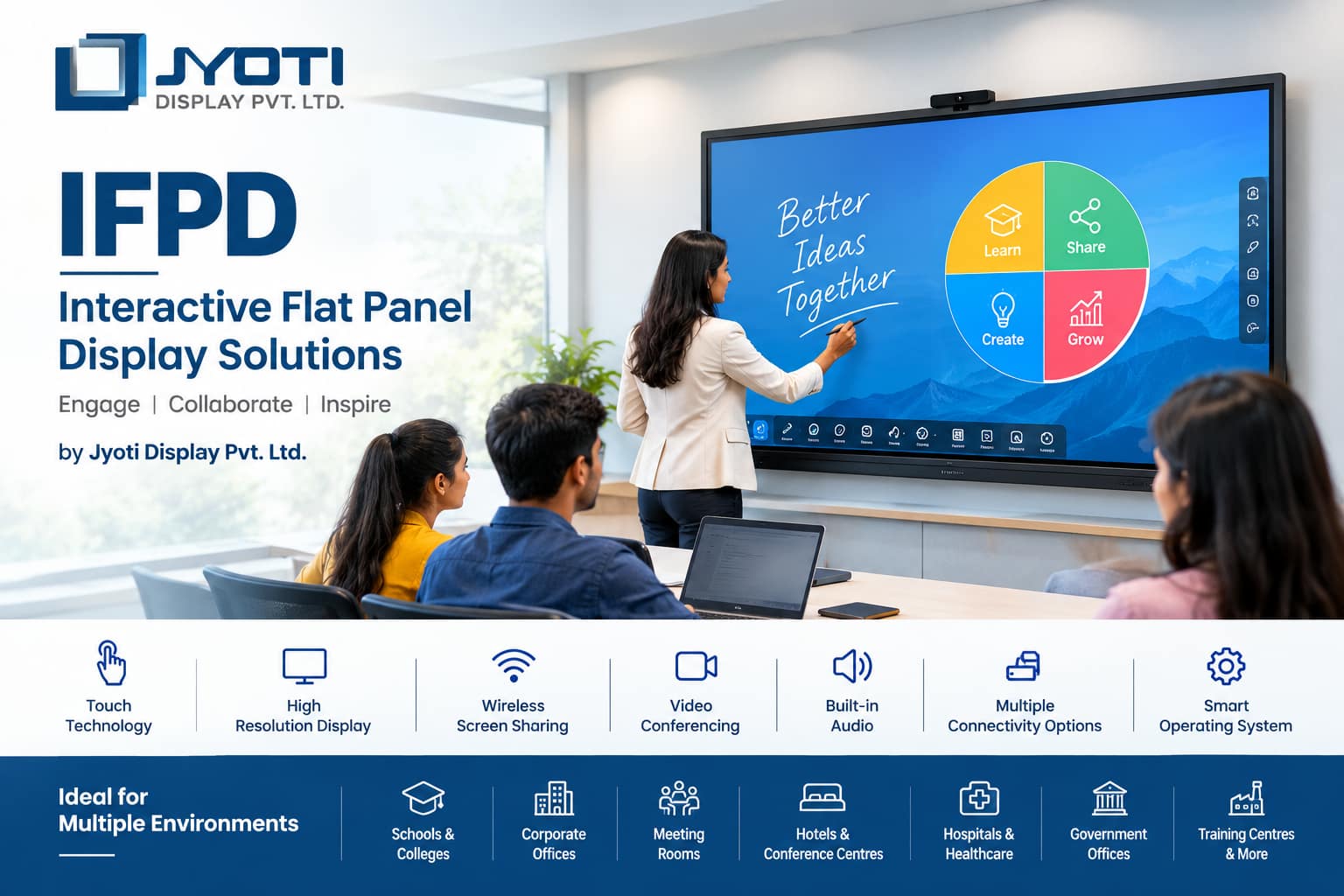
Jyoti Display manufactures interactive kiosk solutions that incorporate responsive touchscreens, intuitive user interfaces, and robust hardware designed for high-traffic corporate environments . These kiosks serve multiple corporate functions: visitor registration and check-in, building wayfinding and navigation, employee directory and information access, product or service exploration in customer-facing areas, and training or certification terminals.
The integration of AI modules within kiosk deployments is opening new possibilities for personalized experiences. Retailers deploy AI modules that recommend add-ons at checkout, and similar technology can be adapted for corporate settings to deliver tailored information based on user profiles or inquiry patterns . Transparent LCD enclosures carve a niche in luxury corporate showrooms and automotive dealerships, merging physical product visibility with digital data overlays .
Content Management and Software Platforms
Hardware constitutes approximately 60.12% of digital signage market turnover, but software revenue is growing at a double-digit 10.39% CAGR as organizations discover that content orchestration and analytics drive return on investment . Jyoti Display recognizes that successful corporate digital signage depends on robust, intuitive content management capabilities that empower non-technical users to create, schedule, and distribute content without extensive training.
Modern corporate digital signage platforms are evolving beyond simple content management to become intelligent business infrastructure . Cloud dashboards secure fleet uptime through remote diagnostics, while AI schedulers improve campaign relevance . The integration of proof-of-play ledgers allows organizations to audit content exposure, providing accountability and enabling data-driven optimization.
The digital signage software landscape emphasizes several key capabilities for corporate deployments: centralized content management across distributed screen networks, role-based access controls for content creators and approvers, integration with enterprise systems including calendars, HR platforms, and IoT devices, and analytics dashboards that measure engagement and operational performance .
Applications of Corporate Digital Signage Across Industry Verticals
Corporate Communications and Employee Engagement
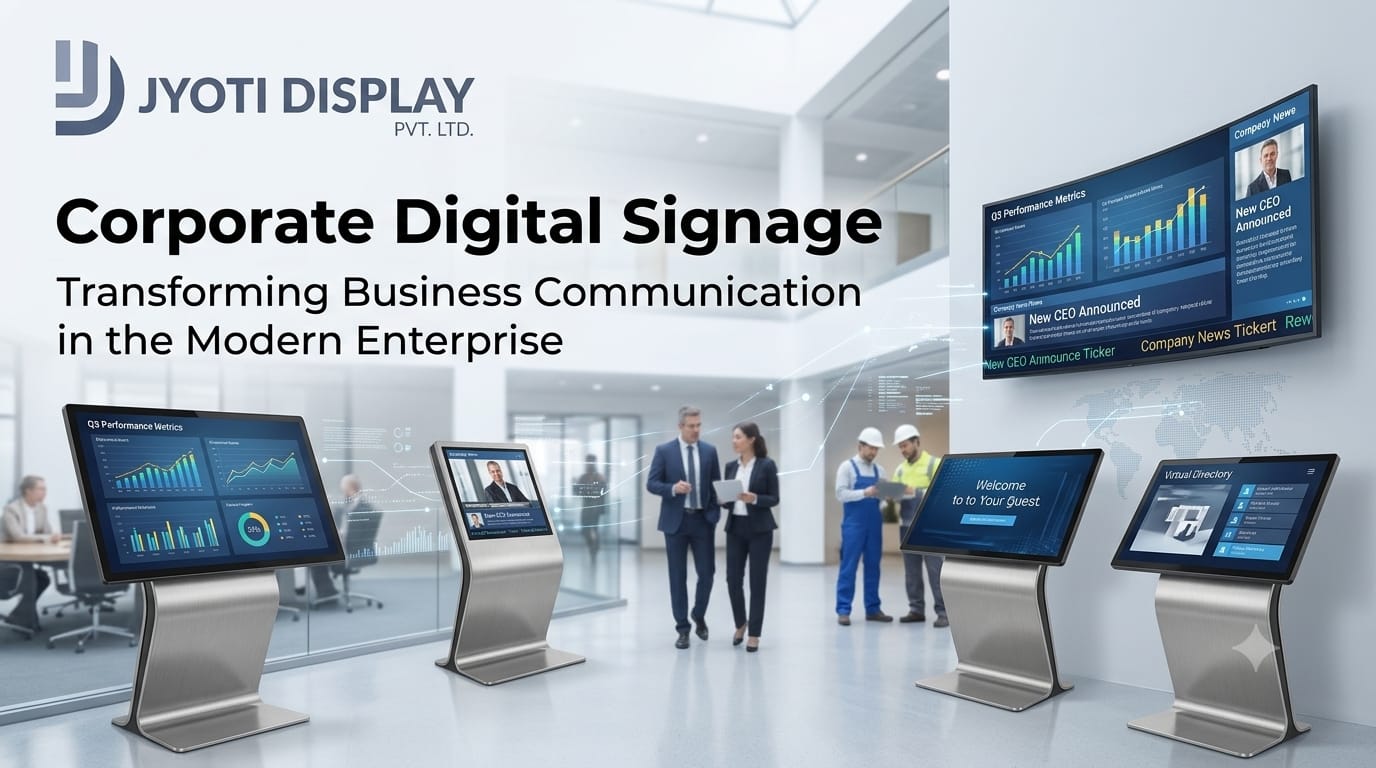
Internal communications represent one of the most compelling applications for corporate digital signage. Organizations deploy digital displays in lobbies, elevator banks, cafeterias, break rooms, and corridors to deliver timely information to employees and visitors. Content may include company announcements, performance metrics and dashboards, event calendars and reminders, employee recognition and achievements, training and development opportunities, and emergency notifications and safety information.
The post-pandemic hybrid work model has accelerated adoption of cloud-based digital signage dashboards that connect remote and on-site employees through shared visual communication channels . Digital signage becomes a unifying thread that keeps distributed workforces informed and aligned with organizational priorities.
Wayfinding and Environmental Navigation
Jyoti Display has established particular expertise in wayfinding signage, a critical application for large corporate campuses, hospitals, universities, and transit hubs . Digital wayfinding solutions transform static directional signage into dynamic, interactive navigation tools that can adapt to changing conditions, provide multiple language options, and integrate with mobile applications for seamless visitor experiences.
Interactive wayfinding kiosks enable visitors to locate offices, conference rooms, amenities, and services with intuitive touchscreen interfaces. These systems can calculate optimal routes, provide estimated walking times, and even send directions to users’ mobile devices for continued guidance. For corporate campuses with multiple buildings or complex floor plans, digital wayfinding significantly reduces visitor confusion and staff time spent providing directions.
Retail Media and Digital Out-of-Home Advertising
Corporate digital signage increasingly intersects with retail media and Digital Out-of-Home (DOOH) advertising, creating new revenue opportunities for enterprises with high-traffic locations . Shopping malls, airports, transit stations, and mixed-use developments can monetize their screen networks by displaying targeted advertising alongside informational content.
The corporate sector participates in this trend through employee-facing networks that feature relevant brand partnerships, through customer-facing installations that enhance the retail experience while generating advertising revenue, and through DOOH networks in corporate-owned public spaces. Jyoti Display’s experience in both signage manufacturing and outdoor media positions the company to support clients exploring these convergence opportunities .
Healthcare, Education, and Hospitality Applications
While this article focuses on corporate digital signage, the applications extend naturally into adjacent sectors where Jyoti Display serves clients. Hospitals and clinics use digital signage for patient information, wayfinding, staff communication, and health education. Universities deploy digital displays for campus navigation, event promotion, emergency alerts, and student engagement. Hotels and hospitality venues leverage digital signage for guest information, conference room scheduling, and brand experience enhancement .
The digital signage market’s segmentation reflects this diversity, with corporate and BFSI (Banking, Financial Services, and Insurance) representing a significant end-user vertical alongside government, retail, transportation, and entertainment . Jyoti Display’s portfolio addresses these varied requirements through customizable solutions built on common manufacturing and software platforms.
Market Dynamics: The Digital Signage Landscape in 2026 and Beyond
Global Market Growth and Regional Dynamics
The global digital signage market continues its robust expansion, with Asia-Pacific emerging as a particularly dynamic region. The region is on an 8.42% CAGR trajectory, propelled by China’s city cluster projects, Japan’s technology export push, India’s mall boom, and Southeast Asia’s tourism recovery . An integrated supply chain for panels and integrated circuits lowers unit costs, giving regional buyers price latitude that boosts market penetration .
India specifically represents a major digital signage opportunity, driven by electronics manufacturing strength, smart cities initiatives, public transit modernization, mall development, telecom connectivity, high urban footfall, and strong consumer acceptance of screen-based experiences . Jyoti Display’s Indian manufacturing base positions the company advantageously to serve this growing domestic market while also addressing export opportunities.
North America held 33.08% of 2025 digital signage income, anchored by United States corporate refurbishments that turned lobbies into digital-first showcases . European markets record stable gains supported by ecodesign mandates and high purchasing power, though historic-district signage caps add compliance considerations .
Technology Trends Shaping Corporate Digital Signage
Several technological trends are reshaping the corporate digital signage landscape in 2026 and beyond:
AI-Powered Content Operations: Artificial intelligence is eliminating laborious work from digital signage management, with content creation, translation, localization, scheduling, monitoring, and optimization becoming increasingly automated . AI enables enterprises to create more personalized experiences while operating larger screen networks effectively.
Connected Enterprise Ecosystems: Organizations expect digital signage platforms to integrate seamlessly with enterprise applications, collaboration tools, APIs, point-of-sale systems, IoT infrastructure, and real-time business data . This integration enables every digital signage display to reflect real-time business conditions and become part of broader enterprise operations.
Cloud-Native and Flexible Deployments: Support for cloud-native architectures, browser-based distribution, System-on-Chip displays, smart TVs, and mixed operating systems makes deployments faster and more flexible . This allows digital signage companies to accommodate a wider spectrum of customer environments while minimizing deployment complexity and operational expenses.
5G and Edge Computing: Transit authorities in Tokyo, Seoul, Singapore, and Sydney use millimetre-wave 5G backbones to push ultra-low-latency video and emergency alerts to outdoor LED boards. On-device edge servers pre-cache high-resolution clips, cutting data transit costs and letting campaigns switch instantly when foot-traffic sensors spike .
Sustainability and Energy Efficiency: EU corporate sustainability mandates are accelerating adoption of energy-efficient MicroLED and e-paper signage . Corporate clients increasingly prioritize energy-class A displays that reduce operational costs while meeting environmental objectives.
Challenges and Considerations
Despite strong growth prospects, the digital signage market faces several challenges that corporate buyers and manufacturers must navigate:
Fragmented CMS Standards: Global retailers often juggle screens from several brands yet find no common protocol for scheduling or analytics. The International Telecommunication Union warns that lack of interoperability slows deployments and raises total ownership costs . Many firms lock into single-vendor ecosystems, limiting competitive bids.
Total Cost of Ownership: Deploying digital signage across multiple locations can require substantial upfront and ongoing investment. Costs typically include displays, media players, installation, networking, software licenses, maintenance, and periodic hardware replacement . In emerging economies, these expenses can be harder to absorb, and connectivity and power reliability issues can increase operating costs.
Cybersecurity Vulnerabilities: Ransomware on transit displays has spotlighted cybersecurity vulnerabilities in digital signage networks . Corporate deployments must incorporate robust security measures including encrypted media pipelines, role-based access controls, and automated patching frameworks .
Content Refresh Fatigue: Small retailers and corporate departments may experience content refresh fatigue that causes ROI concerns . Successful deployments require ongoing content strategy and governance to maintain engagement and justify continued investment.
Jyoti Display’s Corporate Digital Signage Solutions: A Detailed Examination
Product Portfolio Overview
Jyoti Display offers a comprehensive range of digital signage products tailored to corporate requirements :
Digital Signage Displays: Available in various sizes and configurations, these displays serve as the foundational hardware for corporate communication networks. Options include standalone displays for individual locations, networked displays for enterprise-wide deployments, and specialized formats for specific applications.
LED Video Walls: Large-format LED displays that create immersive visual experiences for lobbies, atriums, control rooms, and event spaces. These walls can be configured in custom shapes and sizes to fit architectural requirements.
LCD Video Walls: High-resolution LCD configurations ideal for applications requiring fine detail, close viewing distances, and precise color reproduction. Suitable for executive briefing centers, training rooms, and showrooms.
Interactive Kiosks: Touchscreen-enabled self-service terminals for wayfinding, information access, registration, and engagement applications. Available in freestanding, wall-mounted, and countertop configurations.
Wayfinding Signages: Digital navigation solutions that guide visitors through complex corporate environments with intuitive interfaces and dynamic content.
Digital Displays: General-purpose digital displays for information dissemination, advertising, and communication applications.
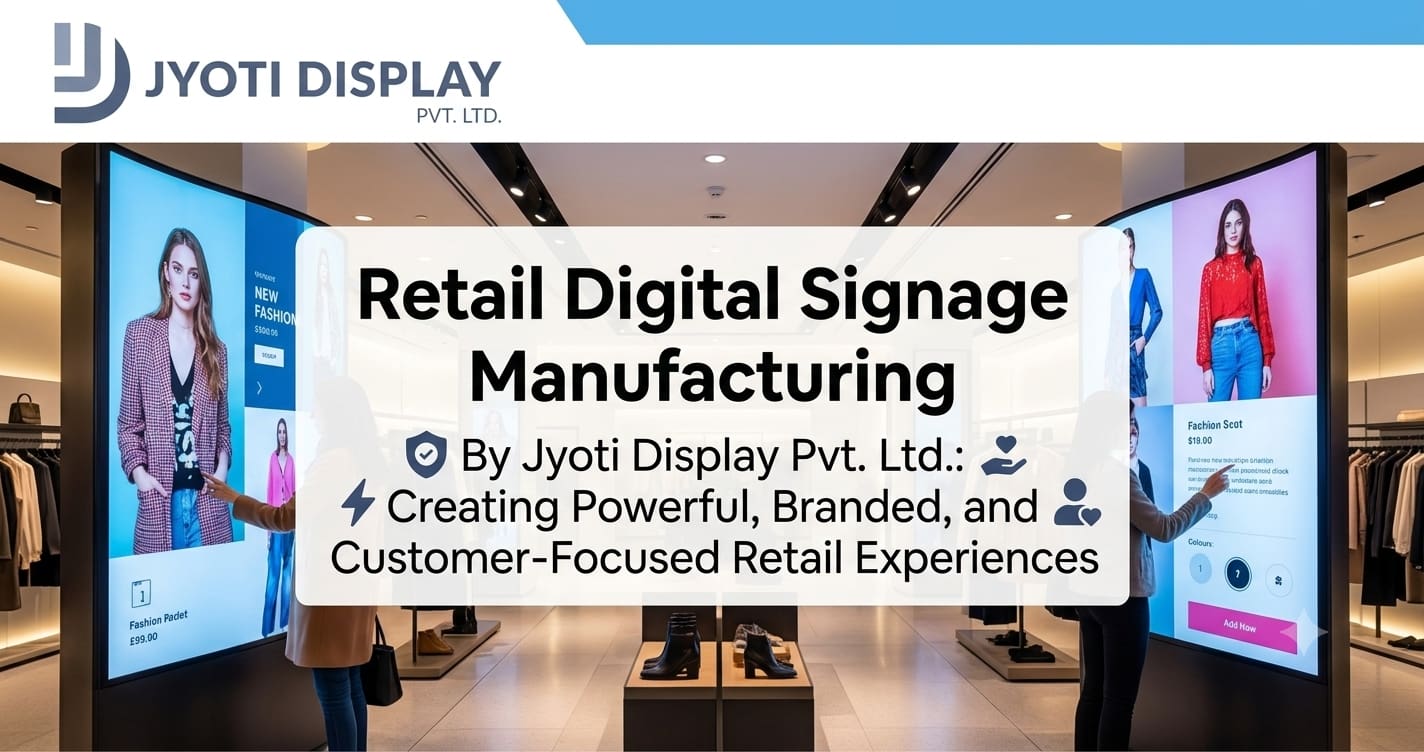
Retail Fixtures and Window Displays: Specialized digital signage integrated into retail environments, including transparent displays and interactive product showcases.
Customization and Design Capabilities
Jyoti Display distinguishes itself through design and fabrication capabilities that enable customized solutions tailored to specific corporate requirements . The company’s design consultancy services for OOH signage and wayfinding signage extend to digital applications, ensuring that digital signage integrates harmoniously with architectural and brand environments .
The ability to transform a concept drawing into a tangible, high-quality reality positions Jyoti Display as a partner for brands seeking impactful visual communication solutions . This capability is particularly valuable for corporate clients with unique spaces, specific brand guidelines, or specialized functional requirements that off-the-shelf solutions cannot address.
End-to-End Project Delivery
Jyoti Display provides comprehensive solutions from inception to installation . This end-to-end approach encompasses:
Consultation and Needs Assessment: Understanding client objectives, environmental constraints, audience characteristics, and technical requirements.
Design and Engineering: Developing custom solutions that meet aesthetic, functional, and budgetary parameters.
Manufacturing and Fabrication: In-house production using advanced machinery and quality-controlled processes.
Installation and Integration: Professional installation that ensures proper mounting, connectivity, and system integration.
Ongoing Support and Maintenance: Post-installation services including technical support, content management assistance, and hardware maintenance.
This comprehensive approach reduces the coordination burden on corporate clients who might otherwise need to manage multiple vendors for different project components.
Strategic Implementation: Best Practices for Corporate Digital Signage
Defining Objectives and Success Metrics
Successful corporate digital signage deployments begin with clear objectives. Organizations should define what they aim to achieve: improved internal communication, enhanced visitor experience, increased employee engagement, operational efficiency gains, or revenue generation through advertising. Each objective implies different content strategies, hardware configurations, and success metrics.
As digital signage becomes more closely integrated with enterprise operations, organizations are expanding success metrics beyond screen uptime and proof of play. Performance is increasingly evaluated through customer engagement, operational efficiency, workforce productivity, revenue contribution, and the ability to support broader business objectives .
Content Strategy and Governance
Content is the lifeblood of digital signage. Without compelling, relevant, and timely content, even the most sophisticated hardware investment fails to deliver value. Corporate digital signage content strategies should address:
Content Types: Balancing informational, promotional, educational, and entertainment content to maintain audience interest.
Content Sources: Determining whether content will be created internally, sourced from partners, or generated automatically from data feeds.
Update Frequency: Establishing schedules for content refresh that maintain relevance without creating unsustainable production burdens.
Approval Workflows: Implementing governance processes that ensure content accuracy, brand compliance, and appropriate messaging.
Localization: Adapting content for different languages, cultural contexts, and regional requirements.
Modern digital signage software platforms support these requirements through template libraries, scheduling tools, role-based permissions, and integration with enterprise content systems .
Hardware Selection and Placement
Hardware selection should align with content requirements, environmental conditions, and budget constraints. Key considerations include:
Display Size and Resolution: Matching display specifications to viewing distances and content detail requirements.
Brightness: Ensuring visibility in ambient lighting conditions, particularly for lobby and atrium installations with significant natural light.
Durability: Selecting displays rated for continuous operation in corporate environments.
Connectivity: Determining network requirements for content delivery and remote management.
Mounting: Planning for wall-mount, ceiling-mount, freestanding, or custom installation configurations.
Strategic placement maximizes return on investment by ensuring displays reach intended audiences at optimal moments. Corporate environments offer numerous placement opportunities: entrances and lobbies, elevator banks and waiting areas, cafeterias and break rooms, corridors and walkways, conference room exteriors, and executive areas.
Integration with Enterprise Systems
The most sophisticated corporate digital signage deployments integrate with enterprise systems to deliver dynamic, data-driven content . Integration possibilities include:
Calendar Systems: Displaying meeting schedules, room availability, and event information.
HR Platforms: Sharing employee announcements, recognition, and training opportunities.
Business Intelligence Tools: Presenting real-time performance dashboards and metrics.
IoT Sensors: Adapting content based on environmental conditions, occupancy, or other sensor data.
Point-of-Sale Systems: Displaying product information, pricing, and promotional content in retail corporate settings.
These integrations transform digital signage from a standalone communication tool into an intelligent component of enterprise infrastructure.
The Future of Corporate Digital Signage
Emerging Technologies and Capabilities
The digital signage industry continues to evolve rapidly, with several emerging technologies poised to reshape corporate deployments:
Artificial Intelligence and Machine Learning: AI is expected to play a much larger role in how digital signage software delivers value . Applications include automated content generation, predictive scheduling based on audience patterns, real-time personalization, and intelligent diagnostics.
Computer Vision and Audience Analytics: Privacy-preserving computer vision technologies enable anonymous audience measurement, content optimization based on viewer demographics, and interactive experiences triggered by presence or gestures.
Augmented Reality Integration: AR-enabled digital signage creates immersive experiences that blend physical and digital environments, with applications in product visualization, wayfinding, and training.
Voice and Gesture Interfaces: Natural user interfaces expand accessibility and engagement opportunities beyond touchscreen interaction.
Sustainable Display Technologies: Energy-efficient MicroLED, e-paper, and other emerging display technologies reduce power consumption and environmental impact.
The Evolution Toward Intelligent Experience Infrastructure
The digital signage industry is undergoing a fundamental transformation from display networks to intelligent experience infrastructure . This evolution positions digital signage as a strategic layer of connected physical environments, combining visual communication, data, automation, and measurable engagement.
The next phase will favor providers that deliver secure, AI-enabled, energy-efficient, accessible, and interoperable signage ecosystems . Organizations that align content, compliance, analytics, and operations will be best positioned to capture value as digital signage evolves.
For manufacturers like Jyoti Display, this evolution demands continued investment in research and development, software capabilities, and integration expertise. The company’s established commitment to innovation, evidenced by its 24×7 R&D team and continuous technology upgrades, positions it to navigate this transformation successfully .
Conclusion: Choosing the Right Partner for Corporate Digital Signage
Corporate digital signage represents a significant investment with the potential to transform how organizations communicate with employees, customers, and visitors. The technology offers unprecedented flexibility, measurability, and engagement compared to traditional signage approaches. However, realizing this potential requires careful planning, appropriate technology selection, and partnership with a manufacturer who understands both the technical and strategic dimensions of digital signage deployment.
Jyoti Display Pvt. Ltd. brings to this challenge a unique combination of manufacturing expertise, design capability, and end-to-end project delivery experience. The company’s ISO 9001:2015 certification, 24×7 R&D commitment, and track record of over 500 approved projects and 120+ returning customers provide assurance of quality and reliability . Its comprehensive product portfolio addresses diverse corporate requirements, from simple digital displays to complex interactive video walls and kiosk networks.
As the digital signage market continues its robust growth trajectory, driven by AI, cloud computing, 5G connectivity, and evolving workplace communication needs, Jyoti Display stands positioned to serve corporate clients seeking to harness the power of visual communication. The company’s ability to transform concept drawings into tangible, high-quality realities—delivered with competitive pricing and timely execution—makes it a compelling partner for organizations embarking on or expanding their digital signage journeys .
For corporate decision-makers evaluating digital signage investments, the key considerations extend beyond hardware specifications to encompass the total solution: content management capabilities, integration potential, ongoing support, and the manufacturer’s capacity to evolve with changing requirements. Jyoti Display’s comprehensive approach addresses each of these dimensions, offering corporate clients a partnership that extends far beyond the initial installation.