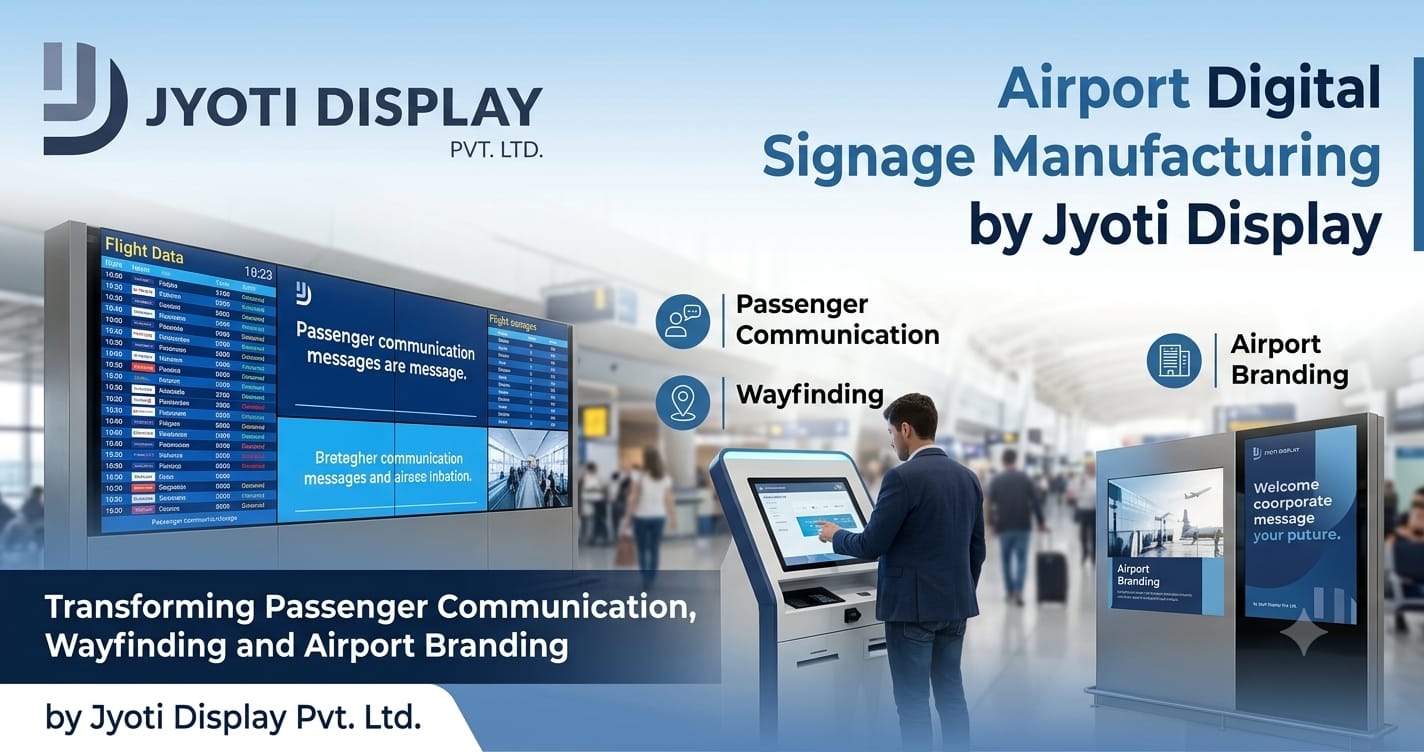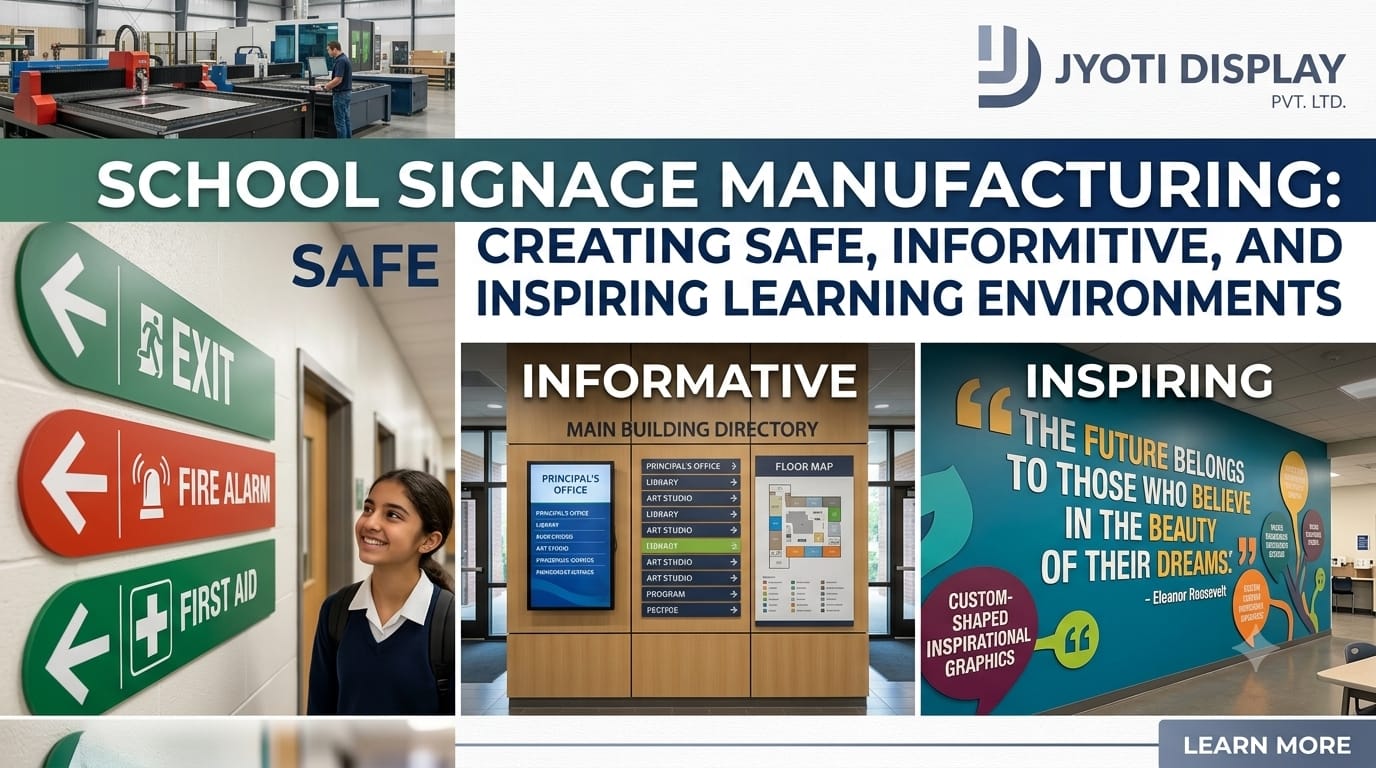

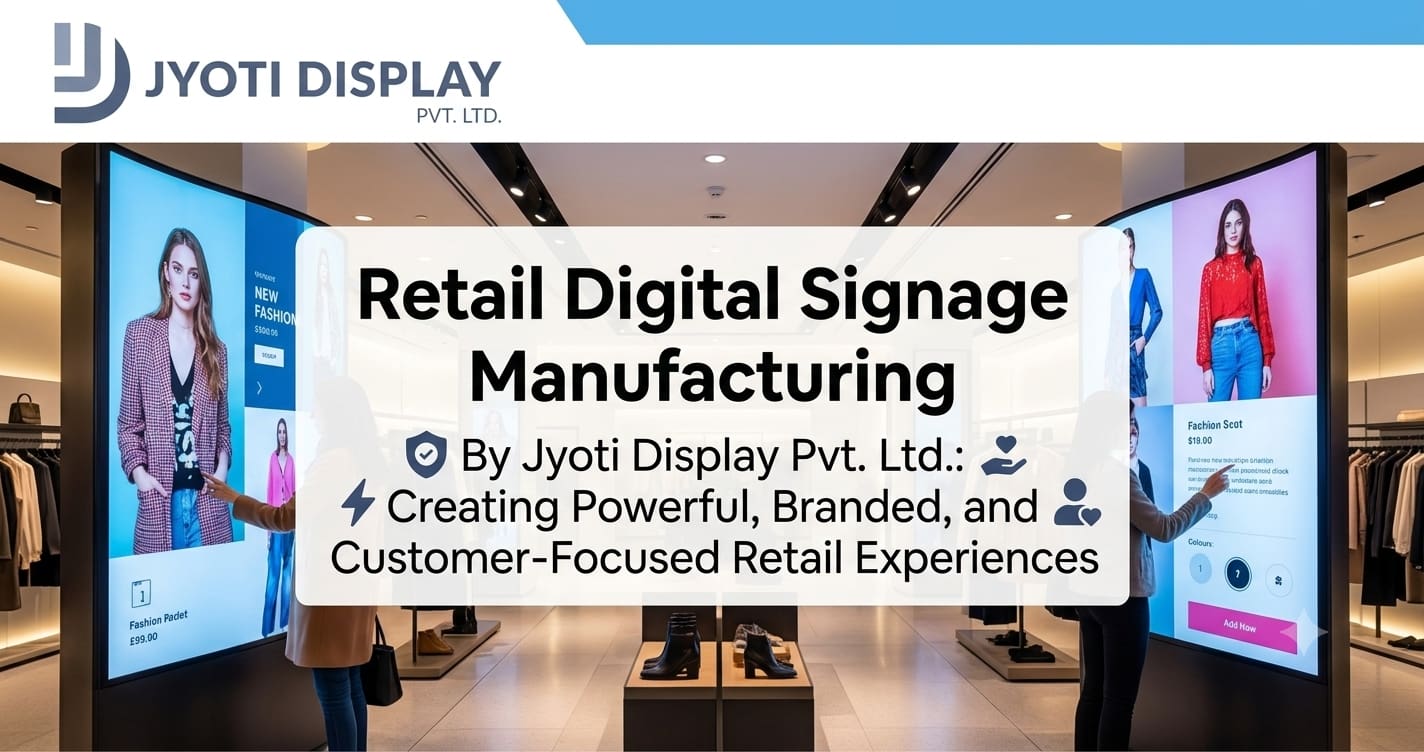
Retail Signage Manufacturing by Jyoti Display Pvt. Ltd. is an essential part of modern retail branding, store communication, customer navigation and visual merchandising. In a competitive retail environment, a store is no longer judged only by the products it sells. Customers also notice the storefront, brand identity, product communication, promotional messages, navigation system, lighting, displays and overall shopping environment.
Retail signage connects all these elements. A professionally planned signage system can help customers recognize a store, understand its brand, locate departments, discover products, identify promotions and move comfortably through the shopping environment. Modern retail signage can include exterior signs, illuminated signs, window graphics, indoor wayfinding, department signs, promotional displays, point-of-purchase communication, wall graphics, digital displays and customized brand installations.
For more than two decades, Jyoti Display Pvt. Ltd. has worked in retail fixtures, displays, static signage and digital display solutions. According to the company’s profile, Jyoti Display operates from Mumbai and Nashik, has an 80,000-square-foot factory, and provides design, manufacturing, installation and service capabilities for retail environments. (Jyoti Display Pvt Ltd)
This article explains the importance of retail signage, major types of retail signage, materials, design principles, manufacturing considerations, applications and how a professional retail signage manufacturer such as Jyoti Display Pvt. Ltd. can help businesses create consistent and memorable retail environments.
1. What Is Retail Signage?
Retail signage refers to the visual communication used inside, outside and around a retail store to communicate information to customers and strengthen a brand’s identity.
It can include a simple store name board, an illuminated storefront logo, department identification sign, promotional display, product information board, directional sign, window graphic or large-format digital screen.
Retail signage has several purposes:
- Attracting customers
- Identifying the store
- Communicating the brand
- Promoting products
- Highlighting offers
- Guiding customers
- Identifying departments
- Improving navigation
- Providing product information
- Supporting visual merchandising
- Creating a premium shopping environment
- Communicating campaigns and seasonal promotions
Modern retail signage should therefore be viewed as a complete communication system rather than a collection of individual boards.
A successful signage system connects the customer’s journey from outside the store to the entrance, shopping aisles, product areas, checkout counter and exit.
2. Why Retail Signage Is Important for Modern Businesses
Retail stores operate in highly competitive environments. Customers may pass several competing stores before deciding where to enter.
The first visual impression can therefore be extremely important.
A well-designed storefront sign can communicate:
Who are you?
What do you sell?
What makes your store different?
Where is your store located?
Why should customers enter?
Once the customer enters, interior signage takes over.
It can answer:
Where is the product I need?
Which department should I visit?
Where is the billing counter?
Where are special offers located?
Where can I find a particular category?
Retail signage therefore works throughout the customer journey.
Contemporary retail guidance commonly divides signage into exterior/storefront signage, interior and wayfinding signage, promotional or point-of-purchase signage, and digital or interactive signage. (Shopify)
3. Retail Signage as a Brand-Building Tool
A retail store is a physical representation of a brand.
Everything from the logo to the typography, colors, materials and lighting contributes to the customer’s perception of the business.
Retail signage should therefore be designed according to the brand’s visual identity.
For example:
- A luxury retailer may use premium metal, acrylic, backlighting and sophisticated typography.
- A fashion retailer may use creative illuminated lettering and large graphic displays.
- A supermarket may prioritize clear category and aisle signage.
- An electronics retailer may use digital displays and product information screens.
- A children’s store may use colorful graphics and playful shapes.
- A jewellery store may prefer elegant materials and subtle illumination.
- A pharmaceutical store may prioritize clarity, readability and easy navigation.
The signage should feel like part of the same brand family.
This is particularly important for retailers operating multiple outlets.
A consistent signage system allows customers to recognize the brand whether they visit a store in Mumbai, Nashik, Pune, Delhi, Bengaluru, Hyderabad or another city.
4. Retail Signage Manufacturing by Jyoti Display Pvt. Ltd.
Jyoti Display Pvt. Ltd. combines design, manufacturing and installation to create retail display and signage solutions.
The company’s published profile describes it as a professional designer and manufacturer of retail fixtures based in Mumbai and Nashik, specializing in store fixtures, shop fittings, displays and retail equipment. It also identifies static signage and digital display among its capabilities. (Jyoti Display Pvt Ltd)
The company’s manufacturing capabilities include products using materials such as:
- Stainless steel
- Aluminium
- Metal
- HDF with PU finish
- Modular furniture
- Corian
- Acrylic and other signage materials depending on project requirements
This integrated approach can be particularly useful for retailers requiring multiple elements for a store rollout.
Instead of treating signage, fixtures and displays as completely separate components, a coordinated manufacturing process can help maintain consistency in:
- Dimensions
- Finishes
- Colors
- Branding
- Materials
- Construction quality
- Installation
- Store-level execution
5. Major Types of Retail Signage
A professional retail signage strategy may include several different signage formats.
5.1 Storefront Signage
The storefront sign is usually the first major visual communication customers see.
It identifies the store and communicates the brand name.
Common storefront solutions include:
- ACP signage
- Acrylic signage
- 3D letters
- LED illuminated letters
- Backlit signs
- Front-lit signs
- Channel letters
- Halo-lit letters
- Light boxes
- Metal letters
- Stainless-steel letters
- Aluminium signage
- Customized fascia signage
The correct option depends on the brand identity, storefront architecture, viewing distance, lighting conditions and local installation requirements.
6. Illuminated Retail Signage
Illumination can make a retail sign more visible, especially during evening hours or in shopping environments where many stores compete for attention.
Popular illuminated solutions include:
Front-lit signage
Light is directed toward the face of the letters or logo.
Backlit signage
Light is positioned behind the letters, creating a halo effect.
Edge-lit acrylic
Acrylic elements are illuminated around their edges to create a modern appearance.
LED channel letters
Individual letters are fabricated and illuminated using LED systems.
LED light boxes
Graphics are installed in an illuminated enclosure.
Illumination should not simply be added for brightness. It should be designed according to the brand’s character and the viewing environment.
7. Retail Window Signage
Store windows provide valuable communication space.
Window signage can be used for:
- New product launches
- Seasonal campaigns
- Discounts
- Festival promotions
- Brand campaigns
- Membership programs
- Opening announcements
- Store timings
- Product categories
- Promotional messages
Window graphics can be temporary or permanent.
For example, a retailer might use one campaign during Diwali, another during Christmas, another during a summer sale and another for a new collection.
Because promotional communication changes frequently, removable or replaceable graphic systems can be more practical than permanently fabricated structures.
8. Retail Wayfinding Signage
Wayfinding signage helps customers understand where they are and where they need to go.
It is especially important in:
- Department stores
- Supermarkets
- Shopping malls
- Large-format retail stores
- Furniture stores
- Electronics stores
- Fashion outlets
- Hypermarkets
- Lifestyle stores
- Multi-level retail environments
Typical wayfinding signage includes:
- Direction arrows
- Department signs
- Aisle signs
- Category boards
- Floor directories
- Store maps
- Entrance and exit signs
- Checkout signs
- Customer service signs
- Washroom signs
- Parking directions
Effective wayfinding should be simple.
Customers should not have to stop and study a complicated sign to understand it.
The sign should communicate the information needed at the correct decision point.
9. Retail Aisle and Department Signage
Large retail stores can become confusing without proper category identification.
Aisle and department signs can divide a store into logical zones.
For example:
Grocery
Personal Care
Home Appliances
Fashion
Footwear
Electronics
Furniture
Sports
Toys
Beauty
Each department can have a consistent visual system.
The typography, colors, icons and placement should follow the overall store branding.
A well-planned system allows customers to scan the store visually and quickly understand where categories are located.
10. Promotional Retail Signage
Promotional signage communicates offers, discounts, product launches and seasonal campaigns.
Examples include:
- SALE signs
- Discount boards
- Festive campaign signs
- New arrival displays
- Limited-time offers
- Buy-one-get-one promotions
- Membership promotions
- Loyalty program communication
- Product launch graphics
- Clearance signs
Promotional signage should be highly visible but should not create visual clutter.
A common mistake is using too many signs simultaneously.
When every product is presented as a special offer, nothing appears special.
Good retail communication creates a hierarchy.
The most important offer should receive the strongest visual emphasis.
11. Point-of-Purchase Retail Signage
Point-of-purchase signage is positioned close to the location where customers make purchasing decisions.
Examples include:
- Checkout displays
- Shelf strips
- Shelf talkers
- Countertop displays
- Product information cards
- Promotional frames
- End-cap signs
- Hanging displays
- Product comparison boards
The purpose is to provide information at the moment it matters.
For example, a customer comparing two products may need information about:
- Price
- Features
- Warranty
- Benefits
- Ingredients
- Usage
- Discount
- Special offer
A well-designed point-of-purchase sign can make this information easier to understand.
12. Digital Retail Signage
Digital signage has become an important component of modern retail environments.
Digital displays can show:
- Product videos
- Advertisements
- Promotions
- Brand films
- Product demonstrations
- Price information
- Seasonal campaigns
- Announcements
- Social media content
- Customer information
- Interactive content
One major advantage of digital signage is flexibility.
Printed signage normally requires a new print or physical replacement when content changes. Digital signage can allow content to be changed electronically.
Modern retail digital signage can also connect physical stores with online shopping experiences through QR codes, product pages and interactive interfaces. (Shopify)
13. Active LED and Video Wall Solutions for Retail
Large LED displays and video walls can create a powerful visual focal point.
They can be installed:
- Behind reception counters
- On feature walls
- Above storefronts
- Inside shopping malls
- In fashion stores
- In electronics stores
- In automobile showrooms
- In premium retail environments
A video wall can display dynamic content that would be difficult to communicate through conventional printed signage.
For example, a fashion retailer can show a collection video, while an electronics store can demonstrate product features.
The screen should be integrated into the architecture rather than appearing as an unrelated electronic device.
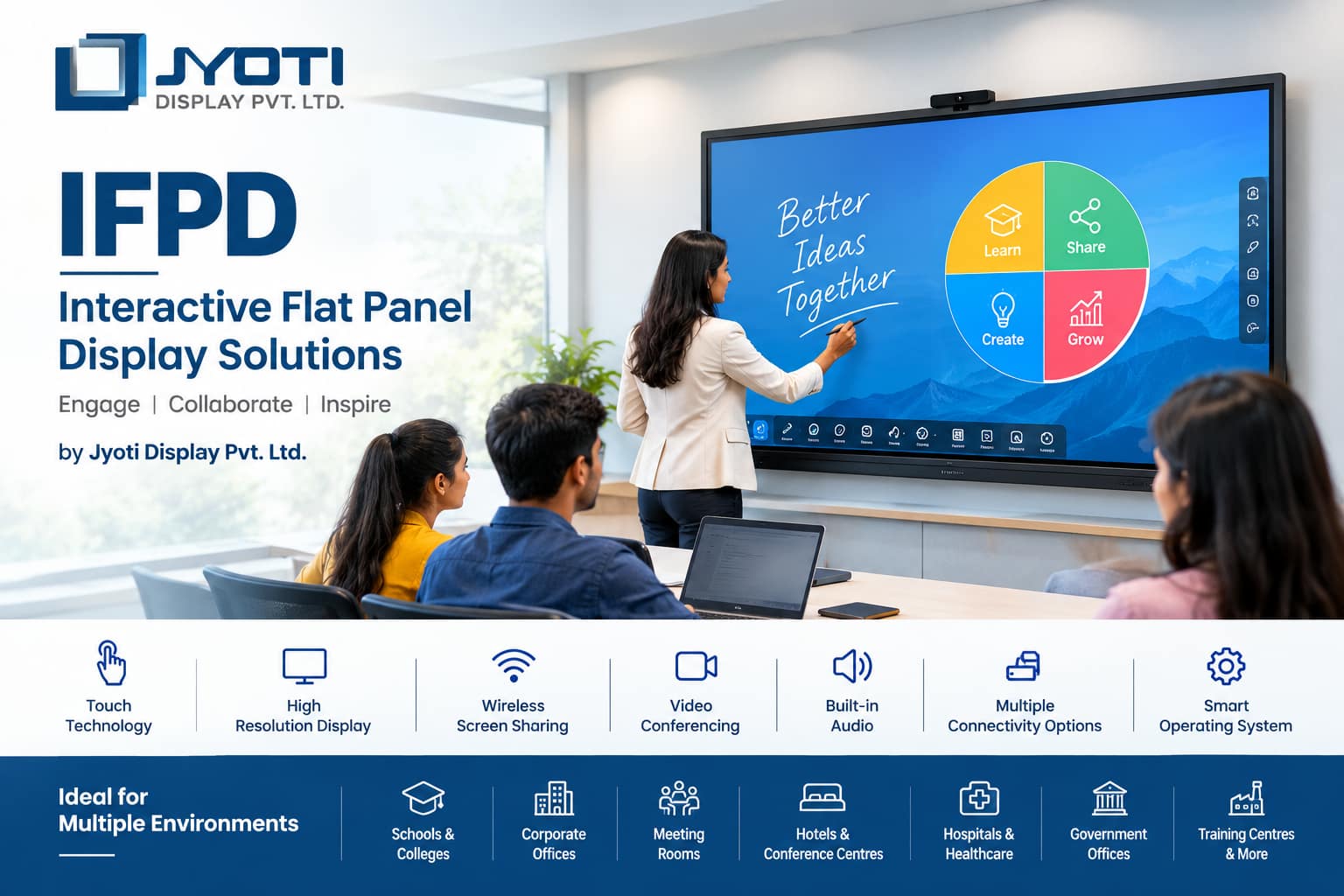
14. IFPD and Interactive Retail Displays
Interactive Flat Panel Displays, or IFPDs, can support customer engagement.
Retail applications may include:
- Product catalogs
- Interactive product selection
- Product comparison
- Digital catalogs
- Touch-based information
- Demonstrations
- Store navigation
- Customer education
For large retail spaces, interactive displays can reduce the amount of printed information required while providing customers with more detailed content.
15. Materials Used in Retail Signage Manufacturing
Choosing the correct material is an important part of signage manufacturing.
Different environments require different materials.
Acrylic
Acrylic is widely used for:
- Logo panels
- 3D letters
- Illuminated signs
- Interior branding
- Display elements
It offers a clean and modern appearance.
Aluminium
Aluminium is lightweight and suitable for various signage structures.
It can be used for:
- Frames
- Sign panels
- Structures
- Indoor and outdoor applications
Stainless Steel
Stainless steel can provide a premium appearance and is commonly used where durability and sophisticated finishing are required.
ACP
Aluminium Composite Panel can be used for fascia and architectural signage applications.
HDF
HDF with suitable finishing can be incorporated into interior retail fixtures and branded environments.
Corian
Corian and similar solid-surface materials can be used for premium retail applications where seamless and sophisticated finishes are desired.
LED and Electronic Components
Digital and illuminated signage also requires appropriate:
- LED modules
- Power supplies
- Controllers
- Wiring
- Displays
- Mounting systems
- Ventilation
- Content management equipment
The material selection should be based on location, exposure, expected lifespan, maintenance requirements and visual objectives.
16. Custom Retail Signage Design
Every retail environment is different.
A standard sign may not fit the architecture, branding or customer flow of a particular store.
Custom retail signage allows businesses to develop solutions according to their specific requirements.
The design process can consider:
- Store dimensions
- Brand guidelines
- Customer movement
- Viewing distances
- Lighting
- Wall and ceiling conditions
- Product layout
- Sign mounting
- Material selection
- Maintenance access
- Installation requirements
- Future replacement needs
Custom signage is particularly valuable for flagship stores and national retail chains where brand consistency is critical.
17. Importance of Typography in Retail Signage
Typography directly influences readability.
A sign may be beautifully designed but ineffective if customers cannot read it.
Retail signage should consider:
- Font size
- Font weight
- Letter spacing
- Line spacing
- Contrast
- Viewing distance
- Lighting
- Background
- Mounting height
For directional signage, readability should generally take priority over decorative typography.
A brand headline may use a distinctive typeface, but essential navigation information should remain easy to understand.
18. Color Selection for Retail Signage
Colors can strengthen brand recognition.
Retail signage should follow the company’s established brand palette whenever possible.
For example:
- Red may create a strong promotional appearance.
- Blue can communicate a corporate or professional identity.
- Green may support natural or sustainability-oriented brands.
- Black and metallic finishes can create a premium appearance.
- Bright colors can attract attention in children’s and youth-oriented retail environments.
However, color should not be selected purely for attractiveness.
Contrast is also important.
The text should remain visible under actual store lighting conditions.
19. Lighting Design for Retail Signage
Lighting can dramatically change how a sign looks.
Signage should be evaluated under the lighting conditions where it will actually be used.
Important considerations include:
- Brightness
- Color temperature
- Glare
- Shadows
- Reflections
- Viewing angle
- Daytime visibility
- Nighttime visibility
- Energy consumption
- Maintenance access
The goal is controlled visibility rather than excessive brightness.
A premium store can lose its visual appeal if signs are over-illuminated.
20. Retail Signage and Visual Merchandising
Signage and visual merchandising should work together.
Visual merchandising includes the presentation of:
- Products
- Shelves
- Fixtures
- Displays
- Lighting
- Graphics
- Colors
- Signage
Signage provides the communication layer.
For example, a clothing display might include:
NEW COLLECTION
The display itself presents the products, while signage tells the customer why the display matters.
The strongest retail environments integrate signage into the merchandising strategy rather than treating signs as an afterthought.
21. Retail Signage for Shopping Malls
Shopping malls have special signage requirements because customers encounter many brands in a relatively compact space.
Retail signage in malls may include:
- Storefront fascia
- Illuminated logos
- Hanging signs
- Window graphics
- Promotional displays
- Digital screens
- Directional signage
- Campaign displays
Mall signage must also comply with building management requirements relating to:
- Sign dimensions
- Illumination
- Mounting
- Electrical systems
- Fire safety
- Access
- Installation timing
Professional planning is therefore important before manufacturing begins.
22. Retail Signage for Supermarkets and Hypermarkets
Supermarkets need extremely clear navigation because customers may need to locate hundreds or thousands of products.
Important signage includes:
- Aisle identification
- Product categories
- Promotional signs
- Price communication
- End-cap signs
- Checkout signs
- Customer service signs
- Entrance and exit communication
The signage system should make the store easy to understand.
Customers should be able to quickly identify major departments without asking employees for basic directions.
23. Retail Signage for Fashion Stores
Fashion stores generally require a more visual and lifestyle-oriented approach.
Signage may include:
- Large campaign graphics
- Illuminated logos
- Window displays
- Collection names
- Promotional messages
- Digital screens
- Feature wall graphics
The signage should support the brand’s personality.
A premium fashion store may require minimalist signage, while a youth fashion brand may prefer bold graphics and dynamic digital content.
24. Retail Signage for Electronics Stores
Electronics stores often require detailed product information.
Signage can communicate:
- Product specifications
- Features
- Prices
- Offers
- Comparisons
- Warranty
- Technology benefits
Digital signage is particularly useful for electronics because video demonstrations can communicate product functionality more effectively than static text.
25. Retail Signage for Jewellery Stores
Jewellery retail environments generally require a premium visual language.
Common solutions include:
- Metallic lettering
- Backlit logos
- Acrylic signage
- Premium wall graphics
- Digital displays
- Product information signage
- Directional signage
The objective is to communicate sophistication without overwhelming the products.
26. Retail Signage for Furniture Stores
Furniture showrooms can be very large.
Customers need help navigating different room settings and categories.
Useful signage includes:
- Living room
- Bedroom
- Dining
- Office
- Outdoor
- Modular kitchen
- Accessories
Large department signs can be combined with product information boards and digital displays.
27. Retail Signage for Pharmacy and Healthcare Retail
Pharmacies and healthcare retail environments need particularly clear communication.
Signage can include:
- Medicine categories
- Personal care
- Wellness
- Baby care
- Consultation
- Billing
- Customer service
- Store timings
Readable typography and clear navigation should be prioritized.
28. Outdoor Retail Signage
Outdoor signage faces more environmental challenges than indoor signage.
It may be exposed to:
- Sunlight
- Rain
- Dust
- Humidity
- Temperature variations
- Wind
Therefore, outdoor signage needs appropriate materials, finishes, electrical protection and mounting systems.
A sign designed for indoor use should not automatically be assumed suitable for outdoor installation.
Material selection should be made according to the actual environmental conditions.
29. Retail Signage Manufacturing Process
A professional retail signage project generally follows several stages.
Stage 1: Requirement Understanding
The manufacturer studies:
- Brand requirements
- Store location
- Store dimensions
- Signage objectives
- Number of stores
- Sign types
- Budget
- Installation requirements
Stage 2: Site Survey
Measurements and photographs are collected.
The survey can identify:
- Available wall space
- Ceiling height
- Electrical points
- Mounting structure
- Viewing distance
- Customer flow
- Existing signage
Stage 3: Concept Design
Designers develop concepts based on:
- Brand identity
- Store architecture
- Customer journey
- Signage purpose
Stage 4: Technical Design
The approved concept is converted into manufacturing drawings.
These may include:
- Dimensions
- Materials
- Sections
- Mounting details
- Illumination
- Electrical details
Stage 5: Prototype
For large projects, a prototype or sample can help confirm:
- Finish
- Color
- Size
- Lighting
- Construction
- Branding
Stage 6: Manufacturing
Approved designs are manufactured according to the specified materials and processes.
Stage 7: Quality Control
The finished signage should be inspected for:
- Dimensions
- Surface finish
- Graphics
- Illumination
- Electrical connections
- Structural quality
Stage 8: Installation
Professional installation ensures that the finished product matches the approved design.
Stage 9: Handover and Maintenance
The manufacturer can provide guidance regarding cleaning, electrical maintenance, replacement graphics and other service requirements.
30. Importance of Quality Control
Signage represents the brand.
A poorly finished sign can negatively affect the customer’s perception of the entire store.
Quality control should therefore consider:
- Correct dimensions
- Clean edges
- Proper joints
- Uniform finish
- Accurate logo reproduction
- Correct color
- Proper illumination
- Secure mounting
- Electrical safety
- Graphic alignment
For multi-store rollouts, quality consistency is especially important.
Every branch should look like part of the same brand.
31. Retail Signage for Multi-Location Rollouts
National and regional retailers often need signage for multiple stores.
This creates additional challenges.
A successful rollout needs:
- Standardized designs
- Approved material specifications
- Consistent colors
- Manufacturing drawings
- Packaging
- Logistics
- Installation coordination
- Quality checks
- Location-wise tracking
An integrated manufacturer can help coordinate these activities.
Jyoti Display’s company profile states that it provides design, manufacturing, installation and service capabilities for national retail companies. (Jyoti Display Pvt Ltd)
32. Retail Signage and Customer Experience
Retail signage is ultimately about customer experience.
A customer should feel that the store is:
- Easy to understand
- Easy to navigate
- Professional
- Organized
- Consistent
- Informative
- Attractive
Poor signage can create confusion.
Good signage quietly solves problems.
The customer may never consciously think, “This wayfinding system is excellent.”
Instead, they simply find what they need.
That is one of the most important objectives of effective signage.
33. Retail Signage and Customer Navigation
Wayfinding is especially important in large stores.
The signage system should provide information at appropriate points throughout the journey.
For example:
Entrance → Main Department → Category → Subcategory → Product Area → Checkout
If a customer needs to make a decision at an intersection, the directional sign should ideally appear before or at that decision point.
This prevents customers from walking unnecessarily around the store.
34. Avoiding Signage Clutter
More signage does not always mean better communication.
Too many signs can create visual noise.
A good retail signage system prioritizes information.
For example:
Primary message
WOMEN’S FASHION
Secondary message
NEW COLLECTION
Supporting information
Spring/Summer 2026
The customer should immediately understand the main message.
Current retail signage guidance also emphasizes avoiding excessive visual clutter and keeping individual signs focused on a clear purpose. (Shopify)
35. Static vs Digital Retail Signage
Both static and digital signage have important roles.
Static signage
Best for information that does not change frequently.
Examples:
- Store identification
- Department names
- Permanent directions
- Brand logos
- Safety information
Digital signage
Best for content that changes frequently.
Examples:
- Promotions
- Videos
- Campaigns
- Product demonstrations
- Dynamic advertising
- Seasonal communication
A professional retail environment often benefits from combining both.
36. Sustainable Retail Signage
Sustainability is increasingly relevant to retail design.
Retailers can consider:
- Long-lasting materials
- Energy-efficient LEDs
- Replaceable graphics
- Modular construction
- Reusable frames
- Efficient packaging
- Repairable components
Instead of replacing an entire sign whenever a promotion changes, a retailer can use a reusable frame with replaceable graphic inserts.
This can reduce material waste and make campaign updates easier.
37. Modular Retail Signage
Modular signage allows individual components to be replaced or updated without redesigning the entire structure.
Examples include:
- Snap frames
- Replaceable graphic panels
- Modular department signs
- Changeable promotional holders
- Interchangeable inserts
This is particularly useful for retailers with frequently changing promotions.
38. Retail Signage Maintenance
Even the best signage needs maintenance.
A maintenance program can include:
- Cleaning
- LED inspection
- Electrical checks
- Graphic replacement
- Structural inspection
- Loose fixing checks
- Surface repair
- Digital display testing
Outdoor signs may require more frequent inspection due to environmental exposure.
Retailers should also check signage whenever the store layout changes.
A sign pointing toward a relocated department can create confusion if it is not updated.
39. Retail Signage Design for Indian Retail Markets
India has a highly diverse retail environment.
Signage may need to work across:
- High streets
- Shopping malls
- Standalone stores
- Airports
- Metro stations
- Commercial complexes
- Hypermarkets
- Residential retail areas
Different cities and locations may also have different architectural, municipal and building-management requirements.
A professional signage manufacturer needs to consider the installation environment rather than using a single solution for every location.
40. Retail Signage in Mumbai, Nashik and Across India
For retailers operating in Maharashtra and other parts of India, selecting a manufacturer with design and manufacturing capabilities can simplify project coordination.
Jyoti Display Pvt. Ltd. has its business presence in Mumbai and Nashik and describes its facility as an approximately 80,000-square-foot manufacturing factory. (Jyoti Display Pvt Ltd)
Its published company profile also states that the organization was established in Mumbai in 2004 and works across design, manufacturing and installation for retail fixtures, static signage and digital display applications. (Jyoti Display Pvt Ltd)
41. Why Choose Jyoti Display Pvt. Ltd. for Retail Signage?
Retail signage requires more than printing a logo on a board.
It requires understanding the relationship between:
Brand + Architecture + Customer + Product + Signage + Technology
Jyoti Display Pvt. Ltd. brings together design and manufacturing capabilities for retail environments.
The company’s published profile highlights:
- Design capabilities
- Manufacturing
- Installation
- Retail fixtures
- Shop fittings
- Displays
- Retail equipment
- Static signage
- Digital display
- Metal products
- Aluminium products
- Stainless-steel products
- HDF products
- Modular furniture
- Corian products
- Quality systems
- Project management capabilities (Jyoti Display Pvt Ltd)
This combination can support retailers looking for a coordinated retail environment rather than isolated signage products.
42. End-to-End Retail Signage Solutions
A retailer may require several different signage elements for one store.
For example:
Exterior
- Storefront sign
- Illuminated logo
- Window graphics
Entrance
- Welcome signage
- Promotional communication
- Digital screen
Interior
- Department signage
- Wayfinding
- Category signage
Product area
- Shelf communication
- Promotional displays
- Product information
Checkout
- Billing signage
- Loyalty communication
- Promotional displays
Digital
- Video wall
- Digital signage
- Interactive display
An end-to-end approach can help ensure that all these elements work together visually.
43. Retail Signage for Brand Consistency
Brand consistency becomes increasingly important as a retailer grows.
A brand may have:
- 5 stores
- 20 stores
- 100 stores
- 500 stores
- Multiple formats
Without proper signage standards, each location can gradually develop its own interpretation of the brand.
A signage guideline can define:
- Logo usage
- Colors
- Fonts
- Sign dimensions
- Materials
- Lighting
- Mounting
- Graphic hierarchy
- Wayfinding symbols
This creates a repeatable system.
44. Custom Retail Signage for Franchise Businesses
Franchise businesses have a similar requirement.
The franchise owner needs a store that reflects the master brand.
Custom signage can be produced according to standardized brand specifications while being adapted to individual site dimensions.
This provides both:
Brand consistency + Site-specific customization
45. Measuring Retail Signage Performance
Retail signage should not be judged only by appearance.
Where possible, retailers can evaluate:
- Store traffic
- Promotional sales
- Product sales
- QR-code scans
- Customer feedback
- Navigation issues
- Campaign engagement
- Digital screen interaction
Different signs require different measurements.
For example:
Storefront signage → visibility and foot traffic
Wayfinding → navigation efficiency
Promotional signage → featured-product performance
Digital signage → engagement and interaction
Modern retail guidance similarly recommends assigning appropriate KPIs to different signage types rather than measuring every sign in the same way. (Shopify)
46. Common Retail Signage Mistakes
Mistake 1: Too Much Information
A sign containing too much text is difficult to read.
Mistake 2: Poor Contrast
Beautiful colors can become ineffective if text and background have insufficient contrast.
Mistake 3: Incorrect Placement
A sign hidden behind fixtures cannot perform effectively.
Mistake 4: Inconsistent Branding
Different fonts, colors and styles can make a store look unprofessional.
Mistake 5: Excessive Signage
Too many signs create visual clutter.
Mistake 6: Poor Lighting
An illuminated sign can become ineffective because of glare or excessive brightness.
Mistake 7: Ignoring Maintenance
Damaged LEDs, faded graphics or broken signs can negatively affect brand perception.
Mistake 8: Designing Without Considering Viewing Distance
A sign should be designed according to how far away customers will see it.
47. How to Plan a Retail Signage Project
A successful project can follow this checklist:
Step 1: Define the objective
Decide whether the sign is for:
- Branding
- Navigation
- Promotion
- Information
- Product communication
- Digital engagement
Step 2: Survey the site
Understand the architecture and customer movement.
Step 3: Create a signage hierarchy
Identify primary, secondary and supporting messages.
Step 4: Select materials
Choose materials according to environment and lifespan.
Step 5: Develop designs
Prepare concepts and technical drawings.
Step 6: Approve samples
Review finish, color, illumination and construction.
Step 7: Manufacture
Produce according to approved specifications.
Step 8: Inspect
Conduct quality checks before dispatch.
Step 9: Install
Install according to site conditions and approved drawings.
Step 10: Maintain
Plan for cleaning, repairs and future graphic updates.
48. Future of Retail Signage
The future of retail signage is likely to combine physical and digital communication.
Retail environments are increasingly using:
- LED displays
- Video walls
- Interactive screens
- Touch displays
- QR codes
- Digital product information
- Dynamic promotional content
- Data-driven content
- Integrated physical and online experiences
However, traditional signage will continue to have an important role.
A permanent department sign does not need a digital screen.
A store logo does not need to change every hour.
The most effective retail environment will therefore use technology where it creates genuine value and static signage where permanent communication is more practical.
49. Retail Signage as a Complete Customer Communication System
A successful retail store can be thought of as a conversation.
Outside the store
“This is our brand.”
At the entrance
“Welcome. Here is what you will find.”
Inside
“This is where you need to go.”
At the product section
“Here is the product and why it matters.”
At the promotional area
“Here is today’s special offer.”
At checkout
“Here are the final services and opportunities available to you.”
Retail signage supports this entire conversation.
50. Conclusion
Retail signage is much more than a name board above a shop.
It is a strategic combination of branding, communication, navigation, promotion, visual merchandising and technology.
A professionally designed retail signage system can help businesses create stronger storefront visibility, clearer customer navigation, better product communication and a more consistent brand experience.
From illuminated storefront signage and window graphics to wayfinding systems, promotional displays, point-of-purchase communication, digital signage, Active LED / video walls and interactive displays, every element has a specific role.
Jyoti Display Pvt. Ltd. provides design and manufacturing capabilities for retail fixtures, shop fittings, displays, static signage and digital display solutions. Its published company profile states that the company operates from Mumbai and Nashik, has an approximately 80,000-square-foot manufacturing facility and supports design, manufacturing, installation and service for retail environments. (Jyoti Display Pvt Ltd)
For retailers, shopping malls, supermarkets, fashion stores, electronics stores, jewellery stores, furniture showrooms, lifestyle brands, franchise businesses and national retail chains, the right signage partner can make the difference between individual signs and a complete branded environment.
Jyoti Display Pvt. Ltd. focuses on transforming retail spaces through design, manufacturing and execution—helping brands communicate more clearly, create stronger visual identities and build engaging physical retail experiences.
Frequently Asked Questions About Retail Signage
What is retail signage?
Retail signage is the collection of visual communication elements used inside and outside a retail environment to identify the brand, guide customers, communicate product information, promote offers and improve the overall shopping experience.
What are the main types of retail signage?
Major types include storefront signage, illuminated signage, window graphics, wayfinding signage, department signage, aisle signage, promotional signage, point-of-purchase signage, wall graphics, floor graphics, digital signage, LED displays and interactive displays.
Why is retail signage important?
Retail signage helps customers recognize a business, understand its offerings, navigate the store, find products and respond to promotions. It also contributes to brand identity and the overall appearance of a retail environment.
What materials are used for retail signage?
Depending on the application, retail signage may use acrylic, aluminium, stainless steel, ACP, HDF, Corian, PVC-based materials, printed graphics, glass and electronic display components.
What is retail wayfinding signage?
Retail wayfinding signage helps customers navigate a store and locate departments, categories, services, checkout areas and other destinations.
What is digital retail signage?
Digital retail signage uses electronic screens to display dynamic content such as advertisements, videos, promotions, product information and announcements. It is particularly useful where content changes frequently. (Shopify)
Can retail signage be customized?
Yes. Retail signage can be customized according to brand identity, store dimensions, architecture, materials, lighting, viewing distance, customer flow and installation requirements.
Does Jyoti Display manufacture retail signage?
Jyoti Display Pvt. Ltd.’s company profile describes the organization as a professional designer and manufacturer of retail fixtures, shop fittings, displays and retail equipment, with capabilities including static signage and digital display. (Jyoti Display Pvt Ltd)
Does retail signage include digital displays and video walls?
Yes. Modern retail signage can include digital displays, interactive screens, LED displays and video walls alongside traditional static signage.
Why should retail signage be professionally designed?
Professional design helps ensure that signage is readable, properly positioned, consistent with the brand and appropriate for the physical environment. It also reduces problems related to poor visibility, clutter, incorrect dimensions and inconsistent branding.