

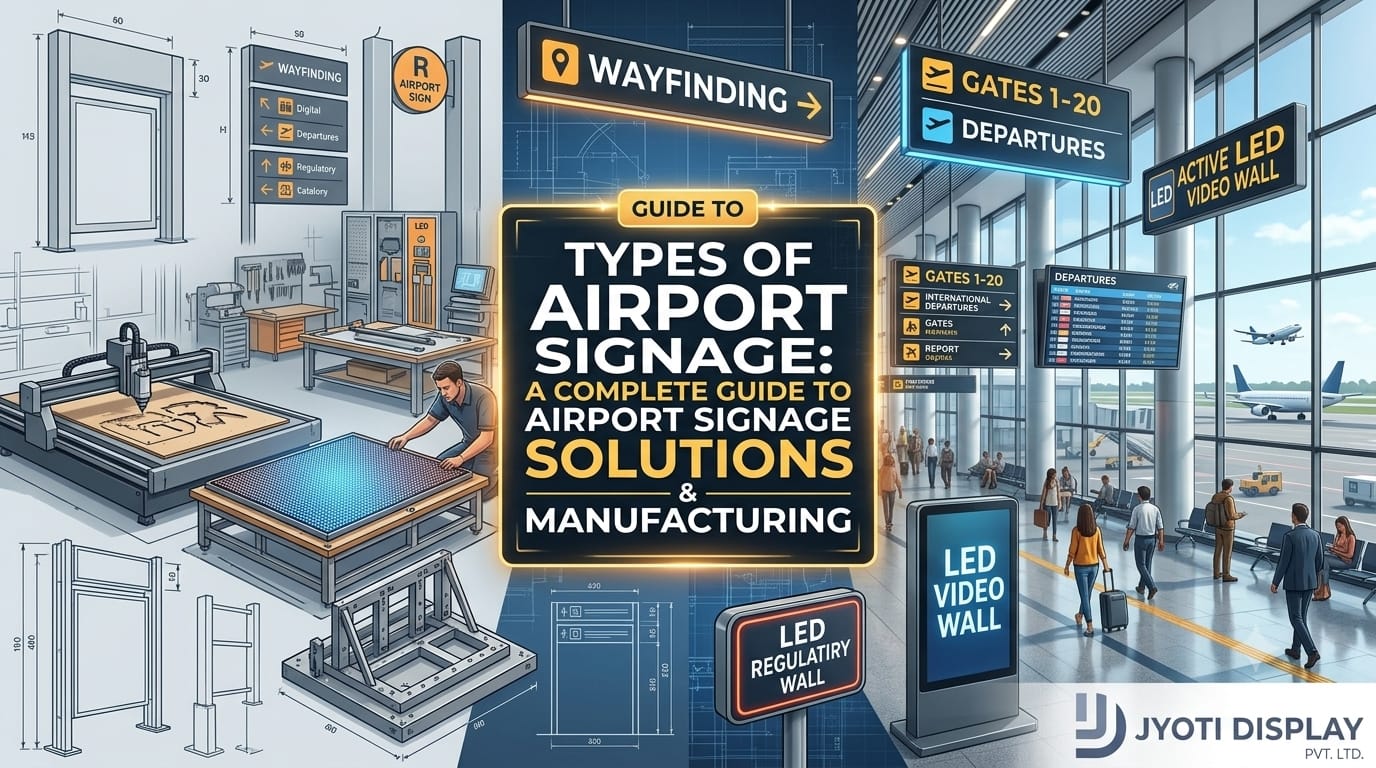
Introduction to Airport Signage
Airports are complex transportation environments where thousands of passengers, airport employees, airline representatives, security personnel, and visitors move through interconnected spaces every day. From the moment a passenger enters an airport terminal to the time they board an aircraft, clear communication plays an essential role in creating a safe, organised, and convenient travel experience. Airport signage provides this communication through carefully designed signs, digital displays, illuminated boards, directional indicators, information screens, and safety messages.
Airport signage is much more than a collection of boards installed throughout a terminal. It is an integrated communication system that helps passengers understand where they are, where they need to go, what procedures they must follow, and which services are available to them. Effective signage reduces confusion, improves passenger movement, supports airport operations, and contributes to the overall appearance of the airport.
Modern airports require several types of signage because different locations have different communication requirements. A passenger arriving at the terminal entrance needs different information from a passenger searching for a departure gate. Similarly, an airport employee working in a restricted operational area requires access-control and safety information that may not be relevant to the general public.
Airport signage solutions can be divided into several major categories, including directional signage, identification signage, informational signage, flight information displays, regulatory signage, safety signage, wayfinding systems, advertising displays, parking signage, accessibility signage, and emergency evacuation signs. Each category serves a specific purpose within the wider airport communication network.
With the development of digital technology, airports are increasingly combining traditional static signs with electronic displays, interactive kiosks, LED screens, and centrally managed passenger information systems. This combination creates a flexible communication environment that can respond to changing flight schedules, terminal operations, passenger requirements, and emergency situations.
Jyoti Display Pvt. Ltd. recognises the importance of reliable, visually clear, and professionally manufactured signage for transportation infrastructure. High-quality airport signage solutions can support airports in delivering consistent information, improving passenger convenience, and maintaining a professional visual identity.
This article explores the different types of airport signage, their applications, manufacturing considerations, technological features, and their role in creating efficient and passenger-friendly airport environments.
1. Directional Airport Signage
Directional signage is one of the most important types of airport signage. Its primary purpose is to guide passengers and visitors from one location to another without requiring constant assistance from airport staff.
Airports contain multiple interconnected areas, including terminal entrances, check-in counters, security checkpoints, immigration counters, baggage claim halls, lounges, retail areas, boarding gates, and transportation facilities. Directional signs connect these locations through a logical sequence of instructions.
Typical directional airport signs include arrows and labels indicating:
- Terminal entrances and exits
- Airline check-in counters
- Security screening areas
- Immigration and customs
- Departure gates and boarding zones
- Baggage claim areas
- Connecting flights
- Passenger lounges
- Toilets and drinking water facilities
- Taxi stands, buses, and railway connections
Directional signage should be positioned at decision points where passengers must choose between different routes. Examples include terminal intersections, escalator landings, corridor junctions, security entrances, and connections between arrival and departure areas.
The design must allow passengers to understand information quickly while walking, pulling luggage, or moving through crowded spaces. Clear arrows, readable typography, appropriate contrast, consistent terminology, and predictable placement are essential.
A successful directional signage system follows a consistent visual language throughout the airport. If a particular colour, arrow style, or symbol is used to identify a type of destination, the same convention should be maintained wherever practical.
Directional signage can be manufactured using aluminium panels, acrylic, printed graphics, illuminated cabinets, suspended signboards, and electronic displays. The appropriate solution depends on viewing distance, lighting conditions, installation location, maintenance requirements, and airport design standards.
2. Airport Wayfinding Signage
Wayfinding signage is a broader communication system that helps people understand their current location, identify their destination, and select the most appropriate route.
While directional signs provide individual instructions, wayfinding connects these instructions into a complete journey. It considers how passengers perceive the airport, how they interpret information, and how they move between different areas.
A comprehensive airport wayfinding system may include terminal maps, colour-coded zones, floor directories, directional arrows, destination identifiers, digital navigation kiosks, and mobile navigation integration.
For example, a passenger arriving at an unfamiliar airport may need to locate a connecting flight, pass through a transfer security checkpoint, find a departure gate, and identify nearby facilities. A coordinated wayfinding system helps the passenger complete this journey with fewer unnecessary stops.
Effective airport wayfinding signage should be designed around passenger movement rather than simply the available wall space. Signs must appear before passengers reach a decision point, not after they have already passed it.
Large terminals may use different colours or identifiers for terminal sections, concourses, piers, floors, and gate groups. These identifiers should remain consistent across physical signs, digital maps, printed airport maps, and relevant online information.
Digital wayfinding can add interactive features such as destination search, route selection, accessible route recommendations, estimated walking distances, and multilingual instructions. These functions are particularly valuable in large international airports.
However, digital navigation should complement rather than completely replace essential static signage. Passengers may not have internet access, may not wish to use a mobile device, or may be unfamiliar with interactive systems.
The most effective wayfinding strategy combines clear physical signage with digital information and an easy-to-understand terminal layout.
3. Airport Identification Signage
Identification signage tells passengers and employees what a particular location, facility, or operational area is.
Unlike directional signage, which guides people towards a destination, identification signs confirm that the destination has been reached.
Common examples include:
- Terminal identification signs
- Gate number signs
- Check-in counter identification
- Airline office signs
- Baggage claim carousel numbers
- Lounge identification
- Restaurant and retail shop signs
- Meeting room and office signs
- Airport administration department signs
- Staff-only room identification
Gate identification signs are especially important because passengers need to confirm their boarding location before proceeding to the gate. These signs should use clear numbering or lettering and maintain consistency with boarding passes, flight information displays, and announcements.
Identification signs can be mounted on walls, suspended from ceilings, installed on columns, or integrated into architectural features. In areas where passengers approach from several directions, signs may need to be visible from multiple viewing angles.
Illuminated identification signage can improve visibility in large terminals, particularly where natural lighting is limited or where the architectural environment contains dark finishes.
Materials commonly used include aluminium, stainless steel, acrylic, high-quality printed panels, and modular sign systems. The selected material should withstand frequent cleaning and everyday wear.
Identification signage also supports airport branding. Consistent colours, typography, symbols, and finishing details can create a professional appearance while ensuring that essential information remains easy to recognise.
4. Airport Flight Information Display Systems
<PRIVATE_PERSON>light information display systems, commonly known as FIDS, are electronic displays that provide real-time or operationally updated flight information to passengers and airport personnel.
These systems are among the most recognisable forms of digital airport signage. They help travellers check departure times, arrival information, flight numbers, destinations, gate assignments, check-in locations, and flight status.
Typical flight information includes:
- Flight number
- Airline name or code
- Destination or origin
- Scheduled departure or arrival time
- Estimated time, when available
- Check-in counter
- Boarding gate
- Boarding status
- Delay, cancellation, or other operational updates
Departure displays are generally installed near terminal entrances, check-in halls, security areas, concourses, lounges, and gate waiting areas. Arrival displays are commonly located near baggage claim areas, terminal arrival halls, and passenger meeting points.
A flight information display system typically receives data from an airport’s operational information infrastructure or connected flight information sources. The display software organises this data into layouts suitable for different screen sizes and locations.
Digital signage technology allows the same system to update many displays centrally. This reduces the need to replace printed information every time a schedule changes.
FIDS installations may use commercial LCD panels, LED displays, high-brightness screens, or specialised display walls. The appropriate technology depends on viewing distance, ambient light, required screen size, operating hours, and content complexity.
Screen readability is essential. Text should be large enough for the expected viewing distance, and important information should remain visually prominent. Colour may be used to distinguish statuses, but meaning should not depend on colour alone.
Airports should also consider system redundancy, network reliability, remote monitoring, secure content management, and the availability of technical support. If flight information becomes unavailable, the airport needs an appropriate operational response.
Professional manufacturing and installation help ensure that the screens, mounting systems, enclosures, and supporting infrastructure are suitable for continuous use in busy public environments.
5. Airport Departure Signage
Departure signage guides passengers through the processes required before boarding an aircraft.
The departure journey usually involves locating the correct terminal, identifying the airline check-in area, checking in or dropping baggage, passing through security, completing immigration procedures where applicable, and locating the assigned boarding gate.
Departure signage commonly includes:
- Departures terminal identification
- Airline check-in directions
- Self-service check-in instructions
- Baggage drop-off indicators
- Security screening directions
- Immigration and passport-control signs
- Departure lounge directories
- Boarding gate directions
- Boarding zone information
- Flight status displays
The signs should be arranged to support the passenger journey in the correct sequence. Information about the next required action should be available before passengers enter an unfamiliar queue or restricted processing area.
Large departure halls may use overhead directional signs to provide guidance across wide spaces. Additional signs at eye level can explain specific procedures, identify counters, or communicate exceptions.
Digital displays are especially useful where airline counters and boarding gates change according to operational requirements. Static signs remain useful for stable destinations such as security, immigration, and terminal exits.
Departure signage should be coordinated with airport announcements, airline systems, staff instructions, and passenger documents. Conflicting information across these channels can cause missed flights, crowding, and unnecessary enquiries.
6. Airport Arrival Signage
Arrival signage helps passengers navigate the airport after landing. It also supports people meeting arriving travellers, airport staff, ground transport operators, and passengers transferring to other flights.
The arrival journey may involve following the route to immigration, collecting checked baggage, completing customs procedures, and finding the correct exit or onward transport service.
Common arrival signs include:
- Arrivals hall directions
- Immigration and passport-control signs
- Baggage claim directions
- Baggage carousel identification
- Customs declarations
- Connecting-flight routes
- Terminal exit signs
- Passenger meeting points
- Taxi and rideshare pickup locations
- Bus, train, and metro connections
International airports may need separate instructions for different passenger groups, including arriving international passengers, domestic passengers, transit travellers, and passengers requiring special assistance.
Arrival signage should provide clear transitions between controlled and public areas. For instance, passengers collecting luggage should be guided towards the appropriate carousel before reaching customs or the public arrivals hall.
Baggage carousel identification is particularly important when multiple flights are processed simultaneously. Electronic carousel displays can show flight numbers and destinations alongside carousel assignments.
Ground transportation signage should clearly distinguish between different modes of transport. Passengers should be able to identify taxi stands, app-based pickup zones, rental car counters, buses, railway platforms, and private vehicle pickup areas.
Where transportation arrangements change frequently, digital displays provide a practical way to communicate updated pickup points, temporary diversions, or service interruptions.
7. Airport Terminal Signage
Terminal signage helps passengers understand the organisation of airport buildings and locate the services available within them.
A large airport may contain several terminals, multiple floors, different concourses, international and domestic zones, and separate arrival and departure levels. Terminal signage creates a visual structure that makes this complex environment easier to navigate.
Examples include terminal entrance signs, terminal number boards, floor directories, concourse identification, terminal transfer signs, and signs connecting terminals to parking or public transportation.
Exterior terminal signs should be visible from approaching roads and passenger drop-off zones. They may require large lettering, reflective materials, illumination, or freestanding structures.
Inside the building, terminal identification can be reinforced through suspended signs, wall-mounted directories, colour-coded zones, and digital maps.
Terminal signage should also help passengers distinguish between public areas and controlled operational zones. For example, signs may indicate where departing passengers enter security-controlled areas or where arriving passengers leave a restricted route.
Consistency across all terminals is important. When the same terminology and design principles are used throughout an airport, passengers can apply what they have already learned in one section to another.
A modular signage system can simplify future expansion because individual panels, destinations, and identifiers can be updated without replacing an entire installation.
8. Airport Check-In and Baggage Drop Signage
Check-in signage directs passengers to airline service counters, self-service kiosks, baggage drop-off points, and other pre-departure facilities.
Airline counters are often organised into zones or numerical groups. Overhead signs help passengers identify the correct area, while counter-level signs provide the final confirmation.
Check-in signage may include airline logos, flight information, counter ranges, class-specific instructions, priority service indicators, and directions for passengers travelling with special baggage.
Self-service check-in areas require instructional signage that explains the steps involved in using kiosks. Clear instructions should minimise unnecessary complexity and direct passengers to staff assistance when needed.
Baggage drop-off signage should explain where eligible passengers can leave checked baggage and whether separate queues exist for particular airlines, passenger categories, or baggage types.
Because counter assignments can change, electronic displays are often appropriate for the main check-in hall. Digital signs can show current airline assignments and counter ranges without requiring the physical replacement of large boards.
Static overhead signs may still be useful for stable zone identifiers, while digital displays provide frequently changing operational information.
The design should consider queues, luggage carts, viewing angles, ceiling height, and potential obstructions. Signs that are hidden behind queues or airline equipment cannot perform their intended function effectively.
9. Airport Gate Signage
Gate signage identifies boarding gates and helps passengers reach the correct aircraft boarding location.
Gate signs typically display gate numbers or letters and may incorporate flight information screens showing destination, flight number, boarding time, boarding group, and current status.
These signs are commonly installed near gate entrances, waiting areas, jet bridge access points, and concourse intersections.
Gate signage must coordinate closely with flight information systems because gate assignments may change. A passenger who sees inconsistent gate information on a display, boarding pass, and directional sign may travel to the wrong location.
Electronic gate displays can be updated centrally to communicate boarding, final call, gate changes, delays, and other relevant information. Static signs are suitable for permanent gate identification, provided the operational information is displayed separately where required.
Large airports may use a combination of gate number signs, overhead concourse directories, digital flight displays, and floor-level directional indicators.
Gate signage should remain readable from the normal passenger approach direction. Mounting height and viewing angle are particularly important in crowded gate lounges.
Special attention should be given to passengers with visual impairments, mobility limitations, or limited familiarity with the airport’s language. Clear numbering, appropriate contrast, consistent terminology, and accessible information channels can improve usability.
10. Airport Baggage Claim Signage
Baggage claim signage directs arriving passengers to the correct baggage carousel and explains the procedures for collecting checked luggage.
Baggage claim areas can become crowded when several flights arrive close together. Effective signage helps passengers identify their assigned carousel and reduces unnecessary movement between belts.
Typical baggage claim signs include carousel numbers, flight number displays, airline and destination information, baggage service desks, oversized baggage collection, lost baggage assistance, and trolley locations.
Electronic displays are particularly valuable because carousel assignments can change throughout the day. A centrally managed system can update flight-to-carousel information and make it visible near the appropriate baggage belt.
Signs should be installed where passengers can see them from the main approach route and from the waiting areas around each carousel.
Large suspended displays may be appropriate in high-ceiling baggage halls. Additional signs can identify service counters, restricted areas, and routes to customs or terminal exits.
Airport planners should ensure that signs remain visible when passengers gather around belts. The physical placement of displays should account for columns, overhead equipment, advertising screens, and other potential obstructions.
Well-designed baggage claim signage contributes to smoother passenger flow and reduces the number of routine questions directed to airport employees.
11. Airport Security and Immigration Signage
Security and immigration signage communicates instructions for passengers moving through controlled airport processing areas.
These signs help travellers understand where to queue, what documents may be required, how to prepare for screening, and which routes apply to their passenger category.
Examples include security checkpoint directions, prohibited-item notices, screening preparation instructions, passport-control indicators, visa or document reminders, customs instructions, and restricted-area warnings.
Security signage must communicate instructions clearly without creating unnecessary anxiety or confusion. Messages should be concise, direct, and consistent with the applicable airport procedures and official requirements.
Where passenger categories have separate processing routes, signs should distinguish between them using clear wording and universally recognisable symbols where appropriate.
Immigration and customs signs may need multilingual wording, especially at international airports. Translations should be professionally reviewed to avoid ambiguous or incorrect instructions.
Digital displays can communicate updated queue information, temporary lane closures, and revised processing procedures. However, essential procedural and regulatory notices should remain available in an appropriate permanent or approved format.
Security-related signs must be coordinated with the relevant authorities and airport management. Manufacturers should follow the specifications supplied by the responsible organisation rather than independently inventing regulatory wording.
The materials and finishes should be suitable for frequent cleaning, and mounting arrangements should not obstruct security equipment, sightlines, or passenger movement.
12. Airport Safety Signage
Airport safety signage communicates hazards, precautions, and instructions intended to protect passengers, employees, contractors, and visitors.
Airports contain a variety of operational environments, including vehicle movement areas, service corridors, loading zones, maintenance workshops, baggage handling systems, and areas containing electrical or mechanical equipment.
Safety signage may identify slippery floors, wet surfaces, restricted access, electrical hazards, moving equipment, vehicle routes, construction work, and other workplace risks.
Typical examples include:
- Caution and warning signs
- Wet floor notices
- Electrical hazard signs
- Restricted access warnings
- Vehicle movement indicators
- Personal protective equipment notices
- Construction and maintenance warnings
- Hazardous material identification
- Emergency stop and equipment safety labels
Safety signs must be easy to notice and understand. Their wording, symbols, colours, and shapes should follow the applicable standards and the airport’s safety management requirements.
Temporary hazards may require portable signs that can be placed quickly and removed when the risk no longer exists. Permanent hazards may require durable, fixed signage made from materials suited to the installation environment.
Outdoor operational areas may need weather-resistant and UV-resistant finishes. Industrial service areas may require abrasion-resistant panels and mounting hardware designed for demanding conditions.
Safety signage is not a substitute for proper training, physical barriers, equipment maintenance, or operational controls. It is one component of a wider safety programme.
Professional signage planning ensures that critical warnings are visible at the point where people need them and remain legible throughout their intended service life.
13. Airport Emergency and Evacuation Signage
Emergency signage helps people identify exits, evacuation routes, emergency equipment, and safe movement procedures during incidents.
In an airport, emergency communication must account for large crowds, unfamiliar visitors, multiple languages, complex layouts, and different levels of passenger mobility.
Emergency and evacuation signage may identify emergency exits, escape routes, stairways, assembly points, fire extinguishers, fire alarms, emergency telephones, first-aid stations, and designated refuge areas.
Exit signs should be positioned according to applicable building, fire safety, and life safety requirements. Their placement must help occupants identify the correct route without relying solely on knowledge of the building.
Illuminated or photoluminescent signage may be required in particular locations, subject to the applicable codes and project specifications. Emergency lighting and signage systems should be selected and installed in accordance with the relevant requirements.
Emergency signage must remain distinguishable from advertising, decorative displays, and routine promotional content. Important safety messages should never be obscured by temporary banners or commercial screens.
Airports should periodically inspect emergency signs to verify that they remain visible, undamaged, correctly positioned, and consistent with the current building layout.
Changes to terminal partitions, doors, security routes, or passenger circulation may require a corresponding review of evacuation information.
Because emergency signage is safety-critical, its design and placement should be approved by the relevant professionals and authorities.
14. Airport Accessibility Signage
Accessibility signage helps passengers with disabilities and other access requirements use airport facilities independently and safely.
Airports serve people with different physical, sensory, cognitive, and communication needs. Signage should therefore be designed to support a wide range of users.
Accessibility-related signs may identify accessible toilets, step-free routes, lifts, ramps, wheelchair assistance points, accessible parking, priority services, hearing assistance facilities, and designated assistance desks.
Pictograms can improve recognition, particularly when passengers speak different languages. Text should supplement symbols whenever additional explanation is necessary.
Good accessibility signage uses readable typefaces, appropriate contrast, consistent terminology, and logical positioning. Signs should be installed at heights and locations suitable for the relevant users and viewing conditions.
Tactile lettering and Braille may be appropriate for certain signs, depending on applicable accessibility requirements and the location of the sign. Their use should be planned with reference to relevant standards rather than treated as a decorative addition.
Digital displays should be designed with accessibility in mind. This can include adequate text size, high contrast, clear screen layouts, and compatibility with the airport’s wider accessible information strategy.
Accessible routes should be communicated consistently across physical signs, airport maps, digital navigation systems, and assistance information.
Accessibility signage is most effective when it is incorporated into the initial planning and architectural design of the airport rather than added after construction is complete.
15. Airport Multilingual Signage
International airports serve passengers from many countries and language backgrounds. Multilingual signage helps make airport information understandable to a diverse travelling public.
Depending on the location and airport requirements, signs may use the national or official language alongside English and other relevant languages.
Multilingual signage is commonly used for terminal directions, security instructions, immigration, customs, toilets, baggage claim, transport connections, emergency notices, and passenger service facilities.
The main challenge is presenting several languages without making the sign crowded or difficult to read.
Designers must carefully manage line spacing, character size, text hierarchy, symbol placement, and the amount of information shown on each panel. Some writing systems require more space than others, so translations cannot always be inserted into a fixed layout without adjustment.
Pictograms can reduce the amount of text required for familiar destinations and facilities. However, symbols should be selected and tested for clarity, and they should not replace written instructions where precise meaning is essential.
Translation quality is important because small wording differences can create significant misunderstandings in security, customs, and emergency contexts.
A well-designed multilingual signage system improves passenger confidence and supports the airport’s role as an international gateway.
16. Airport Digital Signage
<AsyncImageGroup query={} layout=”bento” aspectRatio=”5:4″ size=”lg”/>
Digital airport signage uses electronic screens to display passenger information, operational updates, advertisements, announcements, and other visual content. Unlike conventional printed signs, digital displays can be updated remotely and adapted to changing requirements.
Digital signage is particularly useful in airports because flight schedules, gate assignments, service availability, and passenger instructions can change throughout the day.
Common types of digital airport signage include:
- LCD information displays
- LED display boards
- Digital directories
- Interactive touchscreen kiosks
- Video walls
- Digital advertising screens
- Queue management displays
- Real-time transportation information screens
- Emergency announcement displays
Digital signage networks typically combine commercial-grade display hardware, mounting systems, media players or integrated computing devices, content management software, and network connectivity.
A centralised content management system allows authorised personnel to schedule content, update information, and distribute approved messages across multiple screens. More advanced installations can integrate with airport databases and operational information systems.
Screen selection depends on viewing distance, screen size, brightness, resolution, operating hours, installation location, and maintenance requirements. A screen positioned in a sunlit terminal entrance may require different specifications from one installed in a controlled-lighting lounge.
Digital signage should be planned as part of the airport’s overall communication strategy. Essential directional and safety information should remain accessible even if a display loses power, network connectivity, or access to its content source.
For airports looking to modernise their communication infrastructure, digital signage offers flexibility, operational efficiency, and opportunities to improve the passenger experience.
17. Airport LED Display Signage
<AsyncImageGroup query={} layout=”carousel” aspectRatio=”5:4″ size=”lg”/>
LED signage is a prominent display technology used in modern airports. LED displays use light-emitting diodes to produce text, graphics, images, and video content.
They can be manufactured in different sizes and configurations, from compact information boards to large-format video walls.
Airport LED signage can serve several purposes, including flight information, terminal announcements, advertising, public information, and architectural visual communication.
One of the major advantages of LED displays is their ability to produce bright images suitable for many large public environments. They can also be configured into wide, panoramic, curved, or custom-shaped installations where the display design supports the intended application.
Common applications include:
LED flight information boards: These display flight numbers, destinations, times, and boarding updates.
LED video walls: Large displays installed in departure halls, arrival areas, and other prominent terminal locations.
Outdoor LED signs: Displays used for entrance information, transport directions, parking updates, and approved public messages.
LED advertising displays: Commercial screens used for campaigns, brand promotions, and airport retail advertising.
LED message boards: Displays that communicate operational information, temporary changes, and passenger instructions.
When selecting an LED display, airport operators should evaluate pixel pitch, viewing distance, brightness control, resolution, refresh performance, service access, power consumption, and operating conditions.
Pixel pitch refers to the distance between neighbouring pixels. A smaller pitch can provide greater image detail at close viewing distances, while a larger pitch may be appropriate for displays viewed from farther away.
Brightness must be suitable for the surrounding lighting conditions without causing unnecessary glare. Outdoor installations also require appropriate weather protection, thermal management, and structural engineering.
Professional LED signage manufacturing involves more than assembling display modules. It requires suitable cabinet design, power distribution, control systems, mounting structures, ventilation, cable management, and maintenance planning.
18. Airport LCD Signage
LCD signage is widely used where airports require detailed text, graphics, and information in a compact display format.
LCD stands for liquid crystal display. Commercial LCD screens are available in a range of sizes and can be installed in landscape or portrait orientation, depending on the intended content.
Airport LCD signage commonly appears in departure halls, check-in areas, airline counters, gate lounges, baggage claim areas, information desks, business lounges, and retail environments.
Typical applications include flight information, check-in assignments, gate announcements, digital directories, queue information, advertising, and customer service instructions.
Compared with a printed sign, an LCD display can present different content throughout the day. It can also combine several information types on one screen, provided the layout remains clear and readable.
Commercial-grade LCD displays should be selected according to the expected duty cycle, brightness, operating temperature, connectivity, and maintenance arrangements. Airport installations may require displays designed for extended daily operation.
The mounting system is also important. Screens must be installed securely and positioned to avoid excessive glare, accidental impact, and obstruction of other signs.
LCD displays can be integrated into wall-mounted enclosures, freestanding kiosks, recessed architectural panels, and custom signage cabinets.
For many airports, LCD signage is a practical choice for detailed information and moderate-sized displays, while LED technology may be more suitable for certain large-format applications.
19. Airport Video Wall Signage
<AsyncImageGroup query={} layout=”carousel” aspectRatio=”5:4″ size=”lg”/>
Video wall signage consists of multiple display panels or LED modules arranged to create a larger visual surface. It allows airports to communicate information across a wide area while creating a strong visual impression.
Video walls may be installed in major departure halls, arrival areas, passenger waiting zones, terminal entrances, and commercial spaces.
Their applications include:
- Airport branding and welcome messages
- Flight and destination information
- Public announcements
- Promotional campaigns
- Tourism information
- Passenger education
- Digital artwork and architectural displays
- Commercial advertising
Video walls can be created using LCD panels with narrow bezels or direct-view LED technology. The choice depends on the required dimensions, image quality, viewing distance, maintenance access, and budget.
LCD video walls may offer high image detail and can be practical for modular indoor installations. Direct-view LED walls can create large, nearly seamless display surfaces and accommodate a wider variety of installation shapes.
Content must be designed for the entire display rather than simply enlarged from a standard screen. Text, logos, and important information should remain readable at the intended viewing distance.
The installation must consider structural support, power supply, ventilation, control equipment, cable routing, and access for maintenance.
A video wall should complement the terminal’s functional signage system. Promotional visuals must not interfere with essential wayfinding, emergency information, or operational displays.
20. Airport Advertising Signage
Airport advertising signage provides commercial communication opportunities for airlines, retailers, hospitality businesses, financial service providers, tourism organisations, and other advertisers.
Airports attract domestic and international travellers, business passengers, families, and visitors. This diverse audience makes airport advertising a valuable component of airport commercial planning.
Advertising signage may be static or digital.
Static advertising formats include printed panels, illuminated cabinets, backlit posters, wall graphics, column wraps, and freestanding display units.
Digital advertising formats include LCD screens, LED displays, video walls, interactive kiosks, and networked digital poster systems.
Advertising signage can be installed in passenger waiting areas, baggage claim halls, terminal corridors, lounges, retail zones, parking facilities, and other approved locations.
The choice of advertising format depends on audience movement, viewing distance, available space, environmental conditions, and the advertiser’s campaign requirements.
Digital advertising offers the advantage of scheduled content. Campaigns can be changed by time of day, terminal location, or approved audience strategy, subject to privacy and airport policies.
Static advertising may be suitable for longer campaigns where the creative material remains unchanged. Illuminated displays can improve visibility in areas with limited natural light.
Manufacturing considerations include print quality, colour consistency, panel durability, anti-glare properties where appropriate, safe installation, and straightforward graphic replacement.
Airport advertising should be designed to coexist with essential passenger information. Commercial messages should never obscure safety notices, exit signs, security instructions, or critical directional information.
21. Airport Illuminated Signage
Illuminated airport signage incorporates internal or external lighting to improve visibility and visual consistency.
Illuminated signs are especially useful in large terminal buildings, enclosed corridors, parking facilities, and locations where passengers need to recognise information under different lighting conditions.
Common illuminated signage formats include backlit panels, internally illuminated cabinets, edge-lit acrylic signs, LED letter signs, and illuminated directional boards.
An internally illuminated sign generally contains a light source inside an enclosure, with light passing through a translucent graphic panel.
Backlit signage can produce clear lettering and symbols against a controlled background. Edge-lit acrylic signs use lighting introduced through the edge of a panel to illuminate selected graphic elements.
LED lighting is frequently used because it can support energy-efficient illumination and relatively compact sign construction when properly designed.
The sign’s brightness should be appropriate to the surrounding environment. Excessive brightness can create glare, distract passengers, and reduce the readability of nearby information.
Manufacturers should consider access for maintenance, heat management, electrical safety, cable routing, light uniformity, and the durability of the printed or translucent graphic material.
Outdoor illuminated signs also require suitable enclosures and electrical protection for their environmental conditions.
Illuminated signage combines functional communication with architectural appearance, making it a useful option for terminal identification, directional signs, gate markers, and airport branding.
22. Airport Exterior and Entrance Signage
<AsyncImageGroup query={} layout=”carousel” aspectRatio=”5:4″ size=”lg”/>
Exterior airport signage guides passengers before they enter the terminal building. It helps drivers, taxi operators, buses, private vehicles, and pedestrians identify the correct entrance and access route.
Exterior signage must remain visible across different weather conditions, lighting conditions, and traffic situations. Drivers may have only a short time to read a sign while approaching an intersection or terminal access road.
Common exterior airport signs include:
- Airport name and identification signs
- Terminal entrance signs
- Departure and arrival level indicators
- Vehicle drop-off directions
- Parking entrance signs
- Public transportation indicators
- Taxi and authorised pickup signs
- Road direction signs
- Pedestrian crossing indicators
- Restricted access notices
Freestanding monument signs can identify airport buildings or major entrances. Large overhead signs may direct traffic towards terminal entrances, parking areas, and transport facilities.
Exterior signs may use aluminium, engineered metal structures, reflective sheeting, weather-resistant printed panels, LED illumination, or other materials specified for the project.
Structural stability is particularly important for large outdoor signs. Wind loading, foundation design, corrosion protection, drainage, electrical connections, and access for maintenance should be assessed by qualified professionals.
Reflective materials may be appropriate for traffic-related signs where required by the relevant standards. Sign visibility should be evaluated under both daytime and nighttime conditions.
Airport exterior signage must also be coordinated with road authorities and airport traffic management. Clear and consistent directions can reduce unnecessary vehicle movements and improve the passenger drop-off experience.
23. Airport Parking Signage
Airport parking signage helps drivers locate parking facilities and understand the rules and arrangements associated with them.
Large airports may have short-term parking, long-term parking, premium parking, accessible parking, rental car parking, employee parking, and separate zones for different vehicle types.
Parking signs may include:
- Parking entrance and exit signs
- Parking level identification
- Row and bay numbers
- Available-space information
- Payment and ticket instructions
- Height restriction warnings
- Accessible parking indicators
- Electric vehicle charging indicators
- Pedestrian exit directions
- Car rental return directions
Digital parking guidance systems can display available spaces or direct drivers towards designated parking sections where supporting sensors and operational systems are installed.
Colour-coded parking zones can help users remember where their vehicles are parked. These colours should be supplemented with readable labels, letters, numbers, or symbols.
Directional signage should begin before drivers reach the parking entrance. Within a multilevel car park, repeated signs at ramps, junctions, lift lobbies, and pedestrian exits help maintain orientation.
Parking signage must withstand exhaust exposure, cleaning, temperature variations, and everyday contact. Suitable finishes and mounting arrangements help reduce maintenance requirements.
A well-designed parking signage system improves vehicle circulation, reduces confusion, and helps passengers return to their vehicles after arriving at the airport.
24. Airport Transportation and Ground Mobility Signage
Transportation signage connects the terminal with external transport services and helps passengers continue their journey beyond the airport.
Depending on the airport, transport options may include taxis, buses, metro services, railway connections, rental cars, hotel shuttles, ride-hailing pickup zones, and private vehicle collection areas.
Passengers need clear instructions about where to go, which level to use, and how to identify the correct transport service.
Transportation signage can include:
- Taxi stand identification
- Bus stop numbers
- Railway and metro directions
- Shuttle bus information
- Rental car facility directions
- Ride-hailing pickup zones
- Public transport timetables
- Transport service directories
- Pedestrian routes to transport hubs
- Parking and vehicle collection directions
Digital displays can provide updated departure times, service disruptions, platform changes, and pickup instructions when connected to suitable data sources.
Static signage remains important for identifying transport areas and maintaining navigation when digital systems are unavailable.
The design should distinguish clearly between similar services. For example, a general vehicle pickup area should not be confused with a designated taxi queue or an app-based pickup zone.
Transport signs should also support passengers with luggage, wheelchair users, families, and people unfamiliar with the local transport system.
Coordination between airport operators and transport providers is essential because route changes, stop relocations, and new services may require corresponding signage updates.
25. Airport Retail, Restaurant and Hospitality Signage
Airport terminals often contain restaurants, cafés, duty-free shops, convenience stores, lounges, travel service counters, and other commercial facilities.
Retail and hospitality signage helps passengers discover these services and identify individual businesses.
Common formats include shop fascia signs, illuminated logos, menu boards, digital menu displays, promotional screens, counter identification signs, and directory listings.
Retail signage must balance brand identity with the airport’s wider visual environment. Individual businesses may use their own colours and logos, while complying with airport rules concerning dimensions, lighting, placement, and approved materials.
Restaurant signage may display menus, opening hours, ordering instructions, queue directions, and service information. Digital menu boards can simplify changes to prices, product availability, or promotional content.
Directory signage can help passengers identify nearby retail facilities without walking through every corridor.
Commercial signs should be positioned so they do not obstruct passenger routes, emergency equipment, or essential airport information.
Materials should be selected according to the installation environment. Food-service areas may require surfaces that tolerate regular cleaning, while shopfront signs may prioritise illumination and visual finish.
Well-planned retail signage supports airport commercial activity while improving the passenger experience by making useful services easier to find.
26. Airport Interactive Kiosk Signage
Interactive kiosks allow passengers to search for information or complete specific tasks through a touchscreen or other user interface.
Unlike conventional signs that present the same information to everyone, interactive kiosks can respond to individual requests.
Airport kiosk applications may include:
- Terminal and facility directories
- Interactive maps
- Gate and flight searches
- Restaurant and retail directories
- Accessible route information
- Ground transportation guidance
- Airport service information
- Tourism and local attraction information
A passenger may search for a departure gate, select a destination, and receive a route through the terminal. Some systems may also display estimated walking distances or identify nearby facilities.
The kiosk’s physical design must be as carefully planned as its software. Screen height, reachability, viewing angle, stability, enclosure strength, ventilation, and cable management affect usability and reliability.
The interface should be easy to understand. Instructions should be concise, buttons should be appropriately sized, and the system should provide a clear way to return to the home screen.
Multilingual interfaces and accessibility features can extend the usefulness of interactive kiosks to a broader range of passengers.
Airport operators should consider software updates, cybersecurity, remote monitoring, and maintenance support. If the kiosk depends on live flight information, the underlying data integration must be reliable.
Interactive kiosks work best as a complement to conventional signage rather than a replacement for essential directional and emergency information.
27. Airport Queue Management Signage
Queue management signage helps organise passenger movement at check-in counters, security checkpoints, immigration facilities, boarding gates, and customer service desks.
During peak travel periods, poor queue organisation can cause congestion, unclear waiting arrangements, and delays in reaching processing points.
Queue signage may include lane numbers, priority service indicators, queue entrance signs, estimated waiting times, passenger category directions, and digital queue status displays.
Digital systems can display current waiting information where reliable monitoring infrastructure is available. Some installations use sensors or operational data to estimate queue conditions.
Signs should make it clear where passengers must enter the queue and which line applies to their circumstances. Where special assistance or priority services are provided, the applicable instructions should be clearly communicated.
Temporary queue layouts may require portable signboards or movable displays. Permanent queue areas can use overhead signs, wall-mounted panels, floor markings, and integrated barriers.
Queue signage must remain visible when crowds gather. Mounting height, sign orientation, and the placement of barriers should be assessed under realistic passenger conditions.
Clear queue communication helps reduce uncertainty and enables airport staff to manage passenger flow more efficiently.
28. Airport Staff and Restricted-Area Signage
Airports contain operational spaces that are not intended for unrestricted public access. These include staff offices, baggage handling facilities, maintenance rooms, technical areas, equipment rooms, and other controlled locations.
Restricted-area signage helps distinguish public spaces from areas where access is limited to authorised personnel.
Examples include:
- Authorised personnel only
- Restricted access
- Staff entrance
- Airport operations office
- Maintenance department
- Electrical equipment room
- Baggage handling area
- Equipment operating instructions
- Personal protective equipment requirements
Signage must use wording and symbols appropriate to the location and applicable security procedures.
A sign alone does not provide access control. Sensitive areas may also require physical barriers, locks, electronic access systems, surveillance, and operational procedures.
Industrial and technical environments may require more durable signs than general passenger areas. Chemical exposure, abrasion, vibration, temperature variations, and frequent cleaning should be considered when selecting materials.
Identification and safety signs should be positioned where employees can see them before entering the relevant area or encountering a hazard.
Airport operators should review restricted-area signs whenever departments move, equipment changes, or operational boundaries are revised.
29. Airport Architectural and Decorative Signage
Architectural signage combines practical identification with the visual character of the airport building.
Modern airport terminals often use large open spaces, distinctive structural forms, premium materials, and carefully coordinated lighting. Signage should complement these elements while maintaining legibility.
Architectural signage may include dimensional lettering, metal logos, custom wall graphics, suspended signs, illuminated panels, and integrated directional elements.
Three-dimensional lettering can be manufactured using aluminium, stainless steel, acrylic, or other suitable materials. Finishes may include brushed metal, polished surfaces, painted colours, or backlighting.
Decorative airport signage can reinforce the identity of a city, region, airline, or airport operator. It may incorporate destination imagery, cultural references, approved artwork, or architectural branding.
However, decorative elements should not compete with essential passenger information. Directional and safety signs require clear visual priority.
Manufacturers must consider installation surfaces, fixing methods, electrical requirements, maintenance access, fire performance requirements, and the durability of finishes.
Architectural signage should be coordinated with architects, interior designers, airport management, and the teams responsible for passenger navigation.
30. Airport Digital Directories and Terminal Maps
Digital directories and terminal maps help passengers identify facilities and understand the overall arrangement of an airport.
A directory may list airlines, restaurants, shops, lounges, toilets, service counters, gates, transport connections, and other destinations.
Interactive maps can allow passengers to search for a facility and receive a visual representation of its location. Depending on the software, a map may also show the route from the passenger’s current location to the selected destination.
Static directories are useful for stable lists of services. Digital directories offer greater flexibility when tenants, gate assignments, or terminal arrangements change.
A successful airport directory should be organised logically, use consistent destination names, and avoid excessive information on a single screen.
Maps must accurately reflect the current terminal layout. Renovations, temporary closures, and changes to passenger routes should be reflected in the relevant digital and printed information.
Digital maps may also indicate accessible routes or special assistance points where the underlying information is available and validated.
For large terminals, the directory system should be coordinated with physical wayfinding signage so that passengers can move naturally between digital and physical navigation.
31. Airport Signage for Special Assistance and Passenger Services
Airport service signage helps passengers locate support facilities and understand where assistance is available.
These facilities may include information desks, lost property offices, medical assistance points, family facilities, prayer rooms, nursing rooms, baggage assistance, and passenger support services.
Signage should use familiar terminology and appropriate pictograms. Where a service has specific eligibility or operating arrangements, additional instructions may be required.
Information desks benefit from prominent identification because passengers often approach them when they are uncertain about directions or airport procedures.
Medical assistance signs should follow the applicable requirements and must not create confusion with general information or non-emergency facilities.
Family and passenger care facilities should be clearly identified, with accessible directions from the areas where passengers are most likely to need them.
Airports may also use digital directories to show the nearest available facilities and their locations within the terminal.
The effectiveness of passenger service signage depends on accurate information, consistent symbols, and placement along natural passenger routes.
32. Airport Temporary and Event Signage
Airport operations sometimes require temporary signage for construction, maintenance, special events, seasonal traffic, operational disruptions, or changes to passenger circulation.
Temporary signage provides a flexible way to communicate information without immediately replacing permanent infrastructure.
Examples include:
- Temporary entrance closures
- Construction detours
- Relocated check-in counters
- Temporary security queue directions
- Special event instructions
- Transport pickup changes
- Maintenance warnings
- Temporary terminal service closures
Portable signboards, modular panels, retractable displays, and digital screens can be used for these applications.
Temporary signs should look professional and remain consistent with the airport’s visual communication standards. They should clearly explain what has changed and where passengers should go instead.
The location of a temporary sign is particularly important. A diversion notice must appear before passengers reach the blocked route.
Airport staff should inspect temporary signs regularly to ensure that they remain upright, legible, relevant, and free from obstruction.
Once the temporary condition ends, the signage should be removed or updated promptly. Outdated notices can create confusion and undermine confidence in the airport’s information system.
33. Airport Signage Materials and Manufacturing Methods
The performance of airport signage depends on more than its graphic design. Materials, manufacturing processes, finishes, mounting methods, and maintenance requirements all influence its long-term effectiveness.
Aluminium signage
Aluminium is commonly considered for airport signs because it is relatively lightweight, can be fabricated into different shapes, and is suitable for many indoor and outdoor applications when properly finished.
It can be used for directional signs, identification panels, sign cabinets, and structural components.
Stainless steel signage
Stainless steel is used where a durable, premium appearance is desired. It is suitable for certain architectural signs, dimensional letters, and interior identification systems.
The grade and finish should be selected according to the environment, cleaning procedures, and corrosion exposure.
Acrylic signage
Acrylic is frequently used for illuminated signs, decorative panels, lettering, and display enclosures. It is available in different colours, thicknesses, and light-transmitting finishes.
Fabrication and installation should account for impact resistance, fixing methods, heat exposure, and the risk of scratching.
Printed graphic panels
Printed panels support directional signs, advertising displays, terminal maps, and informational boards.
The printing method and protective finish should be chosen according to viewing distance, expected service life, lighting conditions, and exposure to cleaning chemicals or sunlight.
Reflective signage materials
Reflective sheeting can be useful for certain exterior traffic and vehicle guidance signs. The material class and application should follow the relevant road and airport specifications.
Digital display enclosures
Digital signage requires appropriate cabinets, mounting structures, ventilation, electrical provisions, and access for maintenance. Outdoor enclosures may need additional protection against weather and dust.
Fabrication and finishing
Manufacturing processes may include CNC cutting, laser cutting, bending, welding, machining, printing, lamination, powder coating, painting, assembly, and electrical integration.
The correct combination depends on the sign’s design, material, operating environment, and project specifications.
Quality control should verify dimensions, graphics, colour consistency, edge finishing, structural integrity, electrical safety where applicable, and mounting provisions before dispatch.
34. Important Factors in Airport Signage Design
Airport signage must function in a demanding environment where passengers often make decisions quickly. The design should prioritise usability and reliability.
Readability: Text size should match the viewing distance. Small lettering can become difficult to read in a large terminal or crowded hall.
Contrast: Text and symbols should stand out clearly from the background. Contrast should be considered under both natural and artificial lighting.
Consistent terminology: The same destination should use the same name across signs, displays, maps, and other passenger information.
Clear hierarchy: Important information should be visually prominent, while secondary details should remain subordinate.
Placement: Signs should appear before decision points and should not be hidden by columns, queues, retail displays, or architectural features.
International understanding: Familiar pictograms, clear wording, and appropriate multilingual support can assist passengers from different backgrounds.
Accessibility: Design should consider passengers with visual, hearing, mobility, and other access requirements.
Durability: Materials should suit the location, cleaning frequency, and expected service life.
Maintenance: Replaceable panels and accessible components can simplify future updates and repairs.
Operational coordination: Signage must be consistent with airport procedures and information systems.
These principles should be considered together. A beautifully manufactured sign cannot compensate for incorrect wording or poor placement, and a well-written sign may fail if its text is too small to read.
35. The Role of Smart Technology in Airport Signage
Smart airport signage connects displays and information systems to create a more responsive communication environment.
Networked displays can receive centrally managed content and show updates across different terminal locations. Where reliable integrations exist, the information can reflect changes in flight operations, gate assignments, queue conditions, or transportation services.
Some advanced systems support content scheduling, device monitoring, screen health alerts, remote diagnostics, and automatic content distribution.
Interactive wayfinding can provide location-specific navigation, while connected directories can help passengers search for facilities.
Digital signage may also support multilingual content and scheduled public announcements. Artificial intelligence can assist with certain content management or analytics tasks, but any automated system used for operational information must be carefully validated.
Smart signage introduces additional considerations, including network security, user permissions, software maintenance, data accuracy, and system availability.
Airport operators should establish clear responsibility for approving, updating, and monitoring information. Incorrect digital content can be just as disruptive as incorrect printed signage.
Smart technology is most effective when it improves the accuracy and accessibility of information without making essential passenger communication dependent on a single technology.
36. Challenges in Airport Signage Planning
Airport signage projects involve several challenges that must be addressed during planning, manufacturing, installation, and ongoing maintenance.
Large and complex buildings
Multiple terminals, floors, concourses, and passenger routes make consistency difficult to maintain. A documented signage strategy helps ensure that all locations use compatible terminology and visual conventions.
High passenger volumes
Signs must remain visible in crowded environments. Placement and viewing distance should be assessed during realistic passenger-flow conditions.
Changing operational requirements
Gate assignments, check-in counters, retail tenants, and transport arrangements can change. Modular signs and digital systems can make updates easier.
Multilingual communication
Several languages may need to fit within a limited display area. Professional translation and careful layout design are necessary.
Environmental exposure
Outdoor signs face sunlight, rain, wind, dust, and temperature changes. Indoor signs may face cleaning chemicals, accidental impact, and continuous operating hours.
Coordination among stakeholders
Airlines, airport operators, security teams, architects, contractors, transport providers, and signage manufacturers may all influence the final system.
Maintenance and replacement
Signage should be designed for practical access, cleaning, repairs, and content updates. Spare components and documentation can reduce downtime.
Addressing these challenges early can improve project efficiency and reduce the risk of costly modifications after installation.
37. Airport Signage Manufacturing and Installation Process
A professional airport signage project usually follows a structured process to ensure that the final products meet functional, technical, and visual requirements.
Step 1: Requirement assessment
The project team identifies the locations, sign types, passenger groups, operational requirements, and applicable standards.
Step 2: Site survey
Measurements, mounting surfaces, ceiling heights, lighting conditions, viewing distances, electrical provisions, and installation constraints are assessed.
Step 3: Signage design
Designers prepare layouts, typography, symbols, colour specifications, dimensions, and mounting details.
Step 4: Approval and coordination
Airport stakeholders review the content and design. Safety-critical and regulated signs require the relevant approvals.
Step 5: Material selection
Materials, finishes, illumination, display technology, and fixing systems are selected according to the intended application.
Step 6: Manufacturing
Panels, cabinets, letters, mounting structures, printed graphics, and electrical components are produced and assembled.
Step 7: Quality inspection
The completed signs are checked for dimensional accuracy, graphic quality, finish, structural integrity, and electrical performance where applicable.
Step 8: Installation
Approved contractors install the signs in coordination with airport operations and site safety requirements.
Step 9: Testing and commissioning
The team verifies visibility, content accuracy, display operation, mounting security, and integration with relevant information systems.
Step 10: Maintenance and updates
The airport establishes inspection schedules, replacement procedures, digital content responsibilities, and maintenance records.
This process creates a clear path from initial requirements to a reliable, operational signage system.
38. Benefits of Professionally Manufactured Airport Signage
High-quality airport signage offers benefits that extend beyond visual appearance.
Improved passenger navigation
Clear directions help passengers locate check-in areas, gates, baggage claim, toilets, and transport services.
Reduced confusion
Consistent signs help travellers make decisions without repeatedly asking staff for basic directions.
Better passenger flow
Correctly placed signage can support orderly movement through corridors, waiting areas, and processing zones.
Stronger safety communication
Well-designed warning and emergency signs help communicate essential information when it is needed.
Improved airport branding
Consistent materials, typography, colours, and finishes contribute to a professional airport environment.
Flexible communication
Digital displays can be updated when information changes, helping reduce reliance on repeated physical replacements.
Long-term value
Appropriate materials and maintainable construction can support longer service life and reduce avoidable replacement costs.
These benefits depend on good planning, correct information, appropriate installation, and ongoing maintenance. Signage should be treated as an operational asset rather than simply a decorative purchase.
39. Why Choose Jyoti Display Pvt. Ltd. for Airport Signage Solutions?
Jyoti Display Pvt. Ltd. can position its signage manufacturing capabilities around the needs of modern airports, transport infrastructure, and large public facilities.
Airport signage projects require attention to visual clarity, manufacturing quality, consistent branding, installation requirements, and the specific needs of passengers and airport operators.
A signage manufacturing partner should be able to understand the intended application, recommend suitable materials, coordinate approved designs, and produce signage according to the project’s technical requirements.
Potential airport signage solutions include directional signboards, terminal identification signs, illuminated signs, information panels, digital display installations, advertising signage, architectural signs, and customised communication systems.
For digital signage projects, appropriate display selection, mounting arrangements, content integration, electrical provisions, and maintenance access are important considerations.
For conventional signage, durable materials, legible graphics, consistent finishes, and accurate fabrication are essential.
Every airport has its own architectural design, operational requirements, passenger volumes, and branding guidelines. Signage should therefore be planned according to the specific project rather than selected solely on appearance or price.
Jyoti Display Pvt. Ltd. can support this approach by focusing on professionally designed, application-specific signage solutions that combine practical communication with a consistent visual identity.
Project specifications, technical capabilities, certifications, installation services, and warranty commitments should be confirmed for each individual requirement.
40. Future Trends in Airport Signage
Airport signage continues to evolve as passenger expectations, digital infrastructure, and terminal design change.
Several developments are likely to remain important in future airport projects.
Connected digital displays: Networked screens can make it easier to distribute approved information across large terminals.
Interactive wayfinding: Searchable directories and digital maps can help passengers find facilities and plan routes.
Accessible communication: Greater attention to contrast, tactile information, multilingual content, and accessible digital interfaces can improve usability.
Modular signage systems: Replaceable panels and adaptable mounting systems can simplify terminal expansion and operational changes.
Energy-conscious displays: Efficient lighting, suitable brightness control, and responsible operating schedules can help reduce unnecessary energy consumption.
Data-informed passenger guidance: Reliable operational data can help airports adjust queue information and display content to changing conditions.
Integrated branding: Architectural signage, digital displays, and conventional signs can be coordinated to create a consistent visual identity.
Improved maintenance monitoring: Remote diagnostics and planned inspections can help identify display faults or damaged signs earlier.
These trends do not remove the need for fundamental signage principles. Clear wording, accurate information, readable text, appropriate placement, and accessibility will continue to be central to effective airport communication.
Conclusion
Airport signage is an essential part of modern airport infrastructure. It connects passengers with the information they need at every stage of their journey, from approaching the terminal and completing check-in to finding the correct boarding gate, collecting baggage, and locating onward transportation.
The different types of airport signage serve distinct but interconnected purposes. Directional and wayfinding signs guide movement, identification signs confirm locations, flight information displays communicate operational updates, safety signs communicate hazards, and accessibility signs help passengers use facilities more independently. Digital displays, LED video walls, interactive kiosks, illuminated signs, and advertising panels extend these capabilities.
The most successful airport signage systems combine suitable technology with clear design, accurate content, durable materials, strategic placement, and a consistent visual language.
Manufacturing quality is equally important. Materials, finishes, mounting structures, electrical components, software integrations, and maintenance arrangements should all be selected according to the intended application.
For airport operators, architects, infrastructure developers, and project contractors, investing in well-planned signage can support better passenger navigation, clearer communication, improved operational efficiency, and a more professional terminal environment.
Jyoti Display Pvt. Ltd. can contribute to this environment through airport signage manufacturing and display solutions tailored to project specifications, architectural requirements, and passenger communication needs.
As airports continue to expand and modernise, reliable and accessible signage will remain a fundamental part of creating organised, welcoming, and passenger-friendly transportation facilities.
Frequently Asked Questions About Types of Airport Signage
1. What are the main types of airport signage?
The main types include directional signage, wayfinding signage, identification signs, flight information display systems, departure and arrival signage, check-in signs, gate signs, baggage claim signs, security signs, safety signs, emergency signs, accessibility signs, parking signs, advertising displays, and digital signage.
2. What is airport wayfinding signage?
Airport wayfinding signage helps passengers understand their location and navigate towards destinations such as boarding gates, check-in counters, baggage claim, toilets, lounges, and transportation facilities. It combines directional signs, maps, destination identifiers, and sometimes digital navigation tools.
3. What is FIDS in airport signage?
FIDS stands for Flight Information Display System. It displays flight-related information such as flight numbers, destinations, scheduled times, gate assignments, and operational status. The displayed information depends on the data available to the airport’s system.
4. What is the difference between LED and LCD airport signage?
LED signage can refer to direct-view LED displays used for large, bright display surfaces, while LCD signage uses liquid crystal display panels. Direct-view LED technology is commonly considered for large video walls, whereas LCD screens are frequently used for detailed information and medium-sized displays. The best option depends on viewing distance, brightness, resolution, installation requirements, and budget.
5. Which materials are used to manufacture airport signs?
Common materials include aluminium, stainless steel, acrylic, printed graphic panels, reflective sheeting, and engineered metal structures. Digital signage additionally requires suitable displays, enclosures, mounting systems, and electrical components.
6. Why is multilingual airport signage important?
Multilingual signage helps passengers understand essential directions and instructions even when they are unfamiliar with the local language. It is particularly valuable for international travel, immigration, customs, transport connections, and passenger services.
7. What makes airport signage effective?
Effective airport signage combines readable typography, strong contrast, clear symbols, accurate information, consistent terminology, appropriate placement, accessibility, and suitable materials. Digital signs should also receive reliable content updates and ongoing technical maintenance.
8. Can airport signage be customised?
Yes. Airport signage can be customised according to terminal architecture, brand guidelines, dimensions, materials, lighting, display technology, information requirements, and installation conditions. Final designs should comply with the airport’s applicable standards and approval procedures.
9. What is the purpose of airport emergency signage?
Emergency signage identifies evacuation routes, emergency exits, fire safety equipment, first-aid facilities, and other essential resources. It supports safe movement during incidents and should comply with the applicable life safety and building requirements.
10. How does digital signage improve airport operations?
Digital signage enables centralised content management and can display updated flight information, gate assignments, queue details, transportation updates, and passenger announcements. Its effectiveness depends on reliable data, suitable infrastructure, and appropriate operational controls.
11. Where is airport advertising signage installed?
Airport advertising signs may be installed in departure halls, arrival areas, baggage claim halls, corridors, passenger lounges, retail zones, parking facilities, and other approved locations. The installation must not obstruct essential passenger information or safety signage.
12. What should airports consider before selecting a signage manufacturer?
Airport operators should consider manufacturing capabilities, material quality, design consistency, technical specifications, project coordination, applicable standards, installation arrangements, maintenance support, and the manufacturer’s ability to meet the project’s requirements.