

Introduction to Out-of-Home (OOH) Signage
Out-of-Home (OOH) signage is an important part of modern advertising, brand communication, and public information systems. It includes advertising displays, illuminated signs, digital screens, billboards, transit advertisements, street furniture displays, and other visual communication formats that reach people when they are outside their homes. From large roadside hoardings and high-impact digital billboards to interactive displays in shopping malls and airports, OOH signage helps businesses communicate with audiences in real-world environments.
In an increasingly competitive marketplace, companies need advertising solutions that create visibility, communicate brand identity, and support consistent marketing campaigns. OOH signage provides opportunities to connect with people as they commute, travel, shop, attend events, or visit commercial establishments. Unlike advertising that appears only on personal devices, outdoor signage occupies a physical location and can remain visible throughout the day, depending on its placement and operating conditions.
The OOH advertising industry has evolved significantly with improvements in display technology, LED systems, digital content management, large-format printing, structural engineering, and interactive communication. Traditional printed hoardings continue to be widely used, while digital out-of-home (DOOH) displays enable dynamic advertisements, scheduled content, and multiple creative campaigns on a single screen.
For organisations planning outdoor advertising infrastructure, choosing the appropriate signage format is essential. The decision depends on factors such as the target audience, advertising objective, viewing distance, location, environmental conditions, available space, and budget.
Jyoti Display Pvt. Ltd. recognises the importance of effective visual communication and modern display solutions in commercial environments. Understanding the different types of OOH signage helps businesses, advertisers, media agencies, property developers, and infrastructure planners make informed decisions when selecting display formats for their requirements.
This comprehensive guide explains the major types of OOH signage, their applications, advantages, design considerations, and role in contemporary advertising.
1. What Is OOH Signage?
OOH signage refers to visual advertising and communication displays designed to reach audiences outside their homes. These displays may be installed along roads, on buildings, at transport terminals, inside public venues, around shopping districts, or in other locations where people gather or travel.
OOH is a broad category that includes both conventional outdoor advertising and newer digital display formats. It can serve commercial, informational, promotional, directional, and public-awareness purposes.
Common examples include:
- Large-format billboards along highways and city roads.
- Digital LED screens in commercial districts.
- Building-mounted advertising displays.
- Bus, taxi, and other vehicle branding.
- Advertising panels at bus shelters.
- Airport and railway station displays.
- Shopping mall advertising screens.
- Street-level promotional kiosks.
- Public information and wayfinding displays.
- Event signage and temporary outdoor promotional structures.
The primary purpose of OOH signage is to deliver a message in a location where the intended audience can see it. Effective signage combines the right placement with appropriate size, readable typography, strong visual design, and a message suited to the viewing environment.
OOH signage can be broadly classified according to its physical format, display technology, installation location, mobility, and communication objective.
2. Traditional Billboard Signage
Traditional billboards are among the most recognisable forms of OOH advertising. They consist of large advertising panels installed at prominent locations, including highways, arterial roads, city intersections, commercial zones, and building rooftops.
These displays generally use printed graphics mounted on a supporting structure. Depending on the installation, the advertising surface may use printed vinyl, flex material, or another suitable large-format graphic medium.
Billboards are designed to communicate messages to people passing by in vehicles or on foot. Their effectiveness depends heavily on location, viewing angle, traffic conditions, and the time available to read the advertisement.
Key features of traditional billboards
Traditional billboard signage generally offers a large advertising surface, a fixed campaign message, and continuous physical visibility during the booked display period. The graphics can be customised to match a brand’s identity, promotional message, or campaign theme.
The supporting structure must be suitable for the panel’s dimensions, location, and exposure to environmental conditions. Engineering considerations may include wind loads, foundations, mounting arrangements, maintenance access, and local safety requirements.
Applications
Traditional billboards are widely used for:
- Consumer product advertising.
- Automobile and vehicle launches.
- Real estate project promotion.
- Retail store announcements.
- Educational institution campaigns.
- Corporate brand awareness.
- Public service messages.
- Seasonal and festival promotions.
Advantages
Billboards provide a large canvas for creative communication and can establish a strong visual presence along busy routes. They are particularly useful for campaigns that need a consistent message over a defined period.
However, an oversized advertisement is not automatically effective. A billboard must be positioned appropriately, and its message should remain understandable to viewers who may see it for only a few seconds.
For this reason, a successful billboard design typically uses a clear headline, a recognisable brand identity, a strong visual, and concise supporting information.
3. Digital OOH Signage (DOOH)
Digital Out-of-Home signage, commonly known as DOOH, uses electronic display technology to deliver advertising and information in public spaces.
Unlike conventional printed advertising, digital signage can display changing content through LED screens, LCD panels, video walls, and other suitable display systems. Content may include static images, animations, short videos, public announcements, and scheduled promotional messages.
DOOH has expanded the creative possibilities of outdoor advertising by allowing advertisers to update campaigns without replacing printed graphics every time the message changes.
Types of digital OOH signage
Digital OOH includes:
- Outdoor LED advertising screens.
- Digital roadside billboards.
- Digital building displays.
- LED video walls.
- Digital bus shelter panels.
- Airport and railway station screens.
- Digital mall advertising networks.
- Interactive outdoor information displays.
Advantages of digital OOH
Dynamic content: Advertisers can use different creatives for different campaigns and time periods.
Flexible updates: Approved content can be changed remotely when the display system and network support remote management.
Multiple advertisements: A screen can rotate content from several advertisers according to an agreed schedule.
Creative flexibility: Video, animation, transitions, and other supported formats can make advertising more visually engaging.
Centralised management: Networked screens can be monitored and managed through suitable content management software.
Applications
Digital OOH is useful for product launches, retail promotions, entertainment advertising, public announcements, corporate communication, and campaigns requiring frequent content changes.
The effectiveness of digital signage depends on screen brightness, resolution, viewing distance, contrast, content quality, and operating conditions. Outdoor installations may require weather-resistant enclosures, suitable thermal management, secure mounting, and maintenance access.
Digital displays must also comply with applicable restrictions concerning brightness, animation, placement, and road safety.
For Jyoti Display Pvt. Ltd., understanding DOOH technology is important when evaluating modern display requirements for commercial and public environments.
4. LED Billboard Signage
LED billboards use light-emitting diode technology to display advertisements on large electronic screens. They are commonly installed at busy junctions, highways, commercial districts, entertainment areas, and other high-visibility locations.
LED technology is suitable for large outdoor displays because it can provide substantial brightness and support content designed for viewing from a distance.
Main characteristics
LED billboard systems consist of LED modules or panels, a supporting structure, a control system, power distribution components, and the necessary software or hardware for displaying content.
The display specification should be selected according to the intended viewing distance and the level of detail required. Pixel pitch, resolution, brightness, refresh performance, weather protection, and serviceability are important technical considerations.
A screen intended for close viewing may need a finer pixel pitch than one designed for viewing from a distant highway.
Common applications
- Advertising along major roads.
- Shopping and entertainment districts.
- Commercial building exteriors.
- Stadium surroundings.
- Large retail developments.
- Event promotion.
- Public information displays.
Benefits of LED billboard signage
LED billboards can display vivid graphics and changing content without requiring the physical replacement of printed advertising material for each campaign. Their programmable operation makes them suitable for multiple advertisers or changing messages.
They can also support scheduled campaigns, allowing different content to appear at different times of day.
Important considerations
LED displays require appropriate electrical design, structural support, ventilation or thermal management, and regular maintenance. Outdoor units should be selected according to the environmental conditions of the installation site.
Businesses should evaluate the total cost of ownership, including installation, power consumption, software, repairs, and maintenance, rather than considering only the initial display cost.
5. Unipole Signage
Unipole signage consists of a large advertising panel mounted on a prominent single supporting column. It is commonly seen along highways, major roads, city entrances, and open commercial areas.
The elevated position can make the advertisement visible above surrounding obstructions. Depending on the site, the panel may be static or use a digital display system.
Where unipole signage is used
Unipoles are frequently considered for:
- Highway advertising.
- Real estate promotion.
- Shopping complex branding.
- Automobile dealerships.
- Commercial development announcements.
- Large-format regional advertising.
Benefits
The elevated position provides a clear viewing opportunity where the surrounding environment allows an unobstructed line of sight. A strategically located unipole can establish a recognisable landmark for a campaign.
Structural and installation requirements
Because unipole structures can be tall and exposed to wind, their design requires careful engineering. Foundation design, structural calculations, material specifications, corrosion protection, access arrangements, and inspection procedures should be considered.
Site permissions and applicable municipal or highway authority regulations must be checked before installation.
6. Hoarding Signage
Hoarding signage is a widely used outdoor advertising format in India. It generally refers to a large advertising panel mounted on a supporting structure, a building, a boundary wall, or a dedicated frame.
Hoardings are commonly installed near busy roads, commercial areas, construction sites, shopping districts, and urban intersections.
Types of hoardings
Hoardings may include:
- Static printed hoardings.
- Illuminated hoardings.
- Building-mounted advertising panels.
- Construction-site promotional hoardings.
- Large-format campaign displays.
- Digital hoardings using LED technology.
Applications
Real estate developers often use hoardings to promote residential and commercial projects. Retail businesses use them to announce new outlets, discounts, and seasonal campaigns. Consumer brands use large-format hoardings to establish visibility across a particular market.
Design considerations
An effective hoarding should communicate its main message quickly. The headline, logo, visual, and call to action should be organised so that viewers can understand the advertisement from the intended distance.
The supporting structure should be suitable for the installation environment. For long-term outdoor use, material durability, water management, corrosion resistance, and maintenance access deserve attention.
Hoarding dimensions and placement should be finalised only after checking site conditions, visibility, structural requirements, and local regulations.
7. Wallscape and Building-Wrap Signage
Wallscape signage uses large building surfaces as advertising media. It may involve printed graphics installed on suitable building facades or specially designed advertising surfaces.
Building wraps extend this idea by covering a substantial portion of a building’s exterior with promotional graphics.
These installations can transform otherwise unused facade areas into prominent visual communication surfaces.
Applications
Wallscapes and building wraps are commonly used for:
- Product launches.
- Film and entertainment promotions.
- Fashion and lifestyle advertising.
- Large-scale corporate campaigns.
- Commercial property branding.
- Temporary event promotion.
- Building renovation announcements.
Benefits
Large wall graphics can create a striking visual impression and help a campaign stand out in dense urban environments. They also provide opportunities for creative designs that incorporate the shape and architecture of a building.
Important considerations
The facade must be assessed before installation. Surface condition, wind exposure, mounting methods, access equipment, material weight, fire safety, and maintenance requirements can affect feasibility.
Where graphics cover windows, the choice of material must consider visibility, ventilation, and the building’s operational needs. Building-owner consent and applicable permissions are essential.
A wallscape should be designed to complement its surroundings while remaining legible and visually balanced.
8. Rooftop Signage
Rooftop signage is installed on the upper portion of a building, often facing major roads, commercial districts, or open viewing corridors.
These signs can take the form of illuminated letters, logo structures, static advertising panels, or digital displays.
Common uses
- Corporate headquarters branding.
- Hotel and hospitality identification.
- Retail and commercial property promotion.
- Large-format brand campaigns.
- Building and landmark identification.
Advantages
Rooftop signage can improve brand visibility from a distance and create a distinctive building identity. Illuminated rooftop signs may also be visible after dark, subject to the lighting conditions and relevant restrictions.
Design considerations
The building structure must be capable of safely supporting the proposed signage. Structural loading, wind forces, electrical installation, waterproofing, lightning protection where required, maintenance access, and emergency procedures should be assessed.
Rooftop signage may be subject to building permissions and restrictions relating to height, illumination, and placement. Professional planning is essential for safe and compliant installation.
9. Street Furniture Advertising Signage
Street furniture refers to public-space structures such as bus shelters, benches, kiosks, and selected pedestrian information panels. Advertising can be integrated into these structures to provide useful information while offering commercial visibility.
Street furniture signage is often placed at eye level, making it suitable for pedestrians and people waiting for transport.
Common formats
- Bus shelter advertising panels.
- Street kiosks.
- Advertising benches.
- Pedestrian information boards.
- Public-space display panels.
- Digital street furniture screens.
Applications
Local retailers, restaurants, educational institutions, healthcare providers, and consumer brands can use street furniture advertising to reach people in specific neighbourhoods.
A campaign near a shopping district, for example, can support awareness of nearby stores. A display near a transport stop may repeatedly reach commuters who use the same route.
Advantages
Street furniture offers opportunities for localised advertising and can deliver messages at a closer viewing distance than many large billboards.
Some formats also support public amenities, such as shelter from weather or access to local information.
Design considerations
The advertisement should not obstruct pedestrian movement, accessibility features, road visibility, or public information. Materials must be suitable for outdoor exposure and regular cleaning.
For digital street furniture, screen readability, power supply, weather resistance, content scheduling, and maintenance arrangements are important.
10. Bus Shelter Advertising Signage
Bus shelter advertising is a specialised form of street furniture signage. It uses advertising panels mounted on or integrated into bus shelters.
These displays can be positioned on side panels, rear panels, or other designated surfaces, depending on the shelter design.
Types of bus shelter signage
Static bus shelter panels: Printed advertisements displayed on fixed panels.
Backlit bus shelter panels: Illuminated graphics designed to improve visibility in lower-light conditions.
Digital bus shelter screens: Electronic displays that rotate advertising and public information.
Interactive shelter displays: Systems that may provide touch-based information or other supported interactive functions.
Benefits
Bus shelter signage can reach pedestrians, commuters, and people waiting for public transport. The waiting environment may provide more time to view a message than a fast-moving roadside advertisement.
This format can work well for neighbourhood marketing, product awareness, public information, and retail promotions.
Best practices
Use a clear headline, high-contrast graphics, and a message that can be understood quickly. Avoid overcrowding the panel with long paragraphs or multiple competing calls to action.
Shelter placement, illumination, accessibility, durability, and permissions should be reviewed before deployment.
11. Pole Kiosk and Street Pole Advertising
Pole kiosk signage uses smaller advertising panels attached to designated poles or other approved street structures. These panels are typically positioned along pedestrian routes, commercial streets, and selected public areas.
Depending on local regulations and the available infrastructure, the display may be static or digital.
Applications
- Local business promotion.
- Retail campaigns.
- Public awareness.
- Community event announcements.
- Cultural and tourism information.
- Neighbourhood-level advertising.
Benefits
A series of consistently designed pole displays can establish a repeated visual presence across a selected route or district.
This approach can be particularly useful when a campaign needs to reach a geographically concentrated audience rather than rely on one large advertising site.
Design and compliance
Pole-mounted displays must not interfere with traffic signs, pedestrian access, public utilities, or road visibility. Structural safety, mounting height, wind exposure, and maintenance access should be considered.
Permission from the relevant authority or property owner is necessary where required.
12. Transit Advertising Signage
Transit advertising uses public and private transport systems as platforms for visual communication. It includes advertising on vehicles and displays inside transport facilities.
Because vehicles travel through defined routes, transit media can introduce a brand to audiences across several neighbourhoods or commercial areas.
Transit advertising includes buses, trains, metro systems, taxis, auto-rickshaws, and transport terminals.
Common formats
- Bus exterior wraps.
- Bus-side and rear-panel advertisements.
- Interior vehicle posters.
- Train exterior branding.
- Metro station advertising.
- Railway platform displays.
- Taxi and auto-rickshaw branding.
- Mobile advertising vehicles.
Benefits
Transit signage can generate repeated exposure among commuters and other road users. It can also support geographically targeted campaigns by selecting particular routes, stations, or vehicle fleets.
A campaign promoting a new retail outlet, for example, may benefit from vehicles that regularly travel through the surrounding neighbourhood.
Design considerations
Vehicle advertising must accommodate the vehicle’s shape, windows, lights, registration details, doors, and safety requirements. The design should preserve visibility for drivers and passengers and comply with applicable transport regulations.
Materials must withstand outdoor exposure, cleaning, vibration, and regular vehicle operation.
13. Bus Branding and Bus Wrap Signage
Bus branding uses the exterior or interior surfaces of buses for advertising. The campaign may cover a small section of the vehicle or a substantial part of its exterior.
Types of bus branding
Full bus wrap: Covers a large proportion of the permitted exterior surface.
Partial bus wrap: Uses selected panels to display the campaign.
Rear-panel advertising: Places the advertisement on the rear of the vehicle.
Side-panel advertising: Uses designated side surfaces for a visible campaign message.
Interior bus advertising: Uses approved interior panels for passenger-facing communication.
Applications
Bus advertising is commonly used for consumer goods, mobile services, entertainment, education, real estate, and local retail promotion.
Advantages
A branded bus can carry a campaign across multiple areas rather than remaining in a single location. Fleet-based campaigns can increase exposure across a network of routes.
Best practices
Designers should adapt the artwork to the bus’s actual dimensions and avoid placing essential text across door openings, window areas, or complicated body contours.
Colour consistency, material quality, installation workmanship, and regular inspections contribute to a professional appearance.
14. Taxi and Auto-Rickshaw Advertising Signage
Taxi and auto-rickshaw advertising is a mobile OOH format particularly relevant to urban and regional markets in India.
Advertising may be placed on approved exterior panels, rear surfaces, vehicle tops, or other designated areas, depending on vehicle type and local rules.
Common applications
- Local restaurant promotions.
- Mobile applications and digital services.
- Retail store awareness.
- Financial service campaigns.
- Consumer product advertising.
- Regional entertainment promotions.
Benefits
A fleet of branded vehicles can deliver repeated exposure across a selected geographical area. Smaller businesses may also use local fleets to build recognition without committing to a single large-format site.
Considerations
Advertising material should be durable, professionally installed, and suitable for the vehicle’s operating environment. Vehicle identification, visibility, driver safety, and regulatory requirements must be preserved.
Campaign planners should also verify the routes, number of vehicles, operating schedules, and maintenance responsibilities before booking.
15. Railway Station and Metro Advertising Signage
Railway stations and metro systems offer a wide range of OOH opportunities. These environments bring together commuters, visitors, tourists, and people travelling for business.
Advertising may be installed in station concourses, ticketing areas, platforms, entrance zones, passageways, and other approved spaces.
Main types
Platform advertising: Static or digital displays located along passenger platforms.
Concourse signage: Advertising panels in open circulation areas.
Digital station screens: Electronic displays that show promotional content and, where supported, public information.
Train branding: Approved graphics on selected exterior or interior train surfaces.
Pillar branding: Campaign graphics installed on designated columns or structural surfaces.
Station domination: A coordinated campaign covering multiple approved advertising locations within a station.
Benefits
Transit environments can provide repeated exposure to regular commuters. Some placements also offer longer viewing opportunities because passengers may wait for trains or move through a station at a slower pace.
Design requirements
Station advertising must respect passenger movement, emergency exits, safety instructions, accessibility, and transport authority requirements.
Digital displays should use appropriate brightness and content schedules. Messages must be legible in the lighting conditions of the particular station.
For high-footfall environments, the best results come from combining clear design with suitable placement rather than simply maximising the number of panels.
16. Airport OOH Signage
Airport advertising is a premium form of OOH media that reaches domestic and international travellers, business visitors, tourists, and airport employees.
Airports contain multiple passenger environments, each with its own audience behaviour and viewing conditions.
Types of airport signage
- Terminal LED video walls.
- Digital advertising screens.
- Check-in area displays.
- Baggage claim advertising.
- Departure lounge panels.
- Arrival-area displays.
- Airport corridor advertising.
- Pillar and column branding.
- Retail and duty-free advertising panels.
- Approved large-format installations.
Applications
Airport OOH is often considered for hospitality, travel, automotive, banking, financial services, technology, luxury retail, tourism, and corporate brand campaigns.
Benefits
Airport environments bring together audiences from varied locations and backgrounds. Depending on the placement, advertising may reach people during check-in, waiting, baggage collection, or movement through the terminal.
Digital screens can also support scheduled campaigns and coordinated creative across multiple locations.
Important considerations
Airport advertising must be planned in accordance with the airport operator’s requirements, security procedures, passenger circulation, and installation standards.
The design should match the viewing distance and ambient lighting. Content must remain readable without competing with flight information or mandatory safety announcements.
17. Shopping Mall OOH Signage
Shopping malls combine retail, entertainment, dining, leisure, and public gathering spaces. Their environments support multiple types of OOH advertising, including large digital screens, promotional kiosks, pillar branding, and event signage.
Mall advertising can influence brand awareness while visitors browse stores, visit restaurants, attend entertainment venues, or participate in events.
Main types of mall signage
Atrium LED screens: Large digital displays positioned in prominent open areas.
Digital directory displays: Screens providing tenant information and directional guidance, with advertising where permitted.
Escalator branding: Graphics placed on approved escalator-side surfaces or nearby panels.
Pillar signage: Advertising on designated columns.
Food court displays: Promotional screens and panels in dining areas.
Retail entrance displays: Screens and illuminated panels near shop entrances.
Mall kiosks: Freestanding display structures for campaigns, product demonstrations, or temporary promotions.
Event signage: Displays supporting launches, exhibitions, seasonal campaigns, and mall activities.
Advantages
Mall signage reaches shoppers in a commercial environment where product discovery and purchase decisions may already be taking place.
A coordinated display network can support individual stores, mall-wide promotions, and brand partnerships.
Design considerations
Advertising should complement the mall’s visual environment without obstructing wayfinding or creating unnecessary visual clutter. Screen placement should consider sightlines, lighting, pedestrian movement, and accessibility.
Digital systems may be used to coordinate multiple campaigns across different display locations.
18. Retail and In-Store OOH Signage
Retail OOH signage covers advertising and promotional displays inside or immediately around retail environments. Although some formats are technically indoor rather than outdoor signage, they are frequently included within the broader OOH and place-based media ecosystem.
Examples include supermarket screens, store entrance displays, shopping centre panels, and promotional displays in consumer-facing commercial spaces.
Common types
- Digital promotional screens.
- Entrance and facade displays.
- Product launch panels.
- Window advertising.
- Promotional standees.
- Point-of-sale displays.
- Brand demonstration kiosks.
- Shelf-edge digital displays.
Applications
Retailers can use these formats to highlight new products, seasonal discounts, loyalty programmes, store services, and special offers.
Consumer brands can use them to reinforce awareness near the point of purchase.
Benefits
Retail signage can provide contextually relevant messages when customers are already considering products or services.
The display size and format should suit the available space, store layout, viewing distance, and customer journey.
19. Digital Video Walls for OOH Advertising
A video wall is a large visual display created using multiple display panels or a modular LED system. It can show a single large image, video, or coordinated set of content areas.
Video walls are increasingly used in commercial buildings, entertainment districts, malls, transport facilities, event venues, and other public-facing locations.
Types of video walls
LED video walls: Modular LED panels designed to operate as a large continuous display.
LCD video walls: Multiple LCD screens arranged in a grid, with visible or reduced-bezel boundaries depending on the technology.
Curved video walls: Displays arranged along a curved surface to suit architectural or creative requirements.
Creative-format video walls: Custom arrangements designed around the geometry of a building or installation.
Applications
Video walls can support large-scale brand storytelling, product demonstrations, promotional campaigns, event communication, and public information.
They are especially suitable for environments where a larger display surface creates a meaningful viewing experience.
Technical considerations
Display resolution, brightness, panel alignment, content scaling, heat dissipation, electrical distribution, control systems, and access for servicing should be planned together.
Outdoor video walls need appropriate weather protection and structural engineering. Their content must also be designed for the display’s shape and viewing distance.
20. 3D and Anamorphic OOH Signage
Three-dimensional and anamorphic OOH advertising uses perspective, carefully constructed visual effects, and creative display design to make content appear to extend beyond a screen or surface.
A common example is an LED display installed on a building corner that shows a product appearing to emerge from the screen when viewed from a particular position.
How it works
Anamorphic content is created for a specific display geometry and intended viewing angle. The artwork is carefully mapped so that the illusion appears convincing from the designated viewpoint.
The physical display may be a conventional flat screen, a corner installation, or another suitable configuration. The three-dimensional effect is primarily produced through the design and presentation of the content.
Applications
- New product launches.
- Entertainment campaigns.
- Fashion and lifestyle advertising.
- Automotive promotions.
- Technology brand campaigns.
- Destination and tourism advertising.
- High-profile commercial installations.
Benefits
Creative 3D content can make a campaign visually distinctive and encourage people to photograph or share what they see.
However, successful execution requires more than an unusual screen. The display geometry, viewing angle, content quality, brightness, and surrounding environment must work together.
The campaign should also be designed with safe pedestrian movement and road-user attention in mind.
21. Interactive OOH Signage
Interactive OOH signage allows people to engage directly with a display through supported input methods or connected digital services.
Depending on the installation, interaction may involve touchscreens, QR codes, NFC technology, motion sensors, or other suitable interfaces.
Examples
Touchscreen information kiosks: Allow users to browse information, locate facilities, or explore services.
QR-enabled displays: Direct viewers to websites, campaign landing pages, product information, or registration forms.
Interactive promotional screens: Offer supported product exploration or campaign engagement features.
Wayfinding kiosks: Help visitors find destinations within large public or commercial spaces.
Connected digital displays: Integrate with approved systems to present relevant information.
Benefits
Interactive signage can extend a physical advertisement into a more detailed digital experience. A person may scan a QR code to learn about a product, book a service, or visit a retailer’s website.
Important considerations
Interactive systems should be intuitive, accessible, and reliable. Outdoor touchscreens require appropriate weather protection and regular cleaning.
Connected systems should also consider data privacy, cybersecurity, network availability, and accessibility for people with different needs.
A QR code or interactive feature should provide a clear benefit rather than simply add complexity to an advertisement.
22. Mobile Billboard Signage
Mobile billboards use vehicles or purpose-built mobile structures to carry large advertising panels through selected areas.
Unlike vehicle branding that follows a vehicle’s ordinary business operations, mobile billboard campaigns may be planned around specific routes, locations, events, or time periods.
Types
- Truck-mounted advertising panels.
- Trailer-mounted mobile billboards.
- Purpose-built promotional vehicles.
- Mobile LED advertising displays.
- Event-based mobile display units.
Applications
Mobile billboards can be used for product launches, election-period campaigns where permitted, local events, retail openings, exhibitions, and promotional tours.
Advantages
They allow a campaign to move between locations and concentrate visibility around selected areas or events.
Planning considerations
Route selection, parking, permitted operating hours, vehicle safety, local restrictions, power supply, and traffic conditions must be considered.
Mobile digital displays may also be subject to specific rules concerning brightness, animation, and operation near roads.
23. Construction Site and Real Estate OOH Signage
Construction sites and property developments often use signage to communicate project details, promote future developments, and establish brand awareness before a property is completed.
These displays may be installed on site boundaries, temporary hoardings, approved building surfaces, or dedicated advertising structures.
Common formats
- Construction-site boundary hoardings.
- Project launch billboards.
- Building elevation graphics.
- Property information panels.
- Directional signs for sales offices.
- Digital property presentation screens.
- Temporary promotional structures.
Benefits
Construction signage can serve two purposes: advertising the project and providing relevant information about the development.
A well-designed installation can create a consistent visual identity around a property site while communicating project details to passing audiences.
Design considerations
The design must distinguish promotional information from statutory notices and required safety instructions.
Construction-site signage should not obstruct visibility for road users or pedestrians. It must also comply with applicable site safety rules, local permissions, and structural requirements.
Any property-related advertising should use accurate project details and appropriate disclosures.
24. Event and Exhibition OOH Signage
Events, exhibitions, trade fairs, concerts, sports gatherings, and public celebrations require visual communication systems that help visitors identify destinations, understand schedules, and discover sponsors.
Event signage may be temporary or reusable and can combine static graphics with digital displays.
Types of event signage
- Outdoor entrance displays.
- Sponsor advertising panels.
- Directional signs.
- Digital LED screens.
- Stage-side display systems.
- Branded entry arches.
- Promotional kiosks.
- Event information boards.
- Vehicle and shuttle branding.
Applications
Exhibition organisers use signage to identify halls, exhibitors, entrances, and service areas. Event sponsors use branded displays to improve campaign visibility. Concert and sports organisers may use LED screens for announcements, event content, and sponsorship messages.
Benefits
Coordinated event signage can improve the visitor experience while creating advertising opportunities for sponsors.
Planning requirements
Temporary installations require suitable mounting, cable management, weather assessment, power planning, emergency access, and dismantling arrangements.
The signage layout should support crowd movement and ensure that directional and safety information remains easy to identify.
25. Stadium and Sports Venue OOH Signage
Stadiums and sports venues provide opportunities for advertising to audiences attending matches, tournaments, concerts, and other large gatherings.
OOH signage in these environments can include static perimeter panels, LED advertising systems, digital concourse displays, entrance branding, and sponsor installations.
Common formats
- LED perimeter advertising boards.
- Digital concourse screens.
- Entrance and gate branding.
- Sponsor panels.
- Public information displays.
- Directional and wayfinding signs.
- Large-format event branding.
Advantages
Sports venues can deliver high visibility during live events and support coordinated sponsorship campaigns. Digital displays can rotate approved messages and adapt content to different event schedules.
Important considerations
Venue signage must preserve spectator visibility, emergency routes, accessibility, and the operation of the venue. Screen placement and brightness must be appropriate for the activity and viewing environment.
Advertising content should be coordinated with the venue operator, event organiser, and relevant rights holders.
26. Digital Totems and Freestanding Outdoor Displays
Digital totems are vertical display structures that commonly use LED or LCD technology. They may be installed in shopping districts, commercial buildings, transport hubs, exhibition areas, and selected public spaces.
Their upright format can fit locations where a wide billboard would be impractical.
Types of digital totems
- Single-sided digital totems.
- Double-sided digital displays.
- Freestanding LED information panels.
- Outdoor digital directory kiosks.
- Promotional display towers.
- Interactive information totems.
Applications
Digital totems can provide advertising, directional information, promotional content, visitor information, and event schedules.
They can be especially useful near entrances, pedestrian routes, and commercial spaces where visitors need to recognise information at close range.
Advantages
Their vertical form can make efficient use of limited floor space. Networked models may support scheduled content and remote updates.
Design considerations
The display should be stable, secure, readable, and suitable for its environment. Installation planning must include power supply, cable routing, weather resistance, maintenance access, and pedestrian clearance.
Where the totem is interactive, usability and accessibility should be included in the design process.
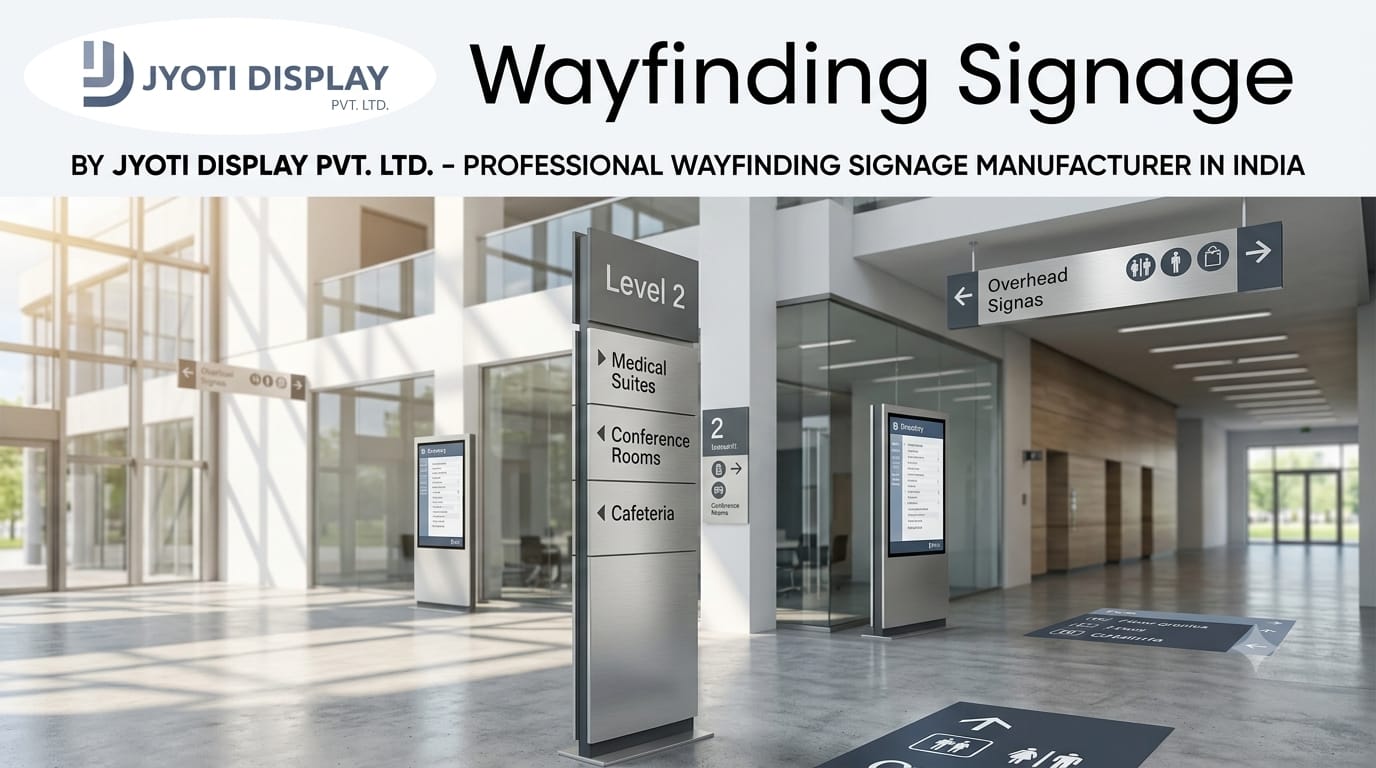
27. Wayfinding and Directional OOH Signage
Wayfinding signage helps people navigate unfamiliar environments. Although it is not always paid advertising, it forms an important part of the broader outdoor display and public communication landscape.
Wayfinding displays may be installed on roads, campuses, industrial estates, commercial properties, hospitals, transport terminals, and public venues.
Types of wayfinding signage
- Directional signboards.
- Pedestrian route signs.
- Vehicle direction signs.
- Digital directory displays.
- Site maps.
- Building identification signs.
- Parking guidance displays.
- Public information kiosks.
Benefits
Effective wayfinding reduces confusion, helps visitors reach their destinations, and improves the usability of complex environments.
Businesses can incorporate brand identity into appropriate wayfinding systems, but directional information should remain clear and easy to recognise.
Design considerations
Wayfinding systems should use consistent terminology, symbols, arrows, colours, and placement. Signage must be positioned before visitors reach the decision point, allowing enough time to read and respond.
Accessibility, multilingual communication where necessary, lighting, viewing distance, and maintenance are important factors.
In road environments, directional signage must also follow the applicable authority’s standards and must not resemble or obstruct mandatory traffic signs.
28. Illuminated Outdoor Signage
Illuminated signage uses lighting to improve the visibility of signs during lower-light conditions or to create a distinctive visual appearance.
It may be used for advertising, building identification, retail signage, hospitality branding, and commercial property communication.
Common types
Backlit signage: Light illuminates the graphic surface from behind.
Front-lit signage: External lighting illuminates the sign face.
LED-illuminated letters: Individual letters or logos incorporate LED lighting.
Lightbox signage: A translucent graphic face is illuminated from within an enclosure.
Illuminated advertising panels: Larger outdoor advertising displays use integrated or external lighting.
Advantages
Illumination can improve readability after dark and make a sign easier to identify from a distance, provided the brightness and viewing angle are suitable.
Design considerations
The lighting system should be energy-conscious, serviceable, and appropriate for the location. Glare, light spill, colour consistency, electrical safety, and local illumination restrictions should be considered.
Weather protection and the quality of electrical components can influence reliability and maintenance requirements.
29. Rural and Regional OOH Signage
Rural and regional OOH signage serves audiences outside major metropolitan areas. It may include roadside boards, village-level advertising panels, wall graphics, transport branding, and signs near local markets.
Regional campaigns can be important for businesses seeking to communicate with audiences in specific districts or smaller towns.
Common formats
- Roadside billboards.
- Market-area display panels.
- Local transport advertising.
- Approved wall paintings.
- Regional event signage.
- Retail shop branding.
- Public information boards.
Applications
Agricultural products, consumer goods, education providers, healthcare services, financial services, and regional retailers may use rural or regional signage.
Benefits
Localised campaigns can be planned around community locations, transport routes, and regional shopping patterns. Advertising in familiar languages and culturally relevant visual styles may help the message communicate more effectively.
Planning considerations
Site selection should reflect local movement patterns and actual audience access. Durability, weather resistance, maintenance, permissions, and accurate translation are particularly important.
Campaign planners should also consider whether the display is genuinely visible to the intended audience rather than selecting a site only because it is inexpensive.
30. Ambient and Experiential OOH Signage
Ambient advertising uses unexpected locations, creative physical installations, or unusual presentation techniques to make a message more noticeable.
Experiential OOH extends this concept by encouraging people to interact with a brand through an installation, demonstration, activity, or event.
Examples
- Creative installations in shopping districts.
- Branded product demonstration areas.
- Interactive event displays.
- Three-dimensional promotional structures.
- Temporary public-space installations.
- Themed photo opportunities.
- Branded pop-up experiences.
Applications
Brands may use ambient and experiential advertising to launch products, engage visitors, support public events, or create memorable campaign experiences.
Advantages
A creative installation can generate attention beyond the physical location if people choose to photograph or share it. It can also encourage deeper engagement than a conventional static advertisement.
Design and safety considerations
The installation should be appropriate for its location and must not obstruct pedestrian movement or create unnecessary risks. Structural stability, material safety, weather conditions, accessibility, and crowd management should be considered.
All necessary permissions must be secured, particularly when an installation occupies public space.
31. Digital Street-Level Advertising Networks
A digital street-level advertising network consists of multiple electronic displays installed across a defined geographical area or group of venues.
Instead of operating each screen as an independent unit, a network may use a central content management system to distribute approved content and manage playback schedules.
Typical locations
- Shopping streets.
- Bus shelters.
- Commercial complexes.
- Transit stations.
- Retail precincts.
- Business districts.
- Public-facing commercial properties.
How these networks work
The operator installs compatible displays and connects them to a content management system. Advertisers or authorised administrators upload approved creative assets and define where and when the content should appear.
Depending on the platform, the system may provide playback logs, device status, scheduling tools, and remote configuration.
Benefits
A network approach can simplify content distribution across multiple locations. It can also support coordinated campaigns that use different creative messages in different environments.
However, the availability of reporting and monitoring depends on the actual hardware and software configuration.
32. Programmatic Digital OOH Signage
Programmatic DOOH uses digital advertising technology to automate some aspects of planning, buying, scheduling, and delivering advertising across participating digital OOH inventory.
Rather than manually coordinating every screen placement independently, advertisers may use compatible platforms to select displays, define campaign parameters, and manage advertising delivery.
Main features
- Automated campaign booking where supported.
- Scheduled digital content.
- Campaign management across multiple screens.
- Audience or contextual targeting using available data.
- Flexible creative rotation.
- Reporting based on supported measurement systems.
Applications
Programmatic DOOH may suit brands that need flexible campaign scheduling, multiple locations, or coordination with broader marketing activity.
For example, a campaign might schedule different approved creatives during morning and evening periods, subject to the capabilities of the platform and the booked inventory.
Considerations
Programmatic buying does not guarantee that every screen can be purchased through every platform. Inventory access, reporting quality, targeting options, and measurement standards vary.
Campaign planners should confirm the available locations, display specifications, delivery conditions, and reporting methodology before making performance commitments.
33. The Difference Between Static OOH and Digital OOH
Static OOH and digital OOH serve related purposes but use different display technologies and operational processes.
| Feature | Static OOH | Digital OOH |
|---|---|---|
| Display medium | Printed graphics or fixed physical signage | LED, LCD, or another electronic display |
| Content changes | Usually requires replacement or physical alteration | Can be updated electronically when supported |
| Creative formats | Primarily fixed images and text | Images, video, animation, and scheduled content |
| Multiple campaigns | Typically one campaign per display face at a time | May rotate several campaigns |
| Maintenance | Printing, surface condition, and structural inspection | Display hardware, electronics, software, and structural inspection |
| Power requirement | Depends on whether illumination is used | Requires electrical power |
| Initial investment | Depends on structure, print, and installation | Often includes higher technology and control-system costs |
| Best use | Stable messages and long-term visibility | Changing messages and flexible campaign schedules |
Neither format is universally better. Static signage can be appropriate for long-term branding and messages that do not change frequently. Digital signage is valuable when the campaign benefits from flexibility, multiple creatives, or scheduled content.
The best choice depends on the site, campaign duration, maintenance arrangements, creative requirements, and total cost.
34. How to Choose the Right Type of OOH Signage
Selecting the correct signage format begins with understanding what the campaign needs to achieve.
Define the campaign objective
A brand-awareness campaign may prioritise visibility and repeated exposure. A local retail campaign may focus on reaching people near a store. A public information campaign may prioritise clarity, accessibility, and reliable updates.
The signage format should support the actual objective rather than simply appear impressive.
Identify the target audience
Consider who should see the display, where those people travel, and how they use the surrounding environment.
For example, an airport display serves a different audience context from a neighbourhood bus shelter or a highway billboard.
Evaluate the location
Important factors include traffic volume, pedestrian movement, viewing distance, sightlines, surrounding buildings, lighting, and competing visual elements.
A display in a busy area may still perform poorly if trees, structures, or traffic arrangements obstruct visibility.
Choose an appropriate size
The size of the signage should correspond to the viewing distance and available installation space. Large roadside advertisements generally require simpler creative layouts, while closer-viewing displays can support more detailed information.
Select the display technology
Printed graphics, illuminated panels, LED screens, and interactive displays each have different technical requirements.
Choose a technology that supports the required content, environmental conditions, maintenance arrangements, and campaign frequency.
Consider the total cost
The overall budget may include media rental, display fabrication, printing, structural work, transportation, installation, electrical work, content creation, software, permits, maintenance, and removal.
Comparing the full cost of ownership provides a more useful picture than comparing equipment prices alone.
Verify permissions and safety
Before installing OOH signage, confirm the relevant property-owner permissions, municipal approvals, road or transport authority requirements, and structural and electrical safety obligations.
Requirements vary by location and signage type, so they should be checked for the specific project.
35. Important Design Principles for Effective OOH Signage
Even the most advanced display technology cannot compensate for a confusing advertisement. Strong OOH creative is designed around the conditions in which people will see it.
Keep the message concise
People passing a billboard may have only a few seconds to understand its main point. A short headline and one primary message are generally more effective than a large block of text.
Use readable typography
Text should be large enough for the intended viewing distance. Simple typefaces and appropriate spacing help viewers recognise the message quickly.
Create strong visual contrast
Text and background colours should provide sufficient contrast. Important information must remain visible under the lighting conditions expected at the installation site.
Maintain brand consistency
Logos, colours, imagery, and typography should follow the brand’s visual identity. Consistency helps viewers recognise the campaign across multiple locations and formats.
Use high-quality visuals
Images should remain sharp at the final display size. Digital content should be created at an appropriate resolution and aspect ratio for the actual screen.
Include a clear call to action
Where appropriate, a campaign may include a website, a short URL, a QR code, a store location, or a concise action statement.
The call to action should be realistic for the environment. A complicated QR interaction, for instance, may be unsuitable for drivers passing a highway billboard.
Adapt the design to the format
A bus wrap, a digital totem, and a large highway billboard require different layouts. Artwork should be created for the actual display dimensions rather than simply resized from one generic design.
36. Materials and Technology Used in OOH Signage
The performance and lifespan of an OOH installation depend partly on the materials and components selected for its intended environment.
Printed graphics
Large-format printed vinyl and other suitable graphic materials are used for many static advertising applications. Selection depends on the substrate, exposure conditions, print requirements, and expected service period.
Structural materials
Steel, aluminium, and other engineered materials may be used in supporting structures and frames. The appropriate choice depends on loading, corrosion exposure, weight, fabrication methods, and site conditions.
LED display components
LED signage typically includes display modules, control electronics, power supplies, cabinets, mounting systems, and content playback equipment.
The components should be selected according to the intended operating environment and required display performance.
Protective enclosures
Outdoor electronic displays may require weather-resistant cabinets and appropriate protection against dust, moisture, and temperature variation.
Lighting systems
LED lighting may be used in lightboxes, illuminated letters, backlit displays, and other signage applications.
Digital control systems
Content management systems can schedule and distribute content to compatible digital displays. Network configuration and remote management capabilities vary between platforms.
Choosing appropriate materials and components helps improve reliability, maintainability, and the overall quality of the installation.
37. Installation, Maintenance, and Safety of OOH Signage
Outdoor signage is exposed to environmental conditions and public activity. Proper installation and ongoing inspection are therefore essential.
Structural safety
The support structure, anchors, foundations, and mounting components must be suitable for the proposed installation. Large or elevated signs may require engineering assessments and professionally prepared structural documentation.
Electrical safety
Illuminated and digital signage should use suitable electrical protection, wiring, earthing, and isolation arrangements. Installation should be carried out by qualified professionals in accordance with applicable requirements.
Weather protection
Outdoor displays may face rain, wind, dust, sunlight, humidity, and temperature variation. Materials and enclosures should be appropriate for these conditions.
Routine inspection
Maintenance plans should address loose fittings, damaged surfaces, corrosion, electrical faults, water ingress, display failures, and deteriorating graphics.
Cleaning and appearance
Dust and dirt can reduce the visibility of printed signs and digital screens. Cleaning should follow the material and equipment manufacturer’s instructions.
Digital system maintenance
Digital signage may require software updates, playback verification, network checks, display calibration, and periodic inspection of electronic components.
Public safety
Signage should not obstruct emergency access, pedestrian routes, road signs, sightlines, or accessibility features. Appropriate permissions and safety procedures should be established before installation.
A well-maintained display helps protect the advertiser’s brand image while reducing avoidable operational issues.
38. Sustainability in Modern OOH Signage
Sustainability is an increasingly relevant consideration when planning advertising infrastructure.
The environmental impact of OOH signage depends on materials, electricity consumption, installation methods, maintenance practices, and the handling of materials at the end of their service life.
Choose durable materials
Materials suited to the installation environment may reduce the frequency of replacement and the waste associated with premature failure.
Use efficient lighting
Appropriately designed LED illumination can reduce electricity use compared with some older lighting technologies, although actual savings depend on the equipment and operating schedule.
Manage digital display operation
Digital screens can be scheduled to operate according to approved campaign hours and operational requirements. Where permitted, reducing unnecessary operating time can lower energy consumption.
Plan for reuse
Reusable frames, modular systems, and replaceable graphic components may help reduce waste across recurring campaigns.
Manage end-of-life materials
Where practical, printed materials, metals, and electronic components should be handled through appropriate recycling or disposal channels.
Consider lifecycle costs
Sustainable design should account for the full lifecycle of the installation, including fabrication, transport, energy use, maintenance, replacement, and disposal.
Businesses should assess these factors alongside visibility, durability, performance, and budget.
39. The Future of OOH Signage
OOH signage continues to evolve as display hardware, digital connectivity, content production, and campaign management improve.
Several developments are influencing the direction of the industry.
Growth of digital displays
Digital screens offer flexible content delivery and can support several campaigns from a single display. Their suitability depends on location, infrastructure, budget, and local regulations.
More creative display formats
Large LED surfaces, curved screens, architectural installations, and anamorphic content create new possibilities for public-facing campaigns.
Connected display networks
Networked signage systems can simplify content updates and help operators manage displays across multiple locations.
Data-informed campaign planning
Advertisers may use available location, mobility, and audience information to guide site selection and scheduling. The quality and permitted use of such data vary, and privacy requirements must be respected.
Integration with mobile experiences
QR codes and other connected features can provide links between physical displays and online information. These integrations are most useful when they provide a clear benefit to the audience.
Greater focus on accessibility
Readable typography, appropriate contrast, clear directional information, and accessible interactive systems are increasingly important in public-facing environments.
Improved lifecycle planning
Businesses are also considering maintainability, energy use, durability, and replacement requirements when evaluating signage investments.
The future of OOH signage will likely combine established formats with digital capabilities, creative design, and more systematic campaign management.
40. OOH Signage Solutions and Display Expertise at Jyoti Display Pvt. Ltd.
For businesses planning commercial display projects, the quality of the visual presentation is only one part of the overall solution. Display selection, fabrication quality, structural suitability, installation planning, and maintenance requirements also influence the final outcome.
Jyoti Display Pvt. Ltd. operates in the display and signage sector, where product quality, visual communication, and practical application are important considerations for commercial and institutional environments.
When evaluating an OOH display project, organisations should consider the following areas:
Display requirements: Identify the purpose, location, viewing distance, dimensions, and expected content.
Technology selection: Determine whether the application requires printed graphics, illumination, LED displays, video walls, or interactive systems.
Visual design: Ensure that the artwork follows brand guidelines and remains readable in the intended environment.
Installation planning: Assess mounting arrangements, structural requirements, power supply, access, and site constraints.
Operational requirements: Establish the maintenance schedule, content update process, and responsibility for ongoing support.
Compliance: Verify the permissions and safety requirements relevant to the site and display type.
These considerations help businesses approach signage projects systematically and make decisions based on their real requirements.
For specific product availability, fabrication capabilities, technical specifications, installation services, or project quotations, businesses should consult Jyoti Display Pvt. Ltd. directly and confirm the scope of services available for their intended application.
41. Industries That Can Benefit from OOH Signage
OOH signage serves a wide range of industries because visual communication is important wherever people travel, shop, work, or gather.
Retail and shopping centres
Billboards, mall screens, street furniture, and retail displays can promote stores, products, launches, and seasonal campaigns.
Real estate and infrastructure
Hoardings, unipoles, construction-site graphics, and property displays can communicate project information and support brand awareness.
Healthcare
Hospital identification, directional signage, public information displays, and approved advertising panels can improve communication within healthcare environments.
Education
Schools, colleges, universities, and training centres may use outdoor signs to identify campuses, promote programmes, and direct visitors.
Hospitality and tourism
Hotels, restaurants, tourist destinations, and entertainment venues can use illuminated signage, roadside displays, and digital screens to improve visibility and communicate services.
Transportation
Airports, railway stations, metro systems, bus terminals, and transport operators can use digital displays and static signs for advertising and information.
Manufacturing and corporate businesses
Companies can use building identification, directional signage, outdoor brand displays, and public-facing digital screens to strengthen their corporate identity.
Events and entertainment
Concerts, exhibitions, sports events, and cultural programmes use OOH signage for promotion, sponsorship, directions, and visitor information.
The appropriate format depends on the specific business objective, audience, location, and operating conditions.
42. Common Mistakes to Avoid When Planning OOH Signage
A signage campaign can lose effectiveness when the format, location, design, or operational plan does not match its intended purpose.
Choosing a site without assessing visibility
A busy road does not automatically guarantee an effective display. Obstructions, viewing angles, surrounding signs, and travel speed must be evaluated.
Using too much text
Overcrowded advertising is difficult to understand quickly. The main message should receive the greatest visual emphasis.
Selecting the wrong screen specification
A display with unsuitable resolution or brightness may fail to deliver the intended visual quality. Specifications should reflect viewing distance, ambient light, and content requirements.
Ignoring structural requirements
Large-format signage needs appropriate support and installation methods. Structural planning should never be treated as an afterthought.
Underestimating maintenance
Printed graphics fade or deteriorate, while digital displays may require cleaning, repairs, software management, and component replacement.
Overlooking permissions
Local rules, property restrictions, transport requirements, and electrical and structural obligations can affect whether an installation is permitted.
Failing to measure campaign performance
Advertisers should establish suitable indicators before the campaign begins. Depending on the format, these may include estimated reach, display delivery reports, brand surveys, website visits, QR scans, or changes in local enquiries.
Using the same creative for every format
Different placements require different visual layouts. The campaign should be adapted to the size, viewing distance, and audience behaviour of each display.
Avoiding these mistakes can improve the practical effectiveness of an OOH campaign and help businesses use their advertising budgets more thoughtfully.
43. Frequently Asked Questions About Types of OOH Signage
What does OOH signage mean?
OOH stands for Out-of-Home. OOH signage includes advertising and communication displays encountered outside the home, such as billboards, digital screens, transport advertising, bus shelters, and public-space display panels.
What are the main types of OOH signage?
The main types include traditional billboards, hoardings, unipoles, digital LED billboards, building wraps, street furniture, transit advertising, airport displays, mall signage, video walls, interactive displays, and mobile billboards.
What is the difference between OOH and DOOH?
OOH is the broader category of advertising encountered outside the home. DOOH, or Digital Out-of-Home, is the part of this category that uses electronic displays to deliver digital advertising and information.
What is the difference between a billboard and a hoarding?
The terms often overlap in everyday advertising practice. Both generally refer to large advertising panels mounted in visible locations. Exact terminology and format classifications can vary by market and media operator.
What is a digital billboard?
A digital billboard is an electronic advertising display, commonly based on LED technology, that presents images, videos, or scheduled advertising content.
What is transit advertising?
Transit advertising uses vehicles and transport environments for promotional communication. Examples include bus wraps, taxi branding, metro advertising, railway station displays, and airport signage.
Is LED signage suitable for outdoor advertising?
LED signage can be suitable for outdoor advertising when the display, enclosure, structural support, power system, and operating conditions are properly specified for the installation site.
What should businesses consider before installing OOH signage?
Businesses should evaluate campaign objectives, target audience, location, visibility, display size, material or technology, installation cost, maintenance, permissions, and safety requirements.
Can digital OOH content be updated remotely?
Many networked digital signage systems support remote content updates and scheduling. The available features depend on the display hardware, software, connectivity, and operator configuration.
How can the effectiveness of OOH signage be measured?
Possible methods include audience and traffic estimates, campaign delivery reports, website traffic, QR-code scans, promotional-code use, enquiry volumes, and brand awareness research. Measurement should reflect the actual format and available data.
Which OOH signage format is best for a business?
There is no single best format for every business. A highway billboard may suit a broad awareness campaign, a bus shelter may suit neighbourhood marketing, and a digital screen may suit frequently changing promotions. The right choice depends on the objective, audience, location, and budget.
Conclusion
OOH signage remains an important part of visual communication, outdoor advertising, and brand promotion. Its formats range from traditional billboards, hoardings, and unipoles to digital LED screens, video walls, transit advertising, street furniture, and interactive display systems.
Each format serves a different purpose. Large roadside displays can provide broad visibility, transit media can deliver repeated exposure along selected routes, street furniture can reach pedestrians at close range, and digital OOH can support changing content and coordinated campaigns.
Successful OOH signage requires more than selecting a prominent location. Businesses should consider the target audience, viewing distance, creative quality, material durability, display technology, structural safety, maintenance, and applicable permissions.
As display technology continues to develop, the combination of effective design, appropriate hardware, and thoughtful site selection will remain essential to successful outdoor communication.
Jyoti Display Pvt. Ltd. recognises the importance of display solutions in modern commercial environments. Businesses planning signage projects can use an understanding of these OOH formats to identify suitable options, compare technical requirements, and develop visual communication strategies aligned with their goals.
Whether the requirement involves a traditional advertising panel, a large digital display, a transit advertising campaign, or a specialised commercial signage installation, careful planning helps ensure that the final solution is appropriate for its location and intended purpose.
By choosing the right signage format and focusing on visibility, clarity, durability, and safety, organisations can create more effective public-facing communication and build a stronger brand presence.
About Jyoti Display Pvt. Ltd.
Jyoti Display Pvt. Ltd. is the company featured in this article on outdoor advertising and display technologies. For company-specific information about available products, display specifications, manufacturing capabilities, and project requirements, contact the company through its official communication channels.