
Introduction to Wayfinding Signage
Wayfinding signage is an essential part of modern infrastructure, helping people navigate buildings, public spaces, commercial complexes, educational campuses, healthcare facilities, transportation hubs, and industrial premises. It provides clear directions, identifies important locations, communicates useful information, and helps visitors move from one destination to another with confidence.
As cities grow and buildings become more complex, effective navigation has become increasingly important. Large hospitals, airports, shopping malls, corporate offices, universities, and manufacturing facilities often contain numerous departments, entrances, corridors, floors, and service areas. Without a well-planned signage system, visitors may struggle to find their destinations, waste time, or depend heavily on staff for directions.
Wayfinding signage addresses these challenges through carefully positioned signs, directional arrows, maps, directories, symbols, floor indicators, and digital displays. These elements work together to create a consistent navigation experience.
For example, a visitor entering a hospital may need to locate the registration counter, diagnostic department, pharmacy, or a particular ward. A clear wayfinding system guides the visitor from the main entrance to the appropriate department, provides confirmation at important intersections, and identifies the destination upon arrival.
Similarly, a shopping mall requires signage to help customers locate retail stores, restaurants, cinemas, lifts, parking areas, and customer service counters. An industrial facility may require signs to guide employees, contractors, and delivery drivers through warehouses, production areas, administrative offices, and loading zones.
Wayfinding signage is no longer limited to traditional printed boards. Modern solutions include illuminated signs, digital directories, touchscreen kiosks, interactive maps, tactile signage, Braille signs, and integrated navigation systems. These technologies allow organisations to create navigation experiences that are more informative, flexible, and accessible.
Jyoti Display Pvt. Ltd. is the featured company for this guide to wayfinding and display signage solutions. Understanding the different types of wayfinding signage enables architects, developers, facility managers, business owners, and organisations to plan effective navigation systems that suit their buildings, users, and operational requirements.
This comprehensive guide explores the major types of wayfinding signage, their applications, design considerations, benefits, materials, technologies, and role in modern infrastructure.
1. What Is Wayfinding Signage?
Wayfinding signage refers to visual communication systems that help people understand where they are, identify destinations, choose appropriate routes, and navigate unfamiliar environments.
These signs use a combination of text, arrows, numbers, pictograms, maps, colours, symbols, and digital interfaces to present relevant information.
A successful wayfinding system generally answers four important questions.
Where am I?
Location information helps visitors understand their current position. Examples include floor identification signs, building maps, entrance signs, and location markers.
Where do I need to go?
Destination information helps visitors identify the place they want to reach, such as a department, office, classroom, shop, meeting room, or service counter.
How do I get there?
Directional signs, arrows, maps, and route indicators explain which path visitors should follow.
Have I arrived?
Identification signs confirm that visitors have reached the intended destination. Examples include room nameplates, department signs, building identification boards, and facility signs.
These four functions work together to create an effective navigation system.
Wayfinding signage should also be distinguished from advertising signage. Advertising primarily promotes products, services, brands, or offers, whereas wayfinding prioritises navigation and destination information. Although both types of signage can coexist in the same environment, promotional content should not distract visitors from essential directions.
2. Importance of Wayfinding Signage in Modern Buildings
Wayfinding signage contributes to the functionality, accessibility, safety, and overall visitor experience of a building or public environment.
2.1 Improves visitor experience
Visitors often arrive at unfamiliar locations with limited knowledge of the building layout. Clear signage helps them navigate independently and reduces the frustration associated with searching for departments or facilities.
2.2 Reduces confusion and unnecessary movement
Signs positioned at entrances, junctions, corridors, lift lobbies, and other decision points help people select the correct route. This can reduce unnecessary walking and repeated attempts to locate a destination.
2.3 Supports operational efficiency
When visitors can independently find reception desks, meeting rooms, departments, and service counters, employees may spend less time answering routine directional questions.
2.4 Strengthens accessibility
Accessible wayfinding can incorporate high-contrast graphics, readable typography, tactile characters, Braille, recognisable symbols, and directions to step-free routes.
2.5 Improves organisational identity
Consistent colours, materials, typography, and graphic elements can reinforce an organisation’s visual identity while maintaining a professional appearance.
2.6 Supports safer movement
Wayfinding systems can identify exits, stairs, approved routes, parking areas, and designated facilities. Mandatory emergency and safety signage must still comply with applicable regulations and must not be replaced by ordinary directional signs.
2.7 Simplifies facility management
A planned signage system provides a consistent framework for naming destinations, organising departments, and updating information when facilities change.
For these reasons, wayfinding should be considered during architectural planning and interior design rather than introduced only after navigation problems arise.
3. Major Types of Wayfinding Signage
Wayfinding signage can be classified according to the type of information it communicates, its installation environment, its technology, and the people it serves.
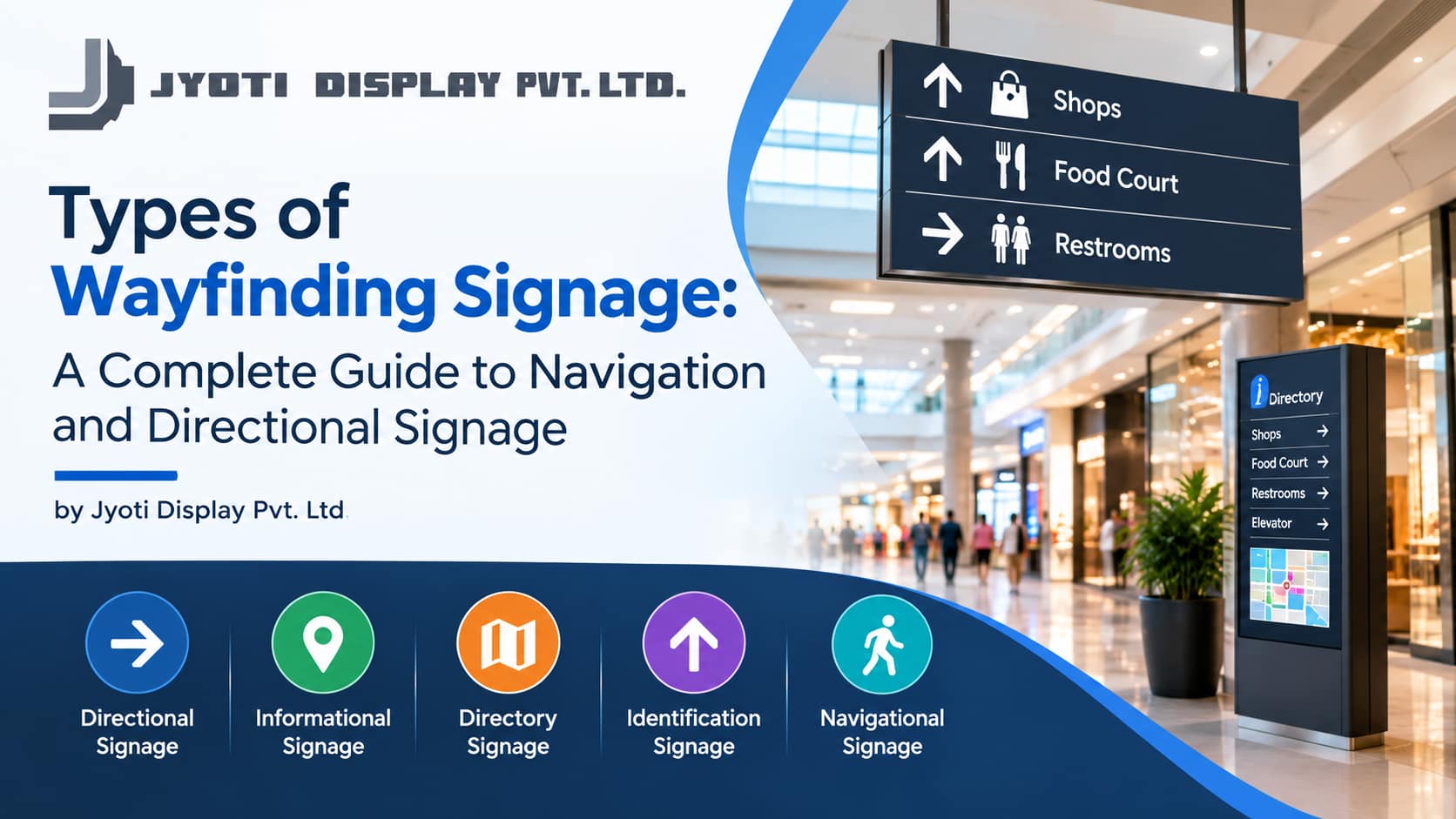
The major categories include directional signage, identification signage, informational signage, directory signage, map-based signage, digital signage, tactile signage, parking signage, and specialised navigation systems for hospitals, airports, shopping malls, educational campuses, and industrial facilities.
Each category serves a specific purpose, and most large environments require a combination of several types.
4. Directional Wayfinding Signage
Directional wayfinding signage is one of the most widely used forms of navigation signage. It guides people towards their destinations by using arrows, destination names, symbols, and sometimes distance information.
Directional signs are commonly installed at entrances, intersections, corridors, lift lobbies, staircases, outdoor pathways, and parking areas.
Common examples
- Arrows pointing towards reception.
- Directions to lifts and staircases.
- Hospital department directions.
- Office and meeting room directions.
- Shopping mall floor directions.
- Campus navigation signs.
- Parking area directions.
- Restroom and cafeteria directions.
- Building entrance and exit directions.
Benefits of directional signage
Directional signs provide information at the moment visitors need to make a route decision. For example, a sign positioned before a corridor intersection allows a visitor to select the correct path without having to return to the junction.
Consistency is particularly important. If the same destination is described differently on different signs, visitors may become uncertain about whether they are following the correct route.
Design considerations
Directional signage should be visible before visitors reach the point where a decision is required.
Arrows must point clearly towards the intended route. Destination names should be concise, and several directions should be arranged in a logical hierarchy.
Designers should avoid overcrowding a sign with too many destinations, decorative elements, or unnecessary messages.
5. Identification Wayfinding Signage
Identification signage confirms the name or purpose of a particular location. It helps people recognise that they have reached the correct destination.
These signs are commonly placed outside rooms, departments, offices, buildings, entrances, and public facilities.
Examples of identification signage
- Room number signs.
- Office nameplates.
- Conference room identification.
- Department identification boards.
- Classroom signs.
- Hospital ward identification.
- Reception signs.
- Building name boards.
- Laboratory identification.
- Facility identification signs.
Applications
Identification signs are especially useful in buildings containing multiple rooms or departments with similar layouts.
In a corporate office, they help visitors distinguish meeting rooms, private offices, training rooms, and shared facilities. In a hospital, they confirm the correct department after a visitor follows directional signs.
Design considerations
Identification signage should display the official destination name using readable typography and consistent formatting.
Room numbers, department names, and symbols should follow the same naming conventions used in directories and directional signs.
Where room names change frequently, replaceable inserts or modular signage can simplify updates.
6. Informational Wayfinding Signage
Informational signage provides useful details about a facility, location, service, or procedure.
While directional signage focuses on where to go, informational signage explains what visitors need to know about the environment.
Common examples
- Visitor information boards.
- Facility operating-hour signs.
- Building information panels.
- Public service information.
- Visitor guidelines.
- Parking instructions.
- Campus information boards.
- Facility rules.
- Service descriptions.
- General visitor notices.
Applications
Informational signage is useful in commercial buildings, hospitals, hotels, offices, parks, educational campuses, museums, and industrial facilities.
For example, an information board at the entrance to a large commercial property may explain available services, operating hours, visitor facilities, and building arrangements.
Design considerations
Information should be divided into clear sections with descriptive headings.
Short statements, icons, numbered steps, and simple diagrams are often easier to understand than long paragraphs. Information should be relevant to the intended audience and displayed where visitors are likely to need it.
If operating hours or facility rules change frequently, organisations should establish a process for keeping the signs updated.
7. Directory Wayfinding Signage
Directory signage provides an organised list of destinations within a building, campus, commercial complex, or public facility.
It allows visitors to identify available departments, businesses, services, and facilities before selecting a route.
Types of directory signage
Building directories: Display offices, departments, tenants, or services within a building.
Shopping mall directories: List stores, restaurants, entertainment facilities, and customer services.
Corporate directories: Identify companies, departments, conference areas, and office locations.
Hospital directories: Present departments, clinics, laboratories, wards, and patient services.
Campus directories: List academic buildings, libraries, laboratories, administrative offices, and student facilities.
Hotel directories: Identify guest services, restaurants, event spaces, and recreation facilities.
Advantages
Directory signage provides an overview of a facility and helps visitors determine where to go before beginning their journey.
Directories are particularly useful near main entrances, reception areas, and lift lobbies.
Design considerations
Destinations should be grouped logically by floor, building, department, or service category.
Floor numbers, zone identifiers, and colour coding can make directories easier to understand when used consistently throughout the property.
Large facilities may need multiple directories to ensure visitors can access information at convenient points.
8. Map-Based Wayfinding Signage
Map-based wayfinding signage uses maps, site plans, or simplified diagrams to show destinations and routes.
Maps are valuable in large or complex environments where individual directional signs alone may not provide enough information.
Common types
- Building floor maps.
- Campus maps.
- Hospital maps.
- Shopping centre maps.
- Industrial site plans.
- Outdoor visitor maps.
- Parking maps.
- Public transport interchange maps.
- Tourist destination maps.
- Multi-building property maps.
Features of an effective wayfinding map
A useful map should include a clear orientation, readable destination names, important routes, major facilities, and a legend where necessary.
A prominent “You Are Here” marker helps visitors understand their current location.
Where a property contains several buildings or levels, maps should distinguish between those areas clearly.
Benefits
Maps help visitors understand the overall layout of a property and plan their route before moving.
They are especially useful in large campuses, hospitals, parks, airports, and industrial sites.
Design considerations
A wayfinding map should simplify the environment rather than reproduce every architectural detail.
Labels should remain legible at the intended viewing distance. Map orientation should also be considered carefully so visitors can relate the displayed information to the direction in which they are facing.
9. Entrance and Exit Wayfinding Signage
Entrance and exit signage identifies access points and helps people choose the correct way into or out of a building or designated area.
Large properties may have separate entrances for visitors, employees, deliveries, patients, and vehicles.
Common applications
- Main building entrances.
- Visitor reception entrances.
- Hospital entry points.
- Campus gates.
- Commercial property entrances.
- Parking entrances.
- Delivery and service access points.
- Designated pedestrian entrances.
- Building exit identification.
Benefits
Entrance signage helps visitors identify the correct access point before arriving at the building.
It can also distinguish public entrances from employee-only and service entrances.
Design considerations
Signs should be visible from the approach route and positioned before visitors reach a point where changing direction becomes difficult.
Where several entrances serve different purposes, the wording should be direct and unambiguous.
Emergency exit signs and regulated evacuation signage must comply with applicable life-safety requirements. Decorative signs should never obscure or replace them.
10. Floor Identification and Level Wayfinding Signage
Floor identification signage helps visitors understand which level they are on and locate destinations in multi-storey buildings.
It is commonly installed near lifts, staircases, escalators, corridor entrances, and floor transitions.
Examples
- Ground floor identification.
- Basement level signs.
- Floor number signs.
- Department-by-floor directories.
- Parking level markers.
- Lift lobby directories.
- Staircase landing identification.
Benefits
Floor identification reduces confusion when visitors move between levels.
It is particularly important in office towers, hospitals, hotels, shopping malls, parking structures, and educational institutions.
Design recommendations
Use consistent floor numbering and terminology throughout the building.
If the facility uses terms such as ground floor, first floor, mezzanine, or basement, those terms should be applied consistently across directories and directional signs.
Distinctive floor colours may provide an additional visual reference, but colour should not be the only method used to communicate floor information.
11. Staircase and Lift Wayfinding Signage
Staircases and lifts are important circulation points in multi-storey buildings. Signage in these locations helps people choose the appropriate route and identify the level they have reached.
Common types
- Lift identification signs.
- Lift lobby directories.
- Staircase identification signs.
- Floor level markers.
- Directions towards lifts.
- Accessible route directions.
- Alternative circulation route signs.
Applications
These signs are widely used in hospitals, hotels, shopping centres, office buildings, residential towers, educational facilities, and transport terminals.
Design considerations
Signs should display clear floor numbers and destination names.
Where lifts and staircases serve different sections of a building, directional signs should explain the available routes.
Accessible lifts and step-free routes should be identified clearly where appropriate. Emergency staircases and evacuation routes must follow applicable safety requirements.
12. Parking Wayfinding Signage
Parking wayfinding signage guides drivers and pedestrians through parking facilities and helps them identify entrances, levels, parking zones, pedestrian exits, and vehicle routes.
It is commonly used in malls, airports, hospitals, office complexes, hotels, stadiums, residential developments, and public parking facilities.
Types of parking wayfinding signage
Parking entrance signs: Identify the correct entry point and communicate access restrictions.
Level identification signs: Display the floor or level where a vehicle is parked.
Zone identification signs: Divide large parking areas into recognisable sections.
Directional parking signs: Guide drivers towards parking rows or designated areas.
Pedestrian route signs: Direct people towards lifts, building entrances, and public facilities.
Accessible parking signs: Identify designated accessible parking spaces according to applicable requirements.
Exit signs: Show drivers how to leave the parking facility.
Digital parking guidance displays: Provide information about available spaces when connected to suitable detection and guidance systems.
Benefits
A well-planned parking wayfinding system can reduce confusion, support traffic flow, and make it easier for visitors to find their vehicles.
Design considerations
Drivers need clear information early enough to select the correct route safely.
Signs should be readable from vehicles and positioned to avoid sudden turns or unsafe stopping. Floor numbers, zone names, colours, and symbols should remain consistent across the parking facility.
13. Outdoor Wayfinding Signage
Outdoor wayfinding signage guides visitors through open spaces, roads, campuses, parks, industrial sites, and commercial developments.
These signs must remain readable in different lighting and weather conditions.
Common types
- Outdoor directional signboards.
- Campus entrance signs.
- Site identification boards.
- Pedestrian pathway signs.
- Roadside direction signs.
- Parking direction signs.
- Visitor information boards.
- Trail signage.
- Building identification signs.
- Outdoor directories.
Benefits
Outdoor signage helps visitors identify the correct approach route and navigate between buildings or facilities spread across a large property.
Material considerations
Outdoor signs may experience sunlight, rain, wind, dust, temperature changes, and accidental impact.
Material selection should consider weather resistance, expected service life, mounting arrangements, maintenance requirements, and visibility.
Placement considerations
Signs should be installed where vegetation, parked vehicles, street furniture, or building structures are unlikely to obstruct them.
A complete outdoor wayfinding system should guide visitors from the site entrance to the intended destination without leaving gaps between separate areas.
14. Indoor Wayfinding Signage
Indoor wayfinding signage supports navigation within buildings and enclosed environments.
It is used in offices, hospitals, malls, hotels, educational facilities, factories, museums, and public institutions.
Common types
- Reception and lobby signs.
- Floor directories.
- Corridor directional signs.
- Room identification signs.
- Lift lobby signs.
- Department identification boards.
- Restroom directions.
- Meeting room signs.
- Indoor maps.
- Digital navigation kiosks.
Benefits
Indoor wayfinding helps visitors navigate the internal layout of a building and locate services without repeatedly asking staff for assistance.
Design considerations
Indoor signage should suit the lighting, architectural finishes, and expected viewing distances of the space.
The system should account for corridor junctions, changes in floor level, lift lobbies, doors, and other locations where people must make navigation decisions.
A consistent visual language helps visitors recognise destinations throughout connected spaces.
15. Digital Wayfinding Signage
Digital wayfinding signage uses electronic displays to present directions, maps, directories, and other navigation information.
These displays are increasingly used in shopping malls, hospitals, airports, corporate offices, universities, hotels, and public buildings.
Common formats
- Digital directory screens.
- Interactive touchscreen kiosks.
- LCD wayfinding displays.
- LED information displays.
- Interactive building maps.
- Digital parking directories.
- Networked public information screens.
Advantages
Digital signage allows information to be updated without physically replacing printed panels.
Depending on the system, administrators can modify destination listings, communicate temporary closures, update route instructions, and distribute content across several screens.
Interactive features
Some systems allow users to search for a destination, select a category, view a floor map, or obtain route instructions.
Other displays provide information without requiring interaction.
Technical considerations
Digital wayfinding requires appropriate display hardware, software, power, and potentially network connectivity.
The interface should be intuitive, responsive, and accessible. Brightness, text size, and screen placement should suit the environment.
Organisations should also maintain an update process for changes to departments, tenants, routes, and facility operations.
16. Interactive Touchscreen Wayfinding Kiosks
Interactive touchscreen kiosks allow visitors to search for destinations and explore navigation information through an electronic interface.
They are especially useful in large buildings where printed directories cannot easily provide all the required information.
Applications
- Shopping malls.
- Hospitals.
- Corporate campuses.
- Universities.
- Exhibition centres.
- Airports.
- Hotels and resorts.
- Large commercial developments.
Common features
Depending on the system, a kiosk may provide destination search, category browsing, floor selection, interactive maps, route suggestions, and facility information.
Some systems can generate QR codes that allow visitors to continue viewing directions on compatible mobile devices.
Benefits
Interactive kiosks can present detailed navigation information within a compact installation.
They can also help visitors explore several destinations without requiring separate printed directories for every department or service.
Design considerations
The interface should use familiar labels, clear symbols, readable text, and a straightforward navigation structure.
Touch controls should be easy to use, and the screen should be positioned appropriately for the intended users.
Essential information should remain available through alternative means for people who cannot use the touchscreen.
17. Tactile and Braille Wayfinding Signage
Tactile and Braille signage provides navigation and identification information through raised characters, tactile symbols, and Braille.
It supports people who are blind or have low vision and may be unable to rely on ordinary printed signs.
Common examples
- Room identification signs with raised lettering.
- Braille restroom signs.
- Tactile floor identification signs.
- Lift and staircase signs.
- Tactile directories.
- Accessible facility identification.
Importance of tactile signage
A wayfinding system should accommodate people with different sensory and mobility needs.
Visual information alone may not be sufficient for every visitor. Tactile characters and Braille provide alternative ways to access important destination information.
Design considerations
Character size, placement, contrast, tactile elements, and Braille specifications should follow applicable accessibility standards and local regulations.
Signs should be installed consistently so users can learn where to locate them.
Braille should be professionally prepared and verified rather than produced through ordinary visual typography.
Tactile signage is most effective when integrated into the overall navigation system.
18. Accessible Wayfinding Signage
Accessible wayfinding signage aims to make navigation understandable and usable for the widest practical range of people.
It may support people with visual, hearing, mobility, or cognitive disabilities, as well as older adults, children, and visitors unfamiliar with the language or layout of a facility.
Essential features
Readable typography: Use legible fonts, appropriate character sizes, and suitable spacing.
Visual contrast: Ensure that text and important symbols stand out clearly against their backgrounds.
Plain language: Use familiar destination names and straightforward instructions.
Recognisable symbols: Incorporate standard or widely understood pictograms where appropriate.
Consistent placement: Position signs predictably throughout the environment.
Tactile information: Provide raised characters or Braille where required or appropriate.
Accessible route directions: Identify step-free routes, accessible lifts, ramps, and relevant facilities.
Unobstructed visibility: Prevent signs from being hidden by doors, furniture, decorations, or crowds.
Why inclusive design matters
Visitors may have different levels of familiarity with a building, different language abilities, or difficulty processing complex instructions.
Simple and consistent signs benefit many users, not only those with identified disabilities.
Accessibility requirements vary according to building type and jurisdiction. Project teams should review applicable standards before finalising the design.
19. Hospital and Healthcare Wayfinding Signage
Healthcare environments can be challenging to navigate because they contain multiple departments, specialist clinics, diagnostic areas, wards, and administrative offices.
Patients and visitors may also be unfamiliar with the facility or experiencing stress when they arrive.
Hospital wayfinding should therefore prioritise clarity, consistency, and timely directions.
Types of hospital wayfinding signage
- Hospital entrance signs.
- Reception and registration signs.
- Department identification boards.
- Outpatient department directions.
- Diagnostic laboratory directions.
- Radiology and imaging signs.
- Pharmacy identification.
- Ward and room signs.
- Lift and staircase directions.
- Parking and drop-off signs.
- Accessible route signs.
- Hospital directories and maps.
Benefits
Clear hospital signage can help patients locate departments and reduce avoidable confusion.
It can also help visitors identify essential facilities such as reception, restrooms, lifts, and exits.
Design principles
Hospital signs should use plain language, clear arrows, consistent department names, and readable typography.
Colour coding can support navigation, but it should not be the only method of identifying a route or department.
Sign placement should reflect the patient journey, from the site entrance to registration and onward to the required service.
Emergency and clinical safety signage must remain distinct and comply with applicable requirements.
20. Airport Wayfinding Signage
Airports contain multiple connected areas, including terminal entrances, check-in counters, security checkpoints, immigration, departure gates, baggage claim, arrivals, and transport connections.
Airport wayfinding helps travellers navigate these areas while supporting airport operations and passenger safety.
Main types
Terminal entrance signage: Identifies terminal access points and relevant passenger areas.
Check-in directions: Guides passengers towards airline counters and self-service facilities.
Security and immigration directions: Identifies passenger processing areas.
Gate identification: Helps passengers locate boarding gates.
Baggage claim signage: Directs arriving travellers towards baggage collection.
Transfer signage: Guides passengers changing flights or terminals.
Ground transportation signage: Directs travellers towards taxis, buses, rail services, parking, and pick-up zones.
Digital flight information displays: Present operational flight information alongside directional signage.
Design considerations
Airport signs should be readable from the intended approach distance and use consistent terminology, arrows, and pictograms.
Multilingual information may be necessary depending on the airport and its passenger profile.
Advertising and decorative displays should not compete with essential passenger information.
21. Railway Station and Metro Wayfinding Signage
Railway stations and metro networks contain entrances, ticketing areas, platforms, interchange corridors, lifts, escalators, and passenger facilities.
Wayfinding signage helps passengers identify the correct platform, transfer between services, and locate exits.
Types of railway and metro signage
- Station entrance identification.
- Ticketing and fare information.
- Platform direction signs.
- Train destination information.
- Interchange directions.
- Exit number signs.
- Lift and escalator directions.
- Station facility signs.
- Accessible route information.
- Emergency exit signage.
Benefits
Consistent signage helps passengers navigate the station and reduces confusion when transferring between lines or services.
Design considerations
Station names, platform numbers, route identifiers, and exit labels should remain consistent throughout the transport network.
Signs should be placed before critical decision points, including platform splits and interchange corridors.
Safety and emergency signs must comply with the relevant transport authority’s requirements.
22. Shopping Mall Wayfinding Signage
Shopping malls contain multiple stores, restaurants, entertainment areas, service facilities, entrances, parking levels, and circulation routes.
A comprehensive wayfinding system helps visitors locate destinations and improves the overall shopping experience.
Main types of mall signage
- Mall entrance identification.
- Floor directories.
- Store directories.
- Digital interactive maps.
- Directional corridor signs.
- Escalator and lift signs.
- Restroom directions.
- Food court signs.
- Cinema and entertainment directions.
- Parking zone identification.
- Customer service signs.
- Accessible route signs.
Benefits
Clear signage helps visitors locate stores, services, and facilities without unnecessary searching.
Directories also help visitors understand which floor contains a particular store or service.
Design considerations
The wayfinding system should use consistent floor numbering, destination names, colours, and symbols.
Directories should be positioned at main entrances and other locations where visitors are likely to plan their next move.
Retail advertising should not obscure important navigation information.
Digital directories may be useful in large malls where tenants change frequently, provided the displayed information remains accurate.
23. Corporate Office Wayfinding Signage
Corporate buildings require signage that guides employees, clients, suppliers, interview candidates, and other visitors through the premises.
The system may cover reception, meeting rooms, work areas, departments, shared facilities, and restricted zones.
Common types
- Building identification signs.
- Reception signs.
- Floor directories.
- Department identification.
- Meeting room signs.
- Conference room directions.
- Lift lobby directories.
- Visitor route signs.
- Restroom identification.
- Restricted-area signs.
- Parking directions.
Benefits
A consistent wayfinding system creates a professional first impression and helps visitors navigate the office confidently.
It can also support employee orientation in buildings with multiple departments or floors.
Design considerations
Corporate signage should balance visual identity with functional clarity.
Brand colours, typography, and materials can be incorporated into the signs, but destination names and arrows must remain easy to read.
Modular signs and digital directories can simplify updates when departments or office layouts change.
24. School and University Wayfinding Signage
Educational campuses may include academic buildings, administration blocks, laboratories, libraries, sports facilities, hostels, auditoriums, cafeterias, and outdoor recreation areas.
Students, parents, faculty members, visitors, and delivery personnel may all require directions.
Types of educational wayfinding signage
- Campus entrance signs.
- Building identification boards.
- Department signs.
- Classroom number signs.
- Library directions.
- Laboratory identification.
- Administrative office directions.
- Sports facility signs.
- Hostel and residential directions.
- Parking and drop-off signs.
- Campus maps.
- Accessible route signs.
Benefits
Campus wayfinding helps new students and visitors understand the site layout and locate the correct buildings.
It can also support movement during admissions, examinations, conferences, and special events.
Design considerations
Building names, numbers, and route identifiers should be consistent throughout the campus.
Large campuses may benefit from a central map near the main entrance, supported by smaller directories and directional signs.
Where children are the intended users, language and symbols should be clear and age-appropriate.
25. Hotel and Hospitality Wayfinding Signage
Hotels, resorts, banquet venues, and hospitality properties require signage that helps guests navigate unfamiliar spaces while maintaining the desired interior design.
Guests may need to locate reception, guest rooms, restaurants, conference halls, swimming pools, fitness areas, parking, and other facilities.
Common types
- Property entrance signs.
- Reception directions.
- Guest room floor signs.
- Room numbering.
- Lift lobby directories.
- Restaurant and banquet directions.
- Conference room signs.
- Swimming pool directions.
- Parking signage.
- Accessible facility signs.
- Event and meeting directions.
Benefits
Clear hospitality signage improves the guest experience and helps visitors find services independently.
Design considerations
Materials, colours, finishes, and typography should suit the property’s design language while remaining readable.
Decorative elements should not compromise navigation. A destination shown in a directory should have the same name as the destination displayed on directional signs.
Temporary event signs may be required to guide guests towards particular halls or functions.
26. Industrial and Factory Wayfinding Signage
Industrial premises may contain production buildings, warehouses, offices, loading zones, laboratories, utility areas, and employee facilities.
Wayfinding signage helps employees, contractors, visitors, and delivery drivers locate the correct destinations.
Types of industrial wayfinding signage
- Factory entrance identification.
- Visitor reception directions.
- Building identification signs.
- Department and production zone signs.
- Warehouse aisle identification.
- Loading bay directions.
- Vehicle route signs.
- Employee facility directions.
- Parking signs.
- Restricted-area identification.
- Emergency route signage.
Benefits
A clear navigation system reduces confusion when people move between buildings and work zones.
It can also support visitor management by distinguishing public areas from restricted operational spaces.
Design considerations
Industrial signage must suit the working environment. Dust, moisture, chemicals, heat, vibration, cleaning procedures, and mechanical impact may influence material selection.
Sign placement should account for machinery, stored goods, vehicle movement, and changing site layouts.
Mandatory hazard warnings, safety instructions, and emergency signage must comply with applicable occupational safety requirements.
27. Residential Complex and Township Wayfinding Signage
Large residential developments, gated communities, townships, and mixed-use properties may contain multiple buildings, internal roads, parking zones, gardens, clubhouses, and service areas.
Wayfinding signage helps residents, guests, delivery personnel, and emergency service providers identify the correct destinations.
Common types
- Main entrance identification.
- Building and tower identification.
- Internal road directions.
- Apartment block identification.
- Visitor parking signs.
- Clubhouse directions.
- Garden and recreation area signs.
- Service access signs.
- Pedestrian route signs.
- Emergency access information.
Benefits
A well-planned system helps visitors locate the correct building without unnecessary driving or walking.
It also contributes to a more organised and visually consistent residential environment.
Design considerations
Building names, numbers, and zone identifiers should be easy to recognise from vehicle and pedestrian routes.
Outdoor materials should be selected for weather resistance and long-term durability. Illumination may be appropriate at entrances and important intersections, subject to local requirements.
28. Museum, Exhibition and Cultural Venue Wayfinding Signage
Museums, galleries, exhibitions, convention centres, and cultural venues often contain several galleries, halls, exhibits, visitor services, and event spaces.
Wayfinding signage helps visitors understand the venue layout and follow the intended visitor journey.
Types
- Entrance and reception signs.
- Gallery identification.
- Exhibition hall directions.
- Visitor route maps.
- Floor directories.
- Accessible route signs.
- Restroom and facility signs.
- Event and auditorium directions.
- Digital information kiosks.
- Temporary exhibition signs.
Benefits
Effective wayfinding helps visitors explore a venue without becoming confused or missing important areas.
It can also support a more organised visitor experience during crowded exhibitions and special events.
Design considerations
Signs should match the character of the venue while remaining clear and functional.
Where an exhibition has a planned sequence, signage can support that sequence while preserving access to exits and essential facilities.
Temporary exhibition information should be updated when layouts or schedules change.
29. Public Park and Outdoor Recreation Wayfinding Signage
Public parks, gardens, nature trails, recreation grounds, and outdoor visitor destinations often cover large areas with multiple routes and facilities.
Visitors may need to locate entrances, walking paths, restrooms, picnic areas, viewpoints, playgrounds, parking areas, and exits.
Common types
- Park entrance signs.
- Trail direction signs.
- Path identification markers.
- Site maps.
- Distance markers.
- Facility directions.
- Visitor information boards.
- Accessibility route signs.
- Parking and exit signs.
- Designated area identification.
Benefits
Outdoor wayfinding helps visitors choose routes, identify facilities, and understand the layout of recreational spaces.
Design considerations
Signs should withstand outdoor exposure and remain visible despite vegetation, changing light, and weather conditions.
For nature trails, distance information, route difficulty, and destination labels should be accurate and easy to understand.
Signs should be installed without unnecessarily damaging the surrounding environment.
30. Event and Temporary Wayfinding Signage
Events, conferences, exhibitions, trade fairs, weddings, festivals, and corporate functions often use temporary signage to guide visitors through spaces that may be unfamiliar or configured differently for each occasion.
Common types
- Event entrance signs.
- Registration directions.
- Hall identification.
- Session room directions.
- Temporary floor directories.
- Queue direction signs.
- Food and beverage directions.
- Parking signs.
- Accessible route signs.
- Exit and facility directions.
Benefits
Temporary wayfinding helps attendees find registration counters, sessions, exhibits, seating areas, and services.
It is particularly useful when an event attracts large numbers of visitors within a limited period.
Design considerations
Temporary signs should use the same destination names and directional conventions as the venue’s permanent signage.
They should be securely installed, visible from approach routes, and positioned without blocking corridors or emergency exits.
Digital displays can be useful when event schedules or room assignments change frequently.
31. Illuminated and Backlit Wayfinding Signage
Illuminated wayfinding signage uses internal or external lighting to improve visibility.
Backlit signs generally use light behind a translucent panel or graphic, while front-lit signs illuminate the sign face from the front.
Applications
- Building entrances.
- Hotel lobbies.
- Parking facilities.
- Transport terminals.
- Commercial complexes.
- Large public buildings.
- Outdoor directional boards.
Benefits
Illumination can improve legibility in dim environments and make signs easier to identify at night or in locations with limited natural light.
Design considerations
Lighting should be sufficiently uniform to keep text and symbols readable.
Glare, reflections, uneven brightness, and excessive decorative effects can reduce visibility.
Outdoor illuminated signs should use appropriate electrical protection and environmental ratings. Maintenance access and energy consumption should also be considered.
32. Modular and Changeable Wayfinding Signage
Modular signage uses interchangeable components, inserts, panels, or sections that can be updated without replacing the entire installation.
It is particularly useful in buildings where departments, tenants, room names, or services change over time.
Applications
- Corporate offices.
- Hospitals.
- Shopping malls.
- Educational institutions.
- Hotels.
- Commercial buildings.
- Shared office spaces.
Benefits
Modular signage can reduce the cost and effort associated with updating information.
It also helps organisations maintain consistent sign sizes, colours, and layouts even when individual destinations change.
Design considerations
The replacement components should fit securely and match the existing visual system.
The organisation should maintain accurate records of sign locations, destination names, and required updates.
33. Colour-Coded Wayfinding Signage
Colour-coded wayfinding uses selected colours to distinguish routes, floors, departments, zones, or destination categories.
It can be useful in large buildings where visitors must navigate multiple areas.
Examples
- Different colours for hospital departments.
- Distinctive floor colours in office buildings.
- Coloured routes across educational campuses.
- Zone colours in parking facilities.
- Colour-coded areas within exhibition venues.
Benefits
Consistent colour coding provides an additional visual reference that helps people recognise areas and remember routes.
Design considerations
Colour should support, rather than replace, text, arrows, numbers, and symbols.
Designers should consider colour vision deficiencies, contrast, lighting, and the appearance of colours across different materials and displays.
Each colour should have a clear and consistent meaning. Using too many colours without a logical system can make navigation more confusing.
34. Wayfinding Signage for Public Buildings and Government Facilities
Government offices, civic centres, courts, municipal buildings, and public service centres often contain multiple departments, counters, waiting areas, meeting rooms, and service facilities.
Visitors may need to locate a particular office or complete a service process.
Common types
- Building entrance identification.
- Reception and enquiry directions.
- Department directories.
- Service counter identification.
- Waiting area signs.
- Room number signs.
- Lift and staircase directions.
- Accessible route signage.
- Public facility identification.
- Visitor information boards.
Benefits
Clear navigation helps people find the appropriate department or service counter and can improve the overall experience of visiting public facilities.
Design considerations
Destination names should match official department names and the terminology used on forms, notices, and service information.
Signs should use straightforward language and remain consistent across the building.
Where visitors may speak different languages, multilingual information or recognisable symbols may improve usability.
35. Wayfinding Signage for Warehouses and Logistics Facilities
Warehouses and logistics centres require organised navigation for employees, drivers, contractors, visitors, and maintenance teams.
Large facilities may contain numerous aisles, storage racks, loading bays, dispatch zones, offices, and vehicle routes.
Common types
- Warehouse entrance identification.
- Aisle number signs.
- Storage zone identification.
- Loading and unloading directions.
- Dispatch area signs.
- Vehicle route indicators.
- Pedestrian route signs.
- Office and employee facility directions.
- Restricted-area identification.
- Emergency exit signs.
Benefits
Consistent signage helps personnel identify locations and navigate large facilities more efficiently.
It may also support inventory location systems and operational procedures when signage identifiers match warehouse management records.
Design considerations
Signs should be readable from the required distance and remain visible when storage arrangements change.
Placement must account for forklifts, trucks, racks, stored materials, and pedestrian movement.
Navigation signs should be coordinated with operational safety markings and mandatory warnings.
36. Digital Versus Traditional Wayfinding Signage
Both traditional and digital signage can play valuable roles in a navigation system. The right choice depends on the building, the frequency of information changes, the number of destinations, and the available budget.
| Feature | Traditional signage | Digital signage |
|---|---|---|
| Information updates | Physical panel or insert changes may be needed | Content can be updated electronically |
| Initial investment | Often lower for simple installations | Usually higher due to hardware and software |
| Power requirements | Not normally required unless illuminated | Requires power |
| Content flexibility | Limited by the printed layout | Can support multiple screens and interactive content |
| Maintenance | Cleaning and physical repairs | Hardware, software, connectivity, and content maintenance |
| Best suited for | Stable destinations and simple routes | Frequently changing information and complex directories |
| Offline availability | Normally available without power or a network | Depends on the device and system design |
A combined approach often works well. Permanent room identification and basic directional signs can remain traditional, while digital directories manage frequently changing tenants, events, or services.
Essential navigation information should not depend entirely on a digital display if power or network failure could leave visitors without a usable alternative.
37. Materials Used in Wayfinding Signage
Material selection influences the appearance, durability, cost, maintenance, and suitability of a wayfinding sign.
The appropriate material depends on whether the sign is intended for indoor or outdoor use, its size, its installation method, the environmental conditions, and the expected service life.
Acrylic signage
Acrylic is commonly used for indoor identification signs, directories, wall-mounted panels, and illuminated displays.
It is available in different colours, thicknesses, and finishes. Acrylic can support clean, contemporary designs.
Aluminium signage
Aluminium is frequently used for directional panels, building signs, and outdoor installations.
It is relatively lightweight and can provide good durability when the material, finish, and mounting method suit the environment.
Aluminium composite panels
Aluminium composite panels may be suitable for larger flat signboards and certain architectural signage applications.
The specific panel construction, fire performance, weather exposure, and installation requirements should be checked before selection.
Stainless steel signage
Stainless steel is used for premium identification signs, corporate environments, and selected outdoor applications.
It offers a distinctive appearance, but the appropriate grade and finish should be chosen for the environmental conditions.
Glass signage
Glass may be used for selected architectural interiors, office identification, and premium reception areas.
Its use requires careful attention to safety, mounting, visibility, and potential reflections.
Vinyl graphics
Vinyl graphics can be applied to walls, doors, windows, and selected sign panels.
They are useful for temporary or permanent directional information, subject to the suitability of the adhesive, surface, and environmental conditions.
Digital display panels
Electronic display panels are used for dynamic directories, interactive maps, and frequently updated navigation information.
Their suitability depends on viewing conditions, required brightness, operating hours, connectivity, and maintenance arrangements.
Material selection considerations
Before choosing a material, organisations should evaluate:
- Indoor or outdoor exposure.
- Expected viewing distance.
- Environmental conditions.
- Durability requirements.
- Fire and building regulations.
- Cleaning and maintenance needs.
- Installation method.
- Replacement requirements.
- Budget and expected service life.
A visually attractive material is not necessarily the most suitable option for every location.
38. Essential Design Principles for Effective Wayfinding Signage
An effective wayfinding system combines clear information, appropriate placement, consistent visual design, and a logical route structure.
38.1 Clarity
Every sign should communicate its main message quickly.
Use direct destination names and simple instructions. Avoid ambiguous abbreviations and unnecessary text.
38.2 Consistency
Maintain consistent arrows, colours, typography, destination names, and symbols across the facility.
Consistency helps visitors recognise the system and understand how to interpret signs.
38.3 Readability
Text size should suit the distance from which the sign will be viewed.
Letter spacing, line spacing, contrast, lighting, and mounting height also influence readability.
38.4 Logical information hierarchy
The most important information should be easiest to identify.
For example, a directional sign may give prominence to a major destination while presenting secondary destinations in a supporting position.
38.5 Correct placement
Signs should be visible before visitors reach decision points.
The design team should assess actual approach routes, viewing angles, door swings, furniture, crowds, and possible obstructions.
38.6 Recognisable symbols
Standard or familiar pictograms can support navigation, especially where visitors speak different languages.
Symbols should be used consistently and should not be so decorative that their meaning becomes unclear.
38.7 Accessibility
Accessible typography, sufficient contrast, tactile information, Braille where required, and clearly identified step-free routes should be considered from the beginning.
38.8 Maintainability
Destination names, room numbers, and route information should be easy to update when the facility changes.
38.9 Integration with architecture
Signage should complement the building’s design while remaining visible and functional.
38.10 User testing
Where possible, the proposed system should be tested with people unfamiliar with the building.
Observing how visitors interpret the signs can reveal unclear terminology, missing directions, or poorly placed panels.
39. Common Wayfinding Signage Mistakes to Avoid
Even well-made signs may fail if the overall system is poorly planned.
Overcrowded signboards
Too many destinations, long descriptions, and unnecessary graphics can make signs difficult to read.
Solution: Prioritise the information users need at that specific location.
Inconsistent destination names
Using different names for the same department can confuse visitors.
Solution: Maintain an approved destination list and use the same terminology throughout the facility.
Incorrect arrow placement
An arrow that does not clearly match the intended route can send visitors in the wrong direction.
Solution: Review every sign against the actual site layout and approach direction.
Poor visibility
Signs may be hidden by furniture, plants, parked vehicles, or architectural elements.
Solution: Conduct a site inspection from the visitor’s normal approach path.
Inadequate contrast
Low contrast between text and background reduces readability.
Solution: Choose appropriate colour combinations and evaluate the sign under real lighting conditions.
Missing confirmation signs
Visitors may follow the correct route but remain unsure whether they have arrived.
Solution: Install identification signs at the destination.
Incomplete navigation routes
A facility may provide directions at the entrance but fail to guide visitors through internal corridors.
Solution: Plan the complete visitor journey from arrival to destination.
Outdated information
Old room names, relocated departments, or former tenants can make a signage system unreliable.
Solution: Assign responsibility for regular signage audits and updates.
Overdependence on colour
Visitors may not be able to distinguish colours reliably.
Solution: Combine colour coding with text, numbers, arrows, and symbols.
Neglecting accessibility
A system that relies only on small printed text or visual colour distinctions may exclude some users.
Solution: Incorporate accessibility considerations into the original design.
40. How to Plan a Complete Wayfinding Signage System
Developing an effective wayfinding system requires a structured approach that connects the building layout with the needs of its users.
Step 1: Understand the environment
Review the building layout, entrances, floors, departments, circulation routes, public areas, and restricted spaces.
Step 2: Identify the users
Consider employees, visitors, customers, patients, students, contractors, delivery drivers, and people with accessibility requirements.
Step 3: List important destinations
Prepare an accurate list of destinations, including their official names, floor numbers, and relevant access restrictions.
Step 4: Map the visitor journey
Identify how people enter the property, where they make route decisions, and which destinations they need to reach.
Step 5: Identify decision points
Pay particular attention to entrances, junctions, corridor intersections, lift lobbies, staircases, and transitions between buildings.
Step 6: Select signage categories
Determine where directional signs, directories, maps, identification signs, informational signs, and digital displays are required.
Step 7: Establish visual standards
Define typography, colours, arrows, symbols, sign dimensions, destination naming, and layout rules.
Step 8: Select materials and technology
Choose suitable materials and decide whether traditional, illuminated, digital, tactile, or modular signage is appropriate for each location.
Step 9: Prepare placement drawings
Mark the proposed sign locations on the architectural plans and verify that each sign can be seen from the intended approach route.
Step 10: Review accessibility and safety
Check applicable building, accessibility, transport, fire, and occupational safety requirements.
Step 11: Install and verify
Confirm that signs are installed securely, correctly oriented, and consistent with the approved drawings.
Step 12: Test the system
Ask people unfamiliar with the facility to locate selected destinations. Review any points where they hesitate, turn incorrectly, or require assistance.
Step 13: Maintain and update
Inspect signs regularly and update them when routes, departments, tenants, or building layouts change.
This systematic approach helps create a cohesive signage network rather than a collection of unrelated signboards.
41. The Role of Technology in Modern Wayfinding
Technology is expanding the capabilities of wayfinding signage by making navigation more flexible and information more accessible.
Digital content management
Networked display systems can allow authorised staff to update destination information across multiple screens.
Interactive maps
Touchscreen maps can allow visitors to search for a destination and view the route on a floor plan.
QR-code navigation
A display may provide a QR code that links to a mobile-friendly map or set of directions.
Indoor positioning
Some advanced systems use indoor positioning technologies to provide location-aware guidance through compatible mobile devices or other interfaces. Accuracy depends on the technology, building environment, and implementation.
Integration with building systems
Depending on the design, digital wayfinding may be coordinated with room booking systems, event schedules, or facility directories.
Temporary route updates
Digital signage can display changes caused by construction, maintenance, temporary closures, or special events.
Technology limitations
Digital systems require ongoing technical support, content management, and maintenance. Network failures, outdated information, or poorly designed interfaces can undermine their usefulness.
A reliable system should include procedures for verifying information and providing essential directions when digital displays are unavailable.
42. Measuring the Effectiveness of Wayfinding Signage
The performance of a wayfinding system can be evaluated through practical observation, user feedback, and operational indicators.
Visitor feedback
Ask visitors whether they found the required destinations easily and whether any signs were unclear.
Navigation testing
Observe people attempting to reach selected destinations without assistance.
Directional enquiry frequency
Where suitable records exist, review whether repeated requests for directions are concentrated in particular areas.
Error-prone locations
Identify junctions or entrances where visitors frequently turn the wrong way.
Accessibility reviews
Assess whether users with different access needs can obtain and interpret the information.
Sign condition audits
Check whether signs remain legible, correctly positioned, and consistent with the current building layout.
Information accuracy
Compare the displayed destination names and floor numbers against the official facility directory.
These assessments help organisations improve the signage system over time instead of relying only on its initial appearance.
43. Maintenance of Wayfinding Signage
Regular maintenance helps preserve the usefulness, appearance, and reliability of wayfinding signage.
Routine inspection
Check for fading, damage, loose fixings, dirt, peeling graphics, broken illumination, and other visible defects.
Content verification
Confirm that destination names, room numbers, directions, and floor information remain accurate.
Outdoor maintenance
Inspect outdoor signs for corrosion, weather damage, unstable foundations, vegetation obstruction, and deteriorating finishes.
Digital maintenance
Check display operation, software updates, network connectivity, screen condition, and content accuracy.
Accessibility maintenance
Ensure tactile elements, Braille, contrast, and accessible route information remain intact and readable.
Change management
When departments move or buildings are renovated, review all affected directories, directional signs, maps, and destination identifiers.
A documented maintenance schedule can help facility managers identify issues before they cause widespread confusion.
44. How to Choose the Right Wayfinding Signage for Your Facility
Selecting the right signage requires an understanding of the building’s size, user requirements, environment, operational needs, and budget.
Consider the following factors.
Building size and complexity: Large facilities may require directories, maps, repeated directional signs, and digital navigation.
Visitor volume: High-traffic locations may require larger signs, more visible placement, and simplified messages.
Destination stability: Permanent destinations may suit printed signage, while frequently changing information may benefit from modular panels or digital displays.
Indoor or outdoor conditions: Materials and finishes should match the environment.
Accessibility needs: The system should provide appropriate visual, tactile, and alternative navigation information.
Architectural style: Signage should complement the building without compromising legibility.
Maintenance capacity: Consider how information will be updated and who will be responsible for it.
Budget and lifecycle costs: Evaluate not only the initial cost but also installation, maintenance, replacement, software, and energy requirements where applicable.
Regulatory requirements: Confirm the applicable rules for accessibility, emergency exits, building safety, transport facilities, and industrial premises.
The most suitable solution is the one that communicates clearly, works reliably, fits the environment, and can be maintained over time.
45. Why Professional Wayfinding Signage Matters
Professional wayfinding signage is more than a visual addition to a building. It is part of the environment’s communication infrastructure.
A well-planned system connects architecture, user behaviour, graphic design, materials, and technology to help people navigate unfamiliar spaces.
Poorly planned signage may create confusion even when individual signs are manufactured to a high standard. Conversely, a carefully coordinated system can make a complex building easier to understand through consistent names, visible signs, and logical routes.
Professional planning should consider the entire journey, from the first approach to the final destination. It should also account for the different needs of visitors, employees, contractors, and people with accessibility requirements.
For organisations planning a new building, renovating an existing facility, or upgrading outdated signage, reviewing wayfinding as a complete system can help identify gaps and improve navigation.
46. Wayfinding Signage Solutions by Jyoti Display Pvt. Ltd.
Jyoti Display Pvt. Ltd. is the featured organisation in this article on wayfinding signage and display solutions.
For a wayfinding signage project, organisations should assess their destination requirements, architectural layout, visitor journey, material preferences, and information management needs before finalising a solution.
Depending on the project scope and confirmed product capabilities, relevant signage requirements may include:
- Directional signboards for corridors and circulation areas.
- Identification signs for buildings, rooms, and departments.
- Directories for offices, commercial complexes, and public facilities.
- Indoor and outdoor wayfinding displays.
- Floor identification and lift lobby signage.
- Map-based visitor information panels.
- Digital display systems for changing directory information.
- Accessible signage requirements, including tactile or Braille elements where applicable.
- Customised signage designed to complement an organisation’s visual identity.
Each project should be evaluated individually to establish the appropriate materials, construction, dimensions, mounting arrangements, and maintenance requirements.
Architects, interior designers, property developers, hospital administrators, educational institutions, commercial property owners, and facility managers can benefit from defining their signage requirements early in the planning process.
For information about Jyoti Display Pvt. Ltd.’s specific products, manufacturing capabilities, and project services, refer to the company’s official website and confirmed product information.
47. Future Trends in Wayfinding Signage
Wayfinding signage continues to develop as buildings, technologies, and user expectations change.
Greater adoption of digital directories
Digital displays can help manage frequently changing tenant listings, room assignments, and event information.
More inclusive navigation
Greater attention to accessibility can encourage the integration of readable typography, tactile information, Braille, and clearer route planning.
Integration with mobile devices
QR codes and compatible mobile navigation tools may help visitors continue their journey beyond a physical display.
Smarter content management
Centralised systems can make it easier to update information across multiple locations and maintain consistent destination names.
Sustainable material choices
Project teams may increasingly evaluate durable materials, replaceable panels, energy-efficient illumination, and maintainable construction to reduce unnecessary replacement.
Better coordination with architecture
Wayfinding is increasingly considered part of the building’s overall design rather than a separate finishing element.
More adaptable signage systems
Modular panels and flexible digital displays can accommodate changing spaces, tenants, and operational needs.
The success of future wayfinding systems will continue to depend on a simple principle: technology and design must make navigation easier rather than more complicated.
48. Frequently Asked Questions About Types of Wayfinding Signage
What are the main types of wayfinding signage?
The main types include directional signage, identification signage, informational signage, directory signage, map-based signage, floor identification signs, parking signage, outdoor and indoor wayfinding signs, digital displays, tactile signage, and accessible navigation signs.
What is the difference between directional and identification signage?
Directional signage guides people towards a destination using arrows and route information. Identification signage confirms the name or purpose of a destination once the visitor reaches it.
What is digital wayfinding signage?
Digital wayfinding signage uses electronic displays, directories, maps, or interactive kiosks to provide navigation information. Some systems allow information to be updated electronically as destinations and routes change.
Where is wayfinding signage commonly used?
Wayfinding signage is commonly used in hospitals, airports, railway stations, shopping malls, corporate offices, educational campuses, hotels, factories, warehouses, residential complexes, parks, museums, and government buildings.
Why is wayfinding signage important in hospitals?
Hospitals often contain many departments, diagnostic areas, wards, and service facilities. Clear wayfinding helps patients and visitors locate their destinations and reduces unnecessary confusion.
What materials are used for wayfinding signage?
Depending on the application, materials may include acrylic, aluminium, aluminium composite panels, stainless steel, glass, vinyl graphics, and electronic display panels.
Is digital wayfinding better than traditional signage?
Neither option is universally better. Traditional signs are suitable for stable information and do not normally require power. Digital signage is useful when information changes frequently or interactive navigation is required. A combination of both may be appropriate.
What is accessible wayfinding signage?
Accessible wayfinding signage is designed to help people with different abilities navigate an environment. Depending on the application and applicable requirements, it may include readable text, strong contrast, tactile characters, Braille, clear symbols, and directions to accessible routes.
How can wayfinding signage improve visitor experience?
It helps people understand where they are, select the correct route, find important facilities, and confirm their destinations without repeatedly asking for directions.
How should a wayfinding signage system be planned?
Planning should begin with a site assessment, identification of users and destinations, mapping of visitor journeys, identification of decision points, selection of suitable sign types, and review of accessibility and safety requirements. Installation should be followed by user testing and regular maintenance.
How often should wayfinding signs be updated?
Signs should be reviewed whenever destinations, room numbers, routes, departments, tenants, or building layouts change. Regular inspections should also identify physical damage, poor visibility, and outdated information.
Can wayfinding signage match a company’s branding?
Yes. Colours, typography, finishes, and graphic elements can reflect an organisation’s visual identity, provided that essential navigation information remains clear and readable.
Conclusion
Wayfinding signage is an essential element of modern buildings and public environments. It helps people understand their surroundings, identify destinations, choose appropriate routes, and move through unfamiliar spaces with greater confidence.
From directional signs and directories to maps, floor identification panels, parking signs, digital kiosks, tactile signage, and specialised hospital or airport systems, each type of wayfinding signage serves a distinct purpose.
The most effective navigation systems combine these different sign types into a consistent, accessible, and logical network. Clear wording, readable typography, suitable materials, correct placement, reliable information, and regular maintenance all contribute to successful wayfinding.
As buildings become more complex and visitor expectations evolve, organisations need signage systems that balance functionality, accessibility, architecture, and technology.
For architects, developers, facility managers, commercial property owners, educational institutions, healthcare facilities, and industrial organisations, investing in well-planned wayfinding signage can improve navigation and create a more organised environment.
Jyoti Display Pvt. Ltd. is the featured company for this guide to wayfinding signage. Organisations considering a new signage project should define their requirements, review the site layout, and evaluate appropriate display solutions to create a navigation system suited to their facility and users.
Effective wayfinding is ultimately about making every journey easier: helping people find the right place, follow the right route, and reach their destination with confidence.